
Have you ever felt your horse drifting to one side, leaning on one rein, or finding it much harder to canter on one lead? These are common signs of a crooked horse, a challenge almost every rider faces. True Horse Straightness Training isn’t just about riding in a perfectly straight line; it’s a foundational element of correct riding that unlocks balance, power, and harmony between horse and rider. Understanding this concept is a game-changer, transforming your riding from a constant struggle to a beautiful dance. Much like the fundamentals taught in english horse training, achieving straightness is a journey worth taking for the health and performance of your equine partner.
Understanding Equine Straightness
Before we can fix a problem, we need to understand it. In equestrian terms, “straightness” means the horse’s spine—from poll to tail—is perfectly aligned with the line of travel. This applies whether you’re on a straight line, like the long side of the arena, or on a curve, like a 20-meter circle. On a circle, for instance, a straight horse bends its body evenly to match the arc of the circle.
Most horses, just like humans, have a natural preference for one side. They are either “left-handed” or “right-handed,” which creates an inherent crookedness. This often manifests as:
- A hollow side: The side the horse naturally bends toward, with more contracted muscles.
- A stiff side: The longer, more stretched-out side that the horse struggles to bend.
This innate imbalance is why horse straightness training is not a quick fix but a core component of any good training program.
Why Is Straightness So Important?
Achieving straightness is about far more than just looking neat and tidy in the arena. It is fundamentally linked to your horse’s balance, soundness, and overall athletic ability. An unbalanced, crooked horse cannot perform at its best and is more susceptible to strain and injury.
Here are the key benefits of dedicated straightness work:
- Improved Balance and Coordination: A straight horse distributes its weight evenly over all four legs. This prevents overloading one side, particularly the forehand, leading to better balance and self-carriage.
- Enhanced Soundness and Longevity: By correcting imbalances, you reduce uneven wear and tear on joints, tendons, and ligaments. This is one of the greatest gifts you can give your horse for a long and healthy athletic career.
- Increased Power and Impulsion: When a horse is straight, it can push off more effectively with its hind legs, channeling energy directly forward instead of letting it escape out a crooked shoulder or hip.
- Foundation for Advanced Work: True collection and advanced movements are impossible without straightness. As the saying goes, “You must straighten the horse before you can collect it.” This principle is a cornerstone of disciplines like dressage, as detailed in guides on how do you train dressage horses.
As renowned (hypothetical) equine biomechanics expert Dr. Alistair Finch states, “Straightness is the conversation between the rider’s aids and the horse’s body. It’s about creating a clear channel for energy to flow, turning raw power into controlled, athletic movement.”
How to Spot Crookedness in Your Horse
The first step in horse straightness training is developing an eye—and a feel—for crookedness. Your horse is constantly giving you feedback. Here are some common signs to look for:
- Leaning on one rein: Does your horse consistently pull more on the left or right rein?
- Drifting or cutting corners: In the arena, does your horse drift toward the rail or bulge away from it? Do they consistently cut corners short?
- Uneven strides: Watch your horse trot away from you. Does one hind leg step further under their body than the other?
- Saddle slipping: A saddle that constantly shifts to one side is a major red flag for crookedness.
- Canter transition issues: Difficulty picking up one canter lead, or consistently picking up the wrong one, is often a symptom of imbalance and a lack of straightness.
- Stiffness on one side: When riding circles, does the horse easily bend one way but feel stiff and resistant the other way?
Essential Horse Straightness Training Exercises
Once you can identify the issue, you can start to correct it with specific, targeted exercises. Remember, patience is key. You are retraining years of muscle memory. The goal is to make your horse more ambidextrous.
Groundwork First
Don’t underestimate the power of groundwork. Simple exercises like leading your horse in straight lines, asking them to move their shoulders or hindquarters away from gentle pressure, and practicing Parelli-style games can build a strong foundation. This approach, similar to the philosophy behind parelli horse training 7 games, establishes clear communication before you even get in the saddle.
The Mighty Leg-Yield
The leg-yield is a fundamental lateral movement where the horse moves forward and sideways simultaneously. It’s a fantastic tool for teaching the horse to move away from your leg and for suppling the stiff side. By asking the inside hind leg to cross over and step under the horse’s center of gravity, you begin to address the root of the crookedness.
Shoulder-In: The Master Exercise
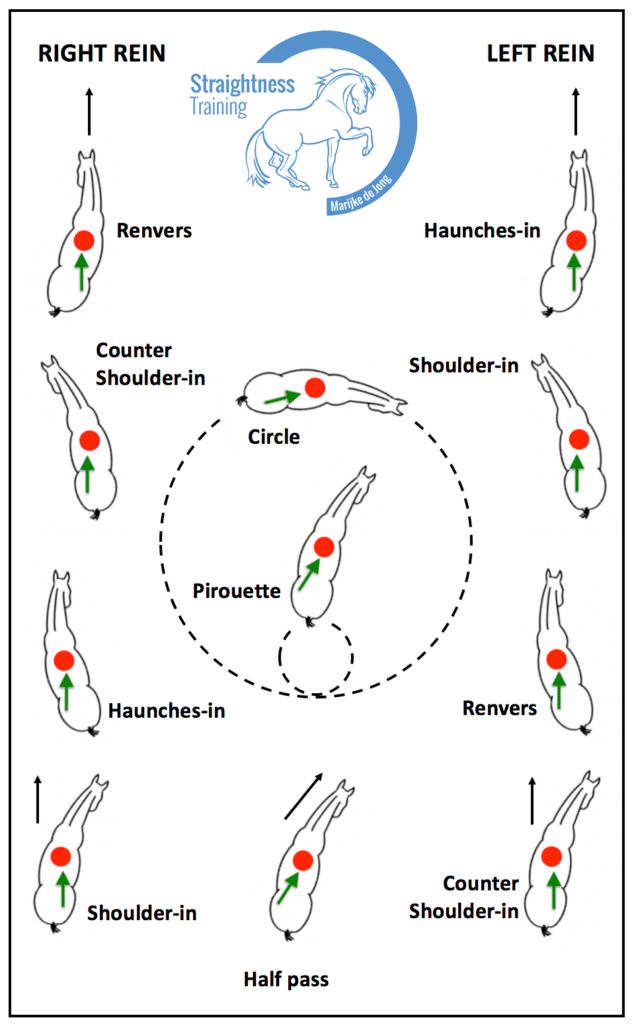
Many trainers consider the shoulder-in to be the ultimate straightening exercise. In this movement, the horse is bent slightly around the rider’s inside leg, with their shoulders brought off the track while the hind legs remain on it. This maneuver specifically encourages the inside hind leg to step directly under the horse’s body, bearing more weight and building strength. It directly counteracts the horse’s tendency to fall in on the circle or bulge out through the shoulder.
Riding Accurate Shapes
Never underestimate the power of geometry. Riding precise circles, squares, and serpentines forces you and your horse to be accountable for every step.
- Circles: A perfectly round circle tests your ability to maintain a consistent bend. Pay attention to the four points of the circle and ensure you are not letting your horse fall in or out.
- Squares: Riding a square with sharp, balanced corners is an excellent test of straightness. You must ride straight into the corner, prepare, turn, and ride straight away.
- Serpentines: This exercise requires you to change the horse’s bend frequently, which is a great way to improve suppleness on both sides.
Common Rider Mistakes to Avoid
Often, the source of the horse’s crookedness can be traced back to the rider. We are just as one-sided as our horses! Be mindful of these common mistakes:
- Riding with the inside rein: A common tendency is to try and “pull” the horse straight or create a bend with the inside rein. This blocks the inside hind leg and makes the problem worse. The bend should come from your leg and seat.
- Collapsing a hip: Be aware of your own posture. If you collapse your inside hip on a circle, you are effectively pushing your horse to the outside.
- Looking down: Where you look is where you go. Keep your eyes up and looking through your turn to help guide your horse.
- Uneven leg pressure: Ensure you aren’t gripping more with one leg than the other. Your aids should be clear, consistent, and symmetrical.
Frequently Asked Questions (FAQ)
How long does it take to make a horse straight?
Straightening a horse is a lifelong process, not a destination. It’s about continuous improvement and maintenance. You will see significant progress in a few months with consistent, correct work, but it’s a concept you will revisit throughout your horse’s entire training career.
Can a horse ever be perfectly straight?
No, just as no human is perfectly ambidextrous. The goal of horse straightness training is to minimize the horse’s natural crookedness to the point where it no longer negatively impacts their balance and performance. The goal is functional straightness.
Is straightness training only for dressage horses?
Absolutely not! Straightness is fundamental for every discipline. A showjumper needs to be straight to a fence to produce a clean, powerful jump. A reining horse needs straightness for a balanced sliding stop. A trail horse needs to be straight to navigate tricky terrain safely.
What’s the difference between straightness and suppleness?
They are two sides of the same coin. Suppleness refers to the horse’s ability to bend its body and stretch its muscles without resistance. Straightness is the result of achieving suppleness on both sides of the horse’s body equally. You cannot have one without the other.
Can I do straightness training outside of the arena?
Yes! Riding up and down hills is a fantastic way to improve straightness and encourage the hind legs to engage. You can also practice leg-yielding and other exercises out on the trail to keep things interesting for both you and your horse.
A Journey to True Partnership
Embarking on the path of horse straightness training is one of the most rewarding things you can do for your equine partner. It requires patience, feel, and a commitment to understanding the biomechanics of how your horse moves. By helping your horse overcome their natural crookedness, you improve their physical well-being, unlock their athletic potential, and deepen the harmonious connection that makes riding so special. It’s a journey that moves beyond simple mechanics and into the realm of true partnership.
