
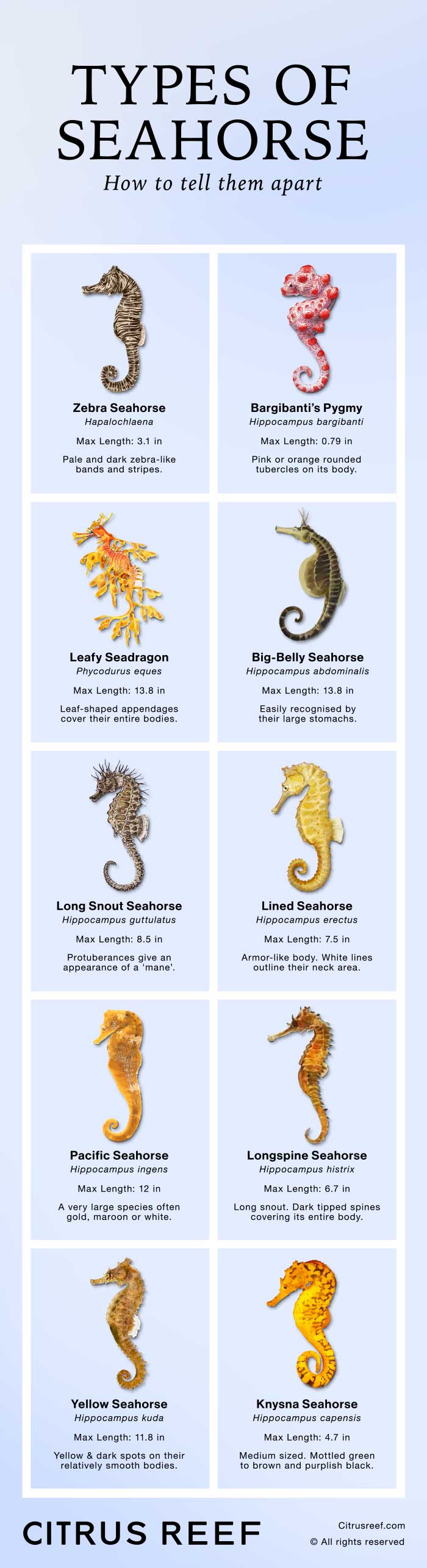
Seahorses, with their distinctive equine appearance, captivate the imagination. These unique marine fish inhabit diverse environments across the globe. Project Seahorse, a leading research and conservation organization, recognizes 46 distinct species of seahorses, each with its own characteristics and ecological niche. This article delves into the fascinating variety of seahorse species, exploring their ranges, sizes, and conservation statuses.
A Glimpse into Seahorse Diversity
The world of seahorses is remarkably varied, with species found in temperate and tropical waters across both the eastern and western hemispheres. From the larger species like the Pot-bellied Seahorse (Hippocampus abdominalis) found in Australia and New Zealand, reaching up to 35 cm, to the diminutive pygmy seahorses that barely exceed a couple of centimeters, there is a remarkable range in size and form.
Here is a closer look at some of the recognized seahorse species:
Pot-bellied Seahorse (Hippocampus abdominalis): Found in Australia and New Zealand, this species can grow up to 35 cm. It is currently listed as Least Concern.
West African Seahorse (Hippocampus algiricus): Inhabiting West Africa, this species reaches up to 19 cm and is classified as Vulnerable.
Western Spiny Seahorse (Hippocampus angustus): Native to Northern Australia, this seahorse grows to about 16 cm and is categorized as Least Concern.
Barbour’s Seahorse (Hippocampus barbouri): This species is found in the Indo-Pacific region and measures up to 15 cm. It is listed as Vulnerable.
Bargibant’s Pygmy Seahorse (Hippocampus bargibanti): One of the smallest, found in the Indo-Pacific, it reaches only up to 2.4 – 2.7 cm. Its conservation status is Data Deficient.
Knobby Seahorse (Hippocampus breviceps): Also known as the short-headed seahorse, this species is found in Southern Australia, growing up to 10 cm and listed as Least Concern.
Cape Seahorse (Hippocampus capensis): Endemic to Southern Africa, this seahorse reaches up to 12 cm and is listed as Endangered, highlighting the need for conservation efforts for this particular species.
Denise’s Pygmy Seahorse (Hippocampus denise): Another tiny resident of the Indo-Pacific, measuring around 2.1 – 2.4 cm, it is also Data Deficient.
Erectus Seahorse (Hippocampus erectus): Commonly known as the northern seahorse or spotted seahorse, this species is found in the Western Atlantic, growing up to 19 cm. It is classified as Vulnerable.
Spiny Seahorse (Hippocampus guttulatus): This European and Mediterranean species can reach up to 18 cm and is listed as Data Deficient.
Common Seahorse (Hippocampus hippocampus): Found in the Mediterranean and Western Atlantic, this species grows up to 15 cm and is currently Data Deficient.
Thorny Seahorse (Hippocampus histrix): Ranging from the Western Indian Ocean to the Central Pacific, this seahorse can reach 17 cm and is listed as Vulnerable.
Giant Seahorse (Hippocampus ingens): The giant seahorse, found along the Pacific coast from California to Peru, can grow impressively large, up to 31 cm, but is unfortunately listed as Vulnerable.
Kellogg’s Seahorse (Hippocampus kelloggi): This species has a wide range across the Indo-Pacific, reaching up to 28 cm and is classified as Vulnerable.
Kuda Seahorse (Hippocampus kuda): Also known as the common seahorse or estuary seahorse, this widespread Indo-Pacific species can grow up to 17 cm and is listed as Vulnerable.
Lemur-tail Seahorse (Hippocampus mohnikei): Found in Japan, Korea, and Thailand, this seahorse reaches up to 8 cm and is classified as Vulnerable.
Patagonian Seahorse (Hippocampus patagonicus): Inhabiting the waters from Brazil to Argentina, this species grows to about 10.3 cm and is listed as Vulnerable.
Pontoh’s Pygmy Seahorse (Hippocampus pontohi): This small Indo-Pacific species reaches only up to 1.7 cm and is listed as Least Concern.
Longsnout Seahorse (Hippocampus reidi): Found along the Atlantic coast from North Carolina to Brazil, this species can grow up to 17.5 cm and is listed as Near Threatened.
Satomi’s Pygmy Seahorse (Hippocampus satomiae): Another tiny species from the Indo-Pacific, measuring up to 1.4 cm, it is listed as Data Deficient.
Shiho’s Seahorse (Hippocampus sindonis): Native to Japan, this seahorse reaches about 8 cm and is currently Least Concern.
Queensland Seahorse (Hippocampus spinosissimus): This Indo-Pacific species can grow up to 17.2 cm and is classified as Vulnerable.
Trimaculatus Seahorse (Hippocampus trimaculatus): Also known as the flat-faced seahorse, this Indo-Pacific species grows up to 17 cm and is listed as Vulnerable.
Sydney Seahorse (Hippocampus whitei): Found in Eastern Australia and the Solomon Islands, this species reaches up to 13 cm and is listed as Endangered.
Dwarf Seahorse (Hippocampus zosterae): Inhabiting the Gulf of Mexico, this tiny seahorse grows up to 2.5 cm and is listed as Least Concern.
Conservation Concerns and the Future of Seahorses
The conservation status of many seahorse species, particularly those listed as Vulnerable, Endangered, or Data Deficient, underscores the urgent need for ongoing research and conservation efforts. Factors such as habitat loss, bycatch in fisheries, and demand from the traditional medicine and aquarium trades pose significant threats to seahorse populations worldwide. Organizations like Project Seahorse are instrumental in studying these fascinating creatures and advocating for their protection, ensuring that future generations can marvel at the diversity of these unique marine fish.
