
The world of horse racing is filled with prestigious events, but few capture the imagination and command global attention quite like the Grand National. This isn’t just a race; it’s a cultural phenomenon, a national institution in the United Kingdom, and the ultimate test of courage, stamina, and skill for both horse and jockey. The Grand National horse racing event is a spectacle of raw power and unpredictable drama, where legends are forged and hearts are broken in the space of a few thrilling minutes. It’s a race that transcends the sport, drawing in millions of viewers who may not watch another race all year, all captivated by its unique blend of history, challenge, and glory.
From the thunder of hooves at the start to the desperate, lung-bursting final stretch, the Grand National delivers a narrative unlike any other. It’s a steeplechase that demands more than just speed; it requires a unique combination of bravery to face its formidable obstacles and the endurance to last its grueling distance. For trainers and jockeys, winning the Grand National is often the pinnacle of their careers, a dream realized on the grandest stage. Even for seasoned professionals like the famed horse trainer peter moody, preparing a horse for this unique challenge is a monumental task.
The Grand National: A Race Like No Other
So, what exactly sets this event apart? The Grand National is a National Hunt horse race held annually at Aintree Racecourse, near Liverpool, England. It is run over a distance of about 4 miles and 2½ furlongs (officially 4 miles, 514 yards), making it one of the longest races in the calendar. During the race, horses must clear 30 fences over two laps of the course. These aren’t just standard hurdles; they are large, imposing obstacles that have become almost as famous as the race itself.
A field of up to 40 runners competes for the title, a much larger number than most horse races, which adds to the chaos, excitement, and unpredictability of the event. The sheer number of competitors, combined with the extreme distance and the daunting fences, creates a unique spectacle. It’s a race where an underdog can emerge from the pack to claim victory, and a seasoned favorite can see their chances end at any one of the 30 obstacles. This element of chance is a huge part of its appeal, turning the race into a national sweepstake in homes and offices across the country.
The Legacy: A Rich and Storied History
The Grand National’s history dates back to the 19th century. While there is some debate about the very first official running, the race is widely considered to have begun in 1839 with a winner appropriately named Lottery. From its early days, it was designed to be the ultimate cross-country challenge, a true test of a hunter’s ability.
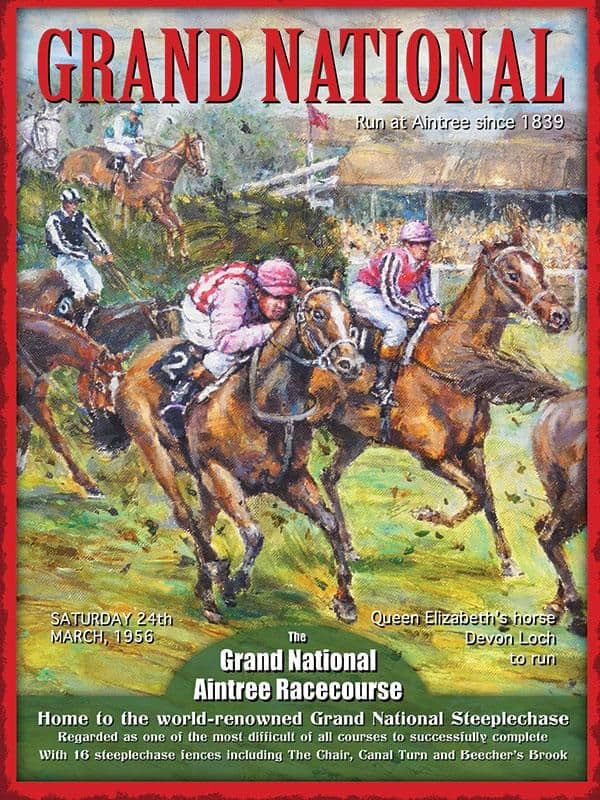
Over the decades, the race has produced countless iconic moments. There was the mysterious case of the 1956 Grand National, where Devon Loch, owned by the Queen Mother, inexplicably collapsed on the final straight with a clear lead, snatching defeat from the jaws of victory. The 1967 race saw a massive pile-up at the 23rd fence, allowing the 100/1 outsider Foinavon to navigate the chaos and gallop to an improbable victory. The fence was subsequently named in his honor.
Perhaps no story is more synonymous with the Grand National than that of Red Rum. The legendary horse won the race an incredible three times (1973, 1974, and 1977) and finished second in the two intervening years. His incredible achievements captured the public’s heart and cemented his status as the greatest steeplechaser in history. His story is a testament to the character and resilience required to conquer Aintree’s demanding course.
Navigating the Notorious Aintree Course
The Grand National course is a character in itself. While the horses jump 30 fences in total, there are 16 unique fences on the course, with the first 14 being jumped on both laps. Some of these obstacles have become legendary in the world of sport for their difficulty and the drama they create. The preparation for such a course is immense, far different from standard tracks you might find at a venue for horse racing in charlotte nc.
Famous Fences
- Becher’s Brook: Jumped as the sixth and 22nd fence, this obstacle is famous for its steep drop on the landing side. The brook itself is small, but the 6-foot 9-inch drop requires a horse to be a skilled and athletic jumper. It’s a fence that demands respect and has been the site of much drama over the years.
- The Chair: At 5 feet 2 inches, this is the tallest fence on the course. It is jumped only on the first circuit and is preceded by a 6-foot open ditch, making it a formidable test of scope and bravery. Its name comes from its position alongside the “seat” used by the distance judge in the early days.
- Canal Turn: This fence, taken as the eighth and 24th, is famous not just for its height but for the sharp 90-degree turn the horses must make immediately after landing. It requires a jockey to be tactical and find a good position to navigate the turn without losing momentum or getting caught in traffic.
- Foinavon: As mentioned earlier, this relatively ordinary fence was the scene of the massive pile-up in 1967 and was named after the unlikely winner who navigated the chaos. It serves as a reminder that in the Grand National, danger can lurk at any corner.
These fences are what make the race a unique spectacle. It’s not just about running; it’s about jumping with precision, courage, and a bit of luck. The expertise of trainers like david hall horse trainer is crucial in preparing a horse mentally and physically for such a challenge.
The Great Debate: Welfare in the Grand National
The Grand National horse racing event has not been without controversy. The difficulty of the course and the high number of runners have led to concerns about horse welfare over the years. The sad reality is that falls are common, and tragically, some have resulted in fatal injuries to the horses.
In response to criticism from animal welfare groups and the public, the race organizers have implemented significant changes to improve safety. These modifications have been made in consultation with veterinary experts and welfare organizations.
“The Grand National represents a unique challenge, and our priority is always the welfare of the horses and jockeys who take part,” states Dr. Sarah Jenkins, an equine sports veterinarian. “The modifications over the past two decades reflect a deep commitment to making the race as safe as possible without losing the essence of what makes it such a special test.”
Key safety changes include:
- Fence Modifications: The core of the fences is no longer made of traditional timber. They now consist of a more forgiving plastic or birch structure, which is designed to give way under significant pressure, reducing the severity of falls.
- Landing Zones: The landing areas behind several fences, including Becher’s Brook, have been leveled and improved to provide a safer experience for the horses.
- Stricter Qualification: The criteria for horses allowed to enter the race have been tightened to ensure that only the most capable and experienced jumpers can compete.
- Veterinary Care: An extensive team of veterinary professionals is on-site to provide immediate care to any horse that needs it.
These changes have led to a noticeable reduction in the number of fallers and injuries. The debate continues, but it’s undeniable that significant strides have been made to protect the magnificent animals who are the stars of the show. The process of conditioning horses for such an event, often done at specialized centers similar to those for horse training ocala fl, also prioritizes building the strength and resilience needed for this unique challenge.
How to Watch and Enjoy the Grand National
For many, the Grand National is an annual tradition. It’s a day for family gatherings and friendly wagers. If you’re new to the race, here’s how to get the most out of the experience.
First, understand the basics of the betting. You don’t need to be an expert to have a flutter. The most common bets are a “win” (your horse must finish first) and an “each-way” bet. An each-way bet is two separate bets: one for the horse to win and one for it to be “placed” (finishing in the top few positions, usually the top four or five in the National). This is a popular option for backing an outsider at long odds. Understanding the odds and potential payouts is key to knowing what is a super high five in horse racing and other complex bets, but a simple each-way stake is all you need to get involved.
When picking a horse, you can study the form guide, looking at their past performances, their jumping ability, and whether they have experience over long distances. Or you can do what millions of others do: pick a horse based on its name, the color of the jockey’s silks, or simply by drawing it in an office sweepstake. The unpredictable nature of the race means that either method has a chance of success!
Frequently Asked Questions about the Grand National
When is the Grand National held?
The Grand National is held annually in April at Aintree Racecourse in Liverpool, England. It is the main event of a three-day race meeting.
How many horses run in the Grand National?
A maximum field of 40 horses is allowed to run in the race, though the final number can sometimes be slightly smaller due to last-minute withdrawals.
What makes the Grand National so difficult?
It is a combination of factors: the extreme distance of over four miles, the 30 large and challenging fences, and the large field of 40 runners, which creates a crowded and unpredictable racing environment.
Who is the most famous Grand National winner?
Without a doubt, Red Rum is the most famous winner. His record of three wins in the 1970s is unlikely to ever be beaten and has cemented his place as a sporting legend.
Have there been any female jockeys who have won?
Yes, in 2021, Rachael Blackmore made history by becoming the first female jockey to win the Grand National aboard the horse Minella Times, a landmark moment for the sport.
The Enduring Allure of the Grand National
The Grand National horse racing event is more than just a competition; it’s a story of courage, a test of endurance, and a spectacle of drama. It’s a race that connects the past with the present, honoring its long history while adapting to the modern world. For the jockeys, trainers, and owners, it represents the ultimate prize. For the horses, it is the ultimate test of their athletic prowess and heart. And for the millions who watch, it is a source of unparalleled excitement and a reminder that in sport, as in life, anything is possible. It’s a day when heroes are made, legends are born, and the whole world stops to watch.
