
There’s a unique magic to a great Horse Race Story, a powerful blend of thunderous hooves, high-stakes competition, and raw emotion that captures the imagination. It’s more than just a sport; it’s a narrative where underdogs can become legends and champions can achieve immortality. These stories tap into our deepest desires for courage, perseverance, and the incredible bond between humans and animals. From the nail-biting tension of the final furlong to the quiet moments of connection in the stable, the world of horse racing has given us some of the most inspiring tales ever told.
These narratives are so compelling that they often transcend the racetrack, becoming cultural touchstones. Exploring them is similar to discovering a story of dream horse, where the lines between reality and legend blur into an inspiring saga. Whether rooted in fact or fiction, a horse race story reminds us that with enough heart, anything is possible.
Seabiscuit: The Unlikely Champion Who Inspired a Nation
No discussion about the ultimate horse race story is complete without mentioning Seabiscuit. In the 1930s, during the depths of the Great Depression, America was desperate for a hero—and they found one in a knobby-kneed, undersized, and overlooked racehorse. Seabiscuit was an unlikely candidate for greatness. Descended from the mighty Man o’ War, he was considered lazy and difficult, often spending his time eating and sleeping rather than training. He was sold for a pittance to a team as unconventional as he was: a quiet, down-on-his-luck trainer named Tom Smith, a partially blind ex-prizefighting jockey named Red Pollard, and a wealthy automobile magnate named Charles S. Howard.
A Team of Misfits
Together, this band of misfits transformed Seabiscuit, and in turn, he transformed them. Smith understood the horse’s psychology, using patience and unorthodox methods to unlock his potential. Pollard, who saw a reflection of his own battered spirit in the horse, formed an unbreakable bond with him. They didn’t just train Seabiscuit; they healed him. The horse began to win, then win consistently, capturing the hearts of a public hungry for an underdog to root for. He became a symbol of hope, proof that greatness could be found in the most unexpected places.
The Race of the Century
The climax of Seabiscuit’s career came in 1938 when he was set to face the formidable War Admiral in a one-on-one match race dubbed “The Race of the Century.” War Admiral was the reigning Triple Crown winner, a picture of aristocratic perfection. On paper, Seabiscuit stood no chance. But in a stunning display of strategy and grit, Seabiscuit, with jockey George Woolf aboard (as Pollard was injured), shot to an early lead and never looked back. He won by four lengths, cementing his status as a legend. This victory was more than a win; it was a powerful statement that spirit, not just pedigree, makes a champion. Many incredible race horse movies true story have been made, but Seabiscuit’s tale remains one of the most beloved.
 Two racehorses neck and neck at the finish line in a classic horse race story, jockeys urging them on, crowd blurred in the background
Secretariat: The Machine That Redefined Perfection
If Seabiscuit’s tale is the ultimate underdog horse race story, then Secretariat’s is the story of absolute, breathtaking dominance. Known affectionately as “Big Red,” Secretariat was a chestnut colt so perfectly conformed, so powerful, that he seemed to have been sent from the gods of racing. He wasn’t an underdog; he was the standard by which all other champions would be measured. His 1973 campaign is widely considered the single greatest performance in the history of the sport.
The Triple Crown Triumph
Secretariat’s quest for the Triple Crown—the Kentucky Derby, the Preakness Stakes, and the Belmont Stakes—was nothing short of spectacular. In the Kentucky Derby, he did something unprecedented: he ran each quarter-mile faster than the last, accelerating through the finish line to set a track record that still stands today. He followed it with another record-breaking win at the Preakness. But it was at the Belmont Stakes that he entered the realm of myth.
In a performance that defies belief, Secretariat didn’t just win; he annihilated the competition. He pulled away from the field with every stride, running with a relentless, awe-inspiring power. The race announcer, Chic Anderson, famously declared, “He is moving like a tremendous machine!” By the time he crossed the finish line, he was an astonishing 31 lengths ahead of the next horse. His time of 2:24 for the 1.5-mile race shattered the world record and remains the fastest ever recorded on a dirt track.
According to Dr. Eleanor Vance, an equine sports historian, “Secretariat’s Belmont was not just a race; it was a transcendent athletic performance. He showed us the absolute physical peak of what a racehorse could be. It was perfection in motion, a moment that will likely never be repeated.”
Secretariat’s story is one of pure, unadulterated talent. He reminded the world that while we love an underdog, we are also left breathless by the spectacle of flawless greatness.
Beyond the Finish Line: What Makes a Great Horse Race Story?
While every horse race story is unique, the ones that endure share common threads that resonate deeply with us. These are not just accounts of athletic achievement; they are fables of character, struggle, and the profound connection that can form between a 1,000-pound animal and a human.
The Heart of an Underdog
We are inherently drawn to stories of overcoming adversity. The horse that was too small, too stubborn, or too injured but found a way to win captures our collective imagination. These tales mirror our own struggles and give us hope that we, too, can defy expectations. These are often the most happy horse stories because they celebrate the triumph of spirit over circumstance.
The Human-Animal Bond
At the core of every great horse racing tale is the relationship between the horse and its team—the jockey, the trainer, and the owner. This bond, built on trust, communication, and mutual respect, is often the secret ingredient to success. It’s a partnership where each relies on the other to achieve what neither could alone. This dynamic is not unlike the themes found in tales like the horse and the wolf story, where communication and understanding are key.
Sheer Determination and Courage
The racehorse is an incredible athlete, possessing a heart and lungs capable of extraordinary feats. A legendary horse race story showcases this physical prowess combined with an intangible will to win. It’s the courage to push through the pain in the final stretch, the determination to chase down a rival, and the heart of a champion that refuses to lose.
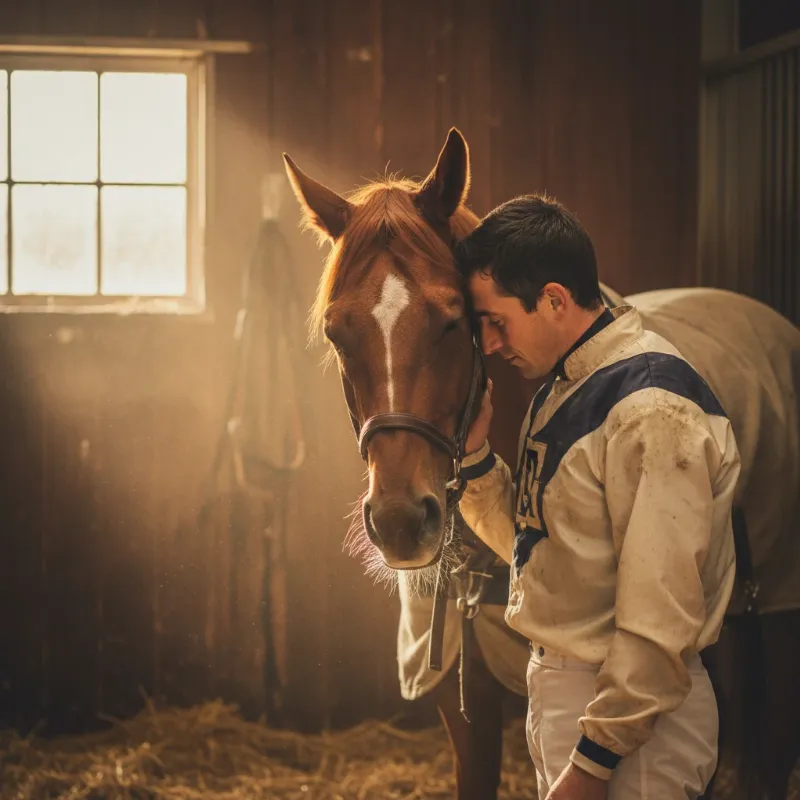 A close-up of a jockey affectionately patting their horse's neck, illustrating the deep bond in a horse race story, set against the backdrop of a quiet stable at dawn.
More Unforgettable Horse Race Stories
While Seabiscuit and Secretariat are titans, the annals of racing are filled with other incredible narratives.
- Red Rum: The beloved British steeplechaser who did the impossible by winning the grueling Grand National three times in the 1970s, a feat of stamina and heart that has never been matched. He famously trained on the beaches of Southport, which helped heal his chronic foot issues.
- Phar Lap: The giant New Zealand-bred horse who dominated Australian racing during the early 1930s. His incredible success and mysterious death have made him a national icon in both Australia and New Zealand.
- Man o’ War: Often considered the greatest racehorse of all time, “Big Red” (the original one) was so dominant that he won 20 of his 21 races. His only loss came in a troubled start, and he was so feared that other owners often refused to race their horses against him. It’s fascinating to consider if something like was a man called horse a true story could ever compare to the real-life legends of these animals.
Frequently Asked Questions (FAQ)
What is the most famous horse race story?
While there are many, the story of Seabiscuit is arguably the most famous. His rise from an overlooked underdog to a national hero during the Great Depression, culminating in his victory over War Admiral, has been immortalized in books and a major motion picture, making it a quintessential horse race story.
Are there any horse race stories about underdogs?
Absolutely. The world of horse racing is filled with underdog stories. Besides Seabiscuit, tales like that of Mine That Bird, a 50-1 longshot who won the 2009 Kentucky Derby, or Red Rum, who overcame a debilitating bone disease to become a Grand National legend, are celebrated examples of underdogs achieving incredible success.
What makes horse racing stories so popular?
Horse racing stories are popular because they combine the thrill of high-stakes sports with powerful emotional themes. They often feature elements of overcoming adversity, the deep bond between humans and animals, and inspiring displays of courage and determination that resonate with a broad audience.
Where can I watch movies about horse racing?
Several excellent films are based on true horse racing stories. Some of the most popular include “Seabiscuit” (2003), “Secretariat” (2010), “Champions” (1984) about jockey Bob Champion and his horse Aldaniti, and “Dreamer” (2005), which is inspired by a true story.
Who was the greatest racehorse in history?
This is a topic of great debate among racing fans. The main contenders are usually Man o’ War, for his sheer dominance; Secretariat, for his record-breaking Triple Crown performance; and Phar Lap, for his incredible versatility and cultural impact. Each has a legitimate claim to the title.
The Enduring Legacy of the Racehorse
The power of a great horse race story lies in its ability to inspire. These are more than just chronicles of wins and losses; they are timeless tales of heart, spirit, and the pursuit of greatness against all odds. They remind us that champions come in all shapes and sizes and that the most powerful force on the track is often an unbreakable will. Whether it’s the story of an unlikely hero or an untouchable legend, these narratives will continue to be told, thrilling and motivating us for generations to come.
