
Gymnastic jumping exercises are a cornerstone of training for equestrian disciplines focused on jumping. These structured sequences of poles and fences are meticulously designed to enhance a horse’s strength, rhythm, balance, and the rider’s coordination, ultimately leading to improved performance. They offer a controlled environment to refine stride length, jumping technique, and consistency over fences. This progressive training method builds crucial muscle power through repeated stretch-shortening cycles, which are fundamental for developing superior jumping capabilities.
The core benefit of gymnastic exercises lies in their ability to develop a horse’s strength, coordination, and technique without the complexities of navigating challenging turns or intricate course lines. Whether a horse is a novice at jumping or an experienced athlete aiming to refine their skills for competition, these exercises provide an excellent developmental foundation. For riders, these gymnastics are equally valuable, fostering improvements in timing, balance, and the clarity of communication with their equine partners. Riders learn to synchronize with their horse’s natural rhythm and employ subtle, precise aids to guide them effectively through the exercises. This article delves into the advantages of gymnastic exercises for horses, the essential equipment required, and foundational exercises suitable for you and your horse.
The Multifaceted Benefits of Gymnastic Exercises for Horses
Gymnastic exercises are an indispensable element in the training regimen for both horse and rider in jumping disciplines. They are instrumental in refining jumping technique, enhancing balance, establishing a consistent rhythm, and improving the horse’s ability to adjust its stride. Furthermore, these exercises demand a high level of concentration from the horse, which helps to mitigate boredom and sharpen their focus.
The repetitive nature of gymnastic exercises presents a significant training opportunity for both horse and rider. Through consistent practice, riders can enhance their own:
- Riding position and technique
- Pacing and timing
- Ability to sight lines and accurately judge distances
- Rhythm and tempo throughout the course
Gymnastic exercises also offer substantial benefits for a horse’s overall fitness, including:
- Encouraging the horse to independently adjust its stride, balance, and rhythm.
- Promoting a regular, consistent rhythm, discouraging tendencies to rush or slow down approaching a fence.
- Building crucial strength and stamina.
These exercises are particularly effective in building a horse’s muscular strength. As horses navigate a gymnastic course, their muscles engage in multiple stretch-shortening cycles, where muscles lengthen and then immediately contract. This elastic stretching of the muscle stores energy before contraction, resulting in increased power for the subsequent stride. Muscular strength training is especially vital for horses involved in jumping disciplines, as their muscles largely operate through anaerobic metabolism. This metabolic process allows them to generate short bursts of extreme power, a characteristic distinct from the sustained, lower-intensity efforts of an endurance horse.
Essential Equipment and Safety Precautions
Setting up gymnastic exercises necessitates standard jumping equipment, including jump rails, standards, and cavalletti. This equipment can be either commercially acquired or fashioned at home.
It is imperative that all equipment used is robust and will not crack, fracture, or splinter if a horse accidentally steps on or strikes it. Jump rails are typically constructed from wood or PVC. Jump standards should feature stable “feet” to prevent tipping if contacted by a horse.
All jump cups should be designed to allow the pole to roll and fall freely. Safety cups (or breakaway cups) are highly recommended as they facilitate the rail’s release if a horse strikes it from above. It is advisable to avoid using metal jump cups, as these pose a significant risk of injury to a horse or rider during an accident.
Consideration for the jumping surface is also crucial. Ideally, jumping surfaces should have a slight give under the horse’s weight, allowing them to leave a discernible footprint. The surface must provide consistent footing and adequate traction, especially for executing tighter turns. If jumping on grass, using horseshoe studs (corks) can enhance traction.
Always ensure there is a spotter present on the ground. This individual can assist with adjusting the gymnastic setup or replacing dislodged rails. More importantly, they can promptly call for emergency services if an accident occurs. Riders should always wear an ASTM/SEI-approved helmet while jumping.
Strategic Setup of Gymnastic Exercises
The precise setup of a gymnastic exercise is critical for its effectiveness, as the distance between obstacles directly influences the horse’s rhythm and pace. Many riders opt to set up gymnastic exercises along the centerline of their arena, as this facilitates approaching the exercise from either direction. Exercises can also be effectively set up across a diagonal or down a long side.
When initially constructing a gymnastic exercise, utilize a measuring tape to establish standard distances based on an average 12-foot horse stride. From this baseline, you can make adjustments to best suit your individual horse’s specific stride length.
Begin by placing poles on the ground where each jump will be situated. Measure the distance between the ends of adjacent poles on both sides to confirm they are perfectly parallel. Once the basic layout is established, position the jump standards.
Table 1. Common gymnastic distances based on an average horse stride.
| Exercise Configuration | Distance (ft) | Distance (m) |
|---|---|---|
| Trot poles | 4 ft | 1.3 m |
| Trot pole in front of a fence | 9 to 10 ft | 2.7 to 3.0 m |
| Canter poles | 9 to 11 ft | 2.7 to 3.3 m |
| Canter pole in front of a fence | 10 to 11 ft | 3.0 to 3.3 m |
| Canter pole after a fence | 10 to 11 ft | 3.0 to 3.3 m |
| Bounce stride | 10 to 12 ft | 3.0 to 3.7 m |
| One stride | 21 to 24 ft | 6.4 to 7.3 m |
| Two strides | 33 to 36 ft | 10.0 to 11.0 m |
| Three strides | 45 to 48 ft | 13.7 to 14.6 m |
Most gymnastic exercises are developed progressively throughout a training session. After setting up your exercise layout, commence with poles on the ground or a single, low jump. Begin at a low height to allow your horse to warm up and acclimate to the exercise. As the session progresses, you can gradually introduce additional jumps or increase fence heights to achieve your specific training objectives.
When constructing gymnastic exercises that include oxers, it is crucial to understand that altering the oxer’s width will impact the striding distance to the subsequent jump. Set the oxer to your preferred width initially while laying out the exercise. If you decide to adjust the width later, remember to also modify the distance to the next fence accordingly.
Top 7 Gymnastic Jumping Exercises for Horses
A wide variety of gymnastic lines can be employed in training. Trainers often develop their own preferred sequences to address specific weaknesses in horses and riders. Here are seven popular gymnastic exercises that can benefit both you and your horse:
1. Simple Two-Jump Grid
This gymnastic involves trotting into a low fence, followed by one or two strides to a second obstacle, which can be a vertical or an oxer.
To set up this grid, place several trot poles in sequence, followed by a distance of 9 to 10 feet to the first jump. This spacing allows the horse adequate room to rock back onto its haunches before jumping the fence. Subsequently, position a second obstacle one or two strides away from the first.
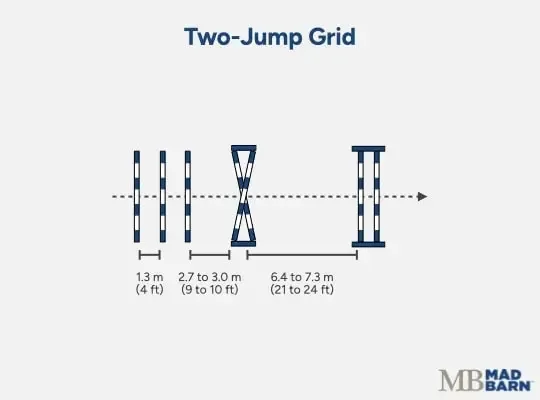 Illustration of a two-jump grid gymnastic exercise for horses
Begin this grid with the first jump set as a low crosspole or vertical, and the second obstacle as poles on the ground. Once your horse is adequately warmed up, you can progressively increase the height of the first obstacle and introduce the second jump.
2. Simple Three-Jump Grid
This exercise builds upon the two-jump grid by incorporating a third jump. Trainers can modify the distances between the jumps, their heights, and the types of obstacles to introduce greater challenge or variety.
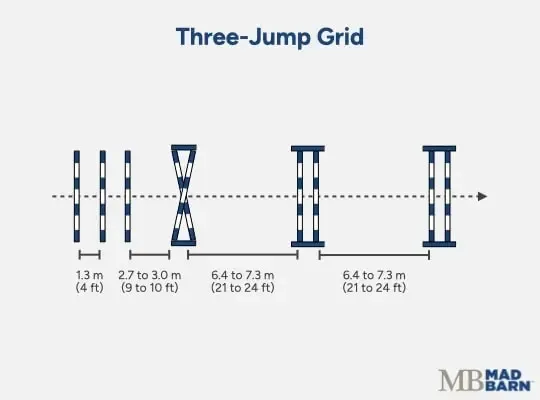 Illustration of a three-jump grid gymnastic exercise for horses
Potential setup variations include:
- Crosspole – vertical – vertical
- Crosspole – vertical – oxer
- Crosspole – oxer – vertical
- Crosspole – oxer – oxer
3. Long Grids
You can extend basic gymnastic setups by adding more fences, contingent on your horse’s experience, strength, and stamina. Crucially, ensure you can successfully navigate each additional fence with appropriate striding and effort before adding another jump. Most riders limit their grids to five or six fences, as gymnastic jumping demands considerable effort from the horse.
4. Bounces
Bounces are short jumps set closely together, requiring the horse to propel off its front limbs to clear the second obstacle, rather than rocking back onto its haunches. These exercises are effective in discouraging rushing and establishing a consistent rhythm. They also maximize the muscle’s stretch-shortening cycle, rapidly building strength.
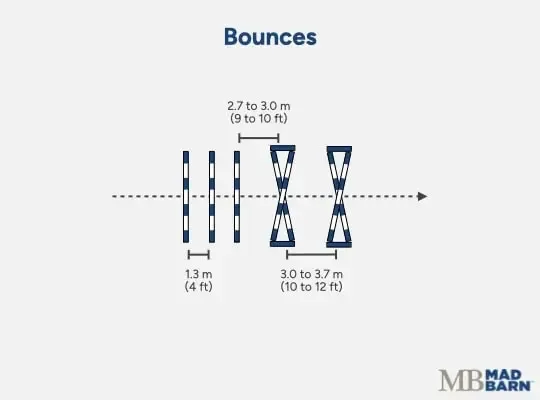 Illustration of a bounce gymnastic exercise for horses
Bounces can be integrated at various points within a grid; however, they are most easily executed at the beginning of a sequence. Incorporating bounces in the middle or at the end of a grid is suitable only for highly advanced horses and riders. When employing bounces, maintain a low fence height. Many trainers recommend setting bounce fences no higher than 3 feet (1.0 meter).
5. Placing Poles
Some trainers utilize placing poles within a gymnastic grid to curb rushing and enforce a regular rhythm and cadence. Horses must pay close attention to their foot placement with every step through the grid, demanding heightened concentration.
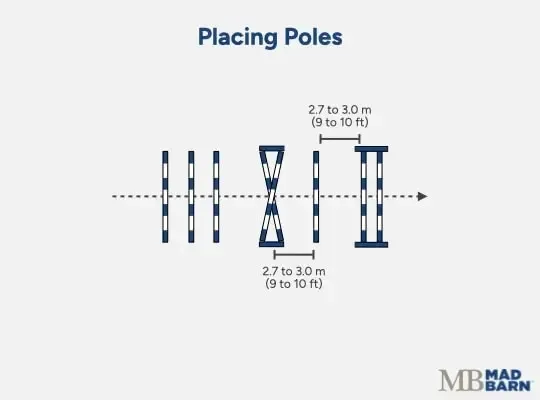 Illustration of placing poles in a gymnastic exercise for horses
Placing poles should be set 10 to 11 feet after a jump, followed by the typical canter stride distance between subsequent obstacles. It is important to maintain a distance of 10 to 11 feet between the last canter pole and the next jump to ensure the horse is well-positioned for success.
6. Gymnastic “Y”
“Y”-shaped gymnastics introduce valuable variety into a horse’s training session. They encourage the horse to focus on the rider, as the horse cannot anticipate which jump to target upon landing. These exercises also foster rider precision and clarity in their directions to the horse.
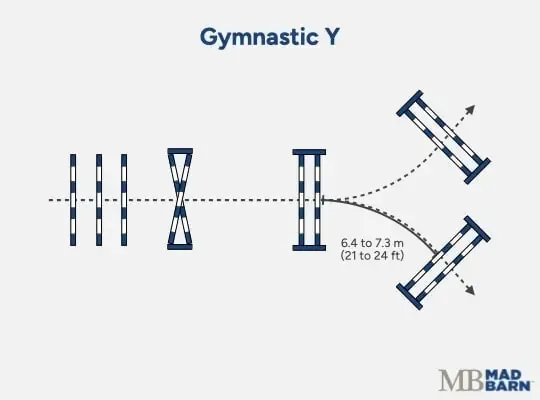 Illustration of a Y-shaped gymnastic exercise for horses
“Y”-shaped gymnastics can incorporate as many fences as desired by the trainer. The difficulty can be further increased by adding subsequent fences after the “Y” branches off, creating two gymnastic grids with a turn in between.
7. Two-Way Gymnastic
While most gymnastics begin with the horse and rider trotting over a low fence, you can also set up gymnastics that can be approached from either direction. These gymnastics must be designed for a canter approach, as the horse will canter out of the gymnastic upon landing.
To construct a two-way gymnastic, place one or more canter poles before and after your existing grid. Ensure a gap of at least 10 to 11 feet between the last canter pole and the jump.
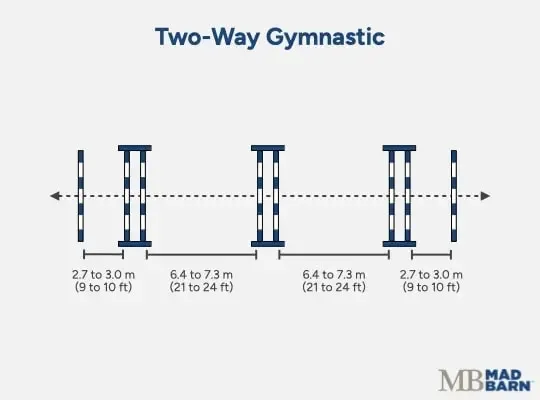 Illustration of a two-way gymnastic exercise for horses
Most riders set these gymnastics up symmetrically, for example, vertical – oxer – vertical. This symmetry allows for consistent training on both leads and in both directions. However, asymmetrical gymnastics can also be designed to train different aspects of jumping. For instance, a vertical – oxer – oxer gymnastic encourages the horse to generate more power exiting the gymnastic, whereas jumping it in the oxer – oxer – vertical direction emphasizes power generation upon entering the gymnastic.
Integrating Coursework with Gymnastics
Gymnastics serve as a valuable addition to coursework by establishing the horse’s pace and rhythm. Many trainers begin by schooling riders through a gymnastic exercise before transitioning to a full course. Advanced riders may incorporate a canter-in gymnastic during the course to challenge their horse’s rhythm and pace control.
The most straightforward application of coursework to a gymnastic is setting a line on the landing side. As the horse and rider exit the gymnastic, they must maintain an appropriate rhythm and pace independently for the striding down the line to be successful. You can also design bending lines coming off a gymnastic to train the rider’s ability to accurately ride a distance with a suitable rhythm. Advanced riders might also utilize related distances leading up to a gymnastic to test their accuracy, rhythm, and pace.
Frequently Asked Questions
What are gymnastic exercises for horses?
Gymnastic exercises are jumping sequences specifically designed to challenge a horse’s balance, rhythm, and jumping technique. They are a common component of training programs for hunters, jumpers, and eventers.
How high should the jumps in a gymnastic for horses be?
The height of the jumps should be tailored to the skill level of both the horse and the rider. Begin with low fences, approximately 2 feet, and gradually increase the height and complexity of your gymnastic as you progress.
How often should horses perform gymnastic jumping?
Gymnastics can be quite demanding for horses, requiring not only strength and stamina but also a significant amount of focus. Limit your gymnastic sessions to no more than one to two times per week.
Summary
Gymnastic exercises involve a series of poles and jumps arranged in a specific pattern designed to challenge the jumping skills of both horse and rider.
- Gymnastics benefit the horse by enhancing strength, coordination, and overall jumping style.
- For riders, gymnastics are crucial for establishing rhythm, balance, and effective communication with the horse.
- These exercises are suitable for all levels of jumping riders and can be adapted to match a partnership’s skill progression.
- By strategically increasing height and complexity, even advanced riders and horses can reap significant benefits from gymnastic training.
References
- Klimke. R. and Klimke. I., Basic Training of the Young Horse. J. A. Allen. 2006.
- Wofford. J. C., Gymnastics: Systematic Training for Jumping Horses. Interpet. 2001.
- Castejon-Riber. C. et al., Objectives, Principles, and Methods of Strength Training for Horses. Journal of Equine Veterinary Science. 2017. DOI: 10.1016/j.jevs.2017.04.011
- Art. T. et al., Effect of Show Jumping on Heart Rate, Blood Lactate and Other Plasma Biochemical Values. Equine Veterinary Journal. 1990. DOI: 10.1111/j.2042-3306.1990.tb04740.x
- Allen. L. and Dennis. D. R., 101 Jumping Exercises for Horse & Rider. Storey Publishing, LLC. 2010.
