
Ensuring your horse is in peak physical condition is crucial, whether you’re competing at an elite level or simply enjoying recreational riding. A fitter horse is not only a healthier horse, reducing the risk of injury, but also a horse capable of performing at its best. Developing a tailored fitness program is key, as each horse possesses a unique starting fitness level and each owner has distinct goals. However, the foundation of health-related fitness for any horse remains consistent.
Training your horse primarily serves three main purposes: to expand his exercise capacity and delay fatigue, to elevate his overall performance in terms of endurance, speed, strength, and skill, and to minimize the likelihood of injury.
Planning Your Horse’s Fitness Program
An effective training program is built upon several core principles to maximize its benefits:
- Specificity: Training must directly align with the specific demands of the activity you are preparing your horse for. It should also consider his individual fitness, strengths, and weaknesses.
- Progression: Gradually increase the exercise regimen, starting slowly to avoid undue stress and potential injury.
- Overload: To foster improvement, your horse must be challenged to work harder, prompting his body to adapt. This can be achieved by adjusting the frequency, intensity, or duration of training sessions.
- Reversibility: The physiological adaptations gained through training will diminish if training ceases or becomes infrequent. A horse will lose fitness if not consistently exercised.
- Rest and Recovery: Incorporate adequate rest periods into the program to allow your horse’s body to repair and recuperate.
- Tedium Avoidance: Employ a variety of training methods, such as schooling, hacking, and jumping, to keep both you and your horse engaged and prevent boredom.
Measuring Your Horse’s Fitness
A heart rate monitor is an excellent tool for assessing your horse’s exertion levels. Typically worn around the trunk at the girth, it displays your horse’s heart rate on a watch. Generally, a heart rate below 140 beats per minute (bpm) indicates aerobic activity, where oxygen is used to fuel energy production, allowing for sustained work without fatigue. Above this threshold, particularly during a fast canter, your horse begins to work anaerobically. This means his body requires energy faster than it can utilize oxygen, leading to lactic acid buildup in the muscles and subsequent fatigue. As your horse becomes fitter, his aerobic capacity will expand, delaying the onset of anaerobic work and improving his recovery rate and overall stamina.
Top Tip: Maintain a detailed log of each training session, noting how your horse felt. This record will illuminate his progress and aid in identifying any potential issues.
A 12-Week Fitness Plan Example
Important Pre-Start Note: This guide is intended for horses returning to work after a 2-3 month break, assuming no prior injury. For horses recovering from injury, consult your veterinarian for a safe return-to-work strategy. If your horse is already in work, you may be able to commence later in the program. Review each week and advance if your horse handles the workload with ease.
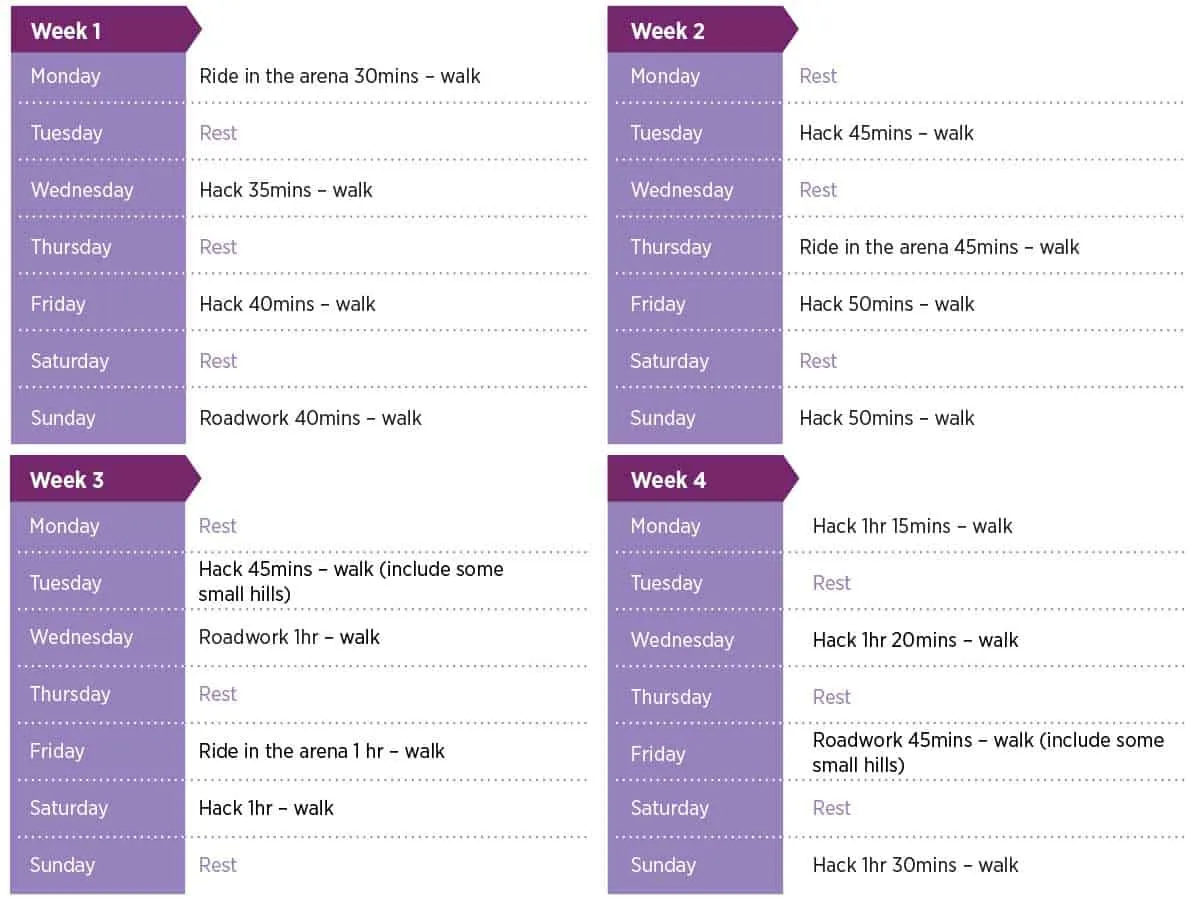 Horse fitness plans weeks 1-4
Gradually Increasing Training Intensity
Determining when to escalate your horse’s training involves a careful balance. Advancing too rapidly increases injury risk, while progressing too slowly yields minimal improvement. Training should increase incrementally, yet remain challenging for your horse’s body. It is advisable to increase duration before intensity. Once duration is established, you can reduce it while increasing intensity, then build both back up to ensure your horse is working harder for longer periods.
Remember that fitness programs are not universal; what benefits one horse may not be ideal for another. Listen to your horse’s responses and adjust training accordingly. When in doubt, ease back and reassess his progress.
Top Tip: When introducing short trotting intervals, begin with one to two minutes and gradually extend the duration. Similarly, for cantering, start with brief bursts and progressively lengthen them to several minutes.
Effective Training Modalities
Several training methods can enhance your horse’s fitness, with continuous and interval training being the most prominent.
Continuous training involves maintaining a steady pace at low to moderate intensity and serves as the initial phase for all horses in training. This typically begins with long, slow distance (LSD) work, which is fundamental for building endurance and improving oxygen uptake. The LSD phase can range from 3-12 months for young horses or about one month for older horses returning to work after an injury-free rest. Hacking is a primary method for LSD training, but it can be supplemented with arena work, lungeing, and the use of a horse walker.
Over time, you can increase the duration and intensity of LSD work, ensuring your horse’s heart rate stays below 140 bpm. Once your horse can comfortably work for an hour, incorporating walk, trot, and canter at an average speed of 6-8 kmph, you can introduce interval training and progress to discipline-specific exercises.
Interval training systematically challenges your horse’s cardiovascular system through periods of high-intensity activity interspersed with shorter recovery phases. This incomplete recovery allows the heart rate to return slightly above resting levels before the next exertion phase. This method progressively increases the difficulty of each speed interval, prompting the horse’s body to adapt and strengthen, thereby enhancing its capacity to handle exercise.
As your horse’s fitness improves and he adapts to the routine, you can increase the intensity and number of speed intervals while decreasing the duration of recovery periods.
Top Tip: Vary the training terrain—including arena surfaces, roads, soft and hard ground, and inclines—to improve your horse’s proprioception and adaptability to different surfaces. This is particularly beneficial for strengthening muscles, bones, tendons, and ligaments.
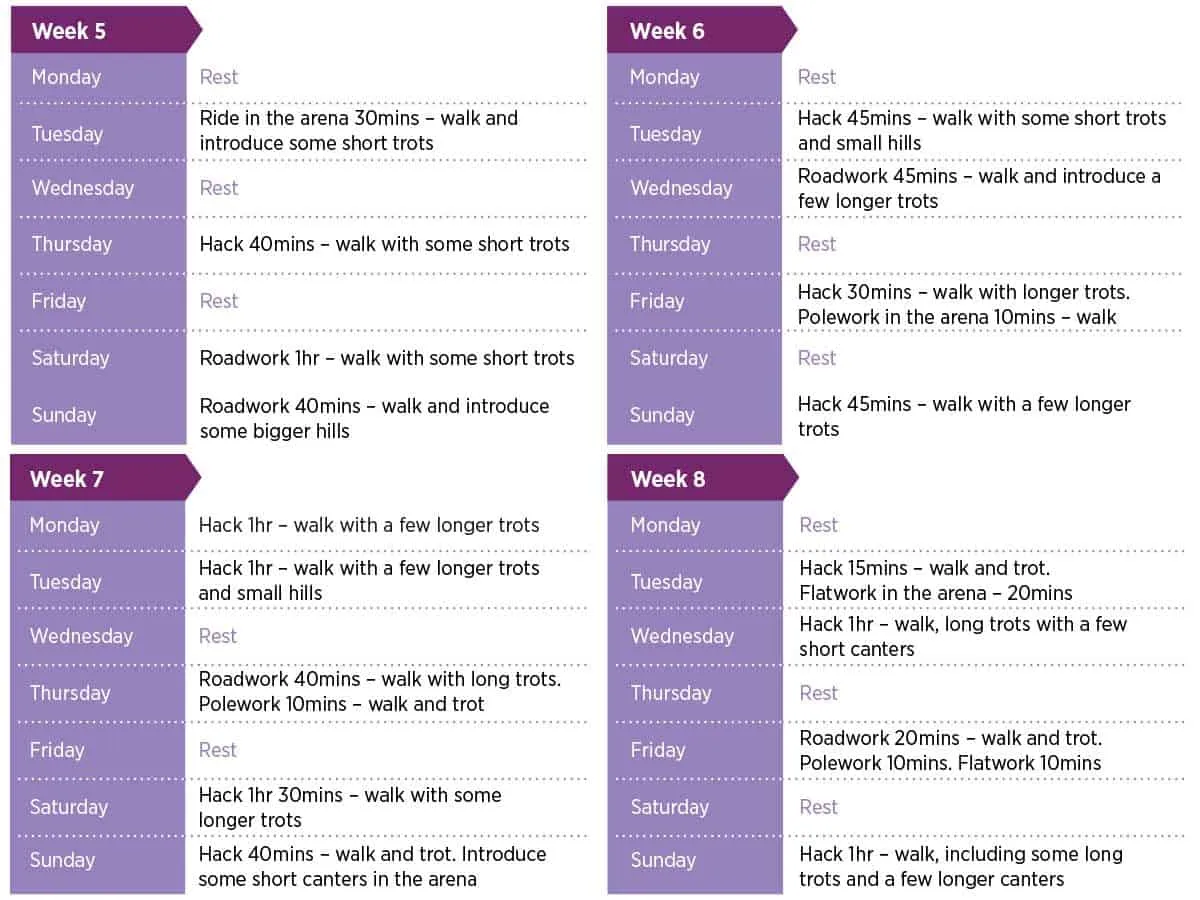 Horse fitness plans weeks 5-8
Physiological Adaptations from Training
Any activity that elevates muscle metabolic activity (the rate of energy utilization) can be classified as exercise. However, without proper planning and a specific focus, exercise may not lead to significant fitness gains in the same way that targeted training does. Training induces beneficial changes in your horse’s:
- Cardiovascular System: The heart muscle enlarges, increasing its capacity to pump blood throughout the body with each beat.
- Muscles: Their efficiency in utilizing oxygen improves.
- Skeleton: Bones remodel in response to exercise, increasing density where stress is highest and decreasing it where it is less pronounced.
- Tendons and Ligaments: These supportive structures become stronger.
- Recovery Ability: As fitness increases, your horse will recover from exercise more rapidly.
Bones, tendons, and ligaments adapt more slowly to training demands compared to the heart and muscles and are therefore more susceptible to injury, highlighting the importance of an initial LSD training period.
Did You Know? Horses experience detraining (loss of fitness) when training ceases or decreases, but at a much slower rate than humans. Research indicates minimal changes in measurable cardiovascular fitness even four months after a reduction in exercise intensity and volume.
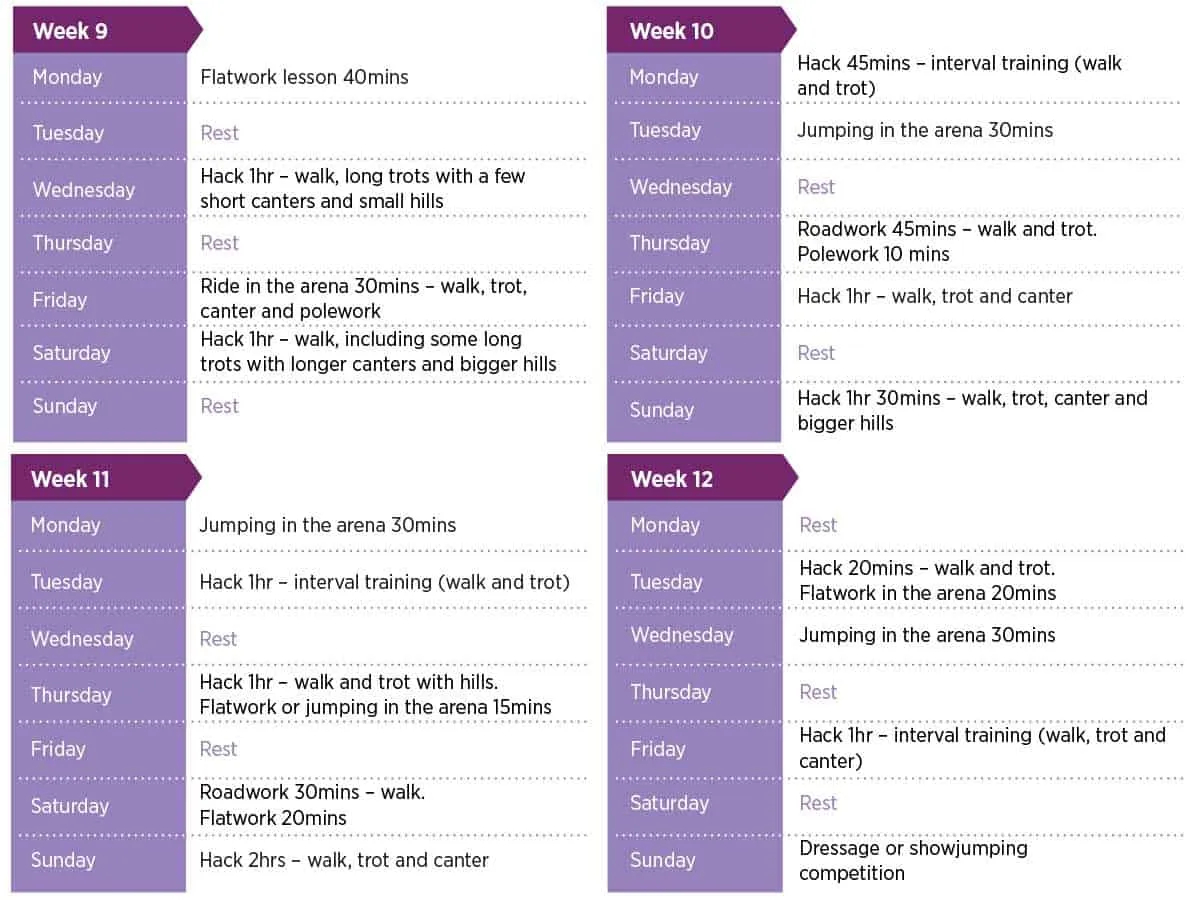 Horse fitness plans weeks 9-12
Prioritizing Quality Over Quantity
Spreading training sessions out is crucial, as your horse’s body requires time to adapt to the stresses of physical exertion. Training intensely on consecutive days (e.g., Friday, Saturday, Sunday) followed by extended rest is more likely to result in injury and is less effective for fitness improvement than engaging in quality exercise every other day.
Discipline-Specific Training
While all disciplines require a fit horse, excelling in a particular discipline necessitates focusing on specific areas. The demands on racehorses and endurance horses are distinct, representing opposite ends of the spectrum. Other disciplines also have unique requirements. Dressage horses need to be strong, supple, and powerful for intricate movements. Showjumping training involves more than just clearing high obstacles; it emphasizes increasing explosive power and refining technique. Three-day eventing, conversely, is the ultimate test of fitness, demanding the ability to delay fatigue, successfully complete the cross-country phase, and maintain athleticism for the showjumping.
Implementing the Plan in Practice
This fitness plan serves as a guideline. In each session, assess your horse’s readiness to progress to the next training stage. It is acceptable if achieving your goal takes an additional eight weeks, or if you cannot adhere to the plan daily. As long as you avoid placing excessive pressure or strain on your horse too early or on too many consecutive days, you can adapt the routine and incorporate other training types. Furthermore, this plan is a starting point, not a final destination. Once you achieve your initial goal, set new ones and continuously work on improving and maintaining your horse’s fitness.
