
India, a nation celebrating its 60th anniversary of independence in 2007, is a land of rich history, diverse culture, and unique contributions to the world. Derived from the Sanskrit word “Sindhu,” referencing the Indus River, India is bordered by the Indian Ocean, the Arabian Sea, and the Bay of Bengal, boasting a coastline of over 7,000 kilometers. Its strategic location has made it a historical hub for trade routes and empires, recognized for its commercial and cultural wealth throughout its long existence. As the world’s largest democracy, India is a vibrant union of twenty-eight states and seven federally governed union territories. The nation’s culture is a testament to its remarkable ability to preserve ancient traditions while seamlessly integrating new customs and ideas from various invaders and immigrants, evident in its diverse languages, customs, and historical monuments. This cultural fusion also extends to its unique contributions in the realm of horse breeding, most notably with the Marwari horse.
The Marwari horse, originating from the Marwar region of Rajasthan in northwestern India, stands as a proud emblem of the country’s equestrian heritage. This ancient breed served as the formidable war mount for the Rathore rulers, a lineage of warriors deeply connected to the land. Historical accounts suggest the Marwari has been meticulously bred since at least the 12th century AD. Following the loss of their ancestral kingdom in 1193, the Rathores retreated to the arid landscapes of the Great Indian and Thar deserts, where these horses proved indispensable. Through rigorous selective breeding, the Marwari was developed to possess exceptional speed and endurance, crucial for survival and combat in the harsh desert environment. Beyond physical prowess, the breed was also cultivated for its courageous temperament. Traditional accounts highlight their unwavering loyalty; a Marwari would reportedly refuse to falter, even when gravely injured, until its rider was safely out of harm’s way. Furthermore, they were trained to protect their riders fiercely, standing their ground, biting, and kicking at any perceived threat.
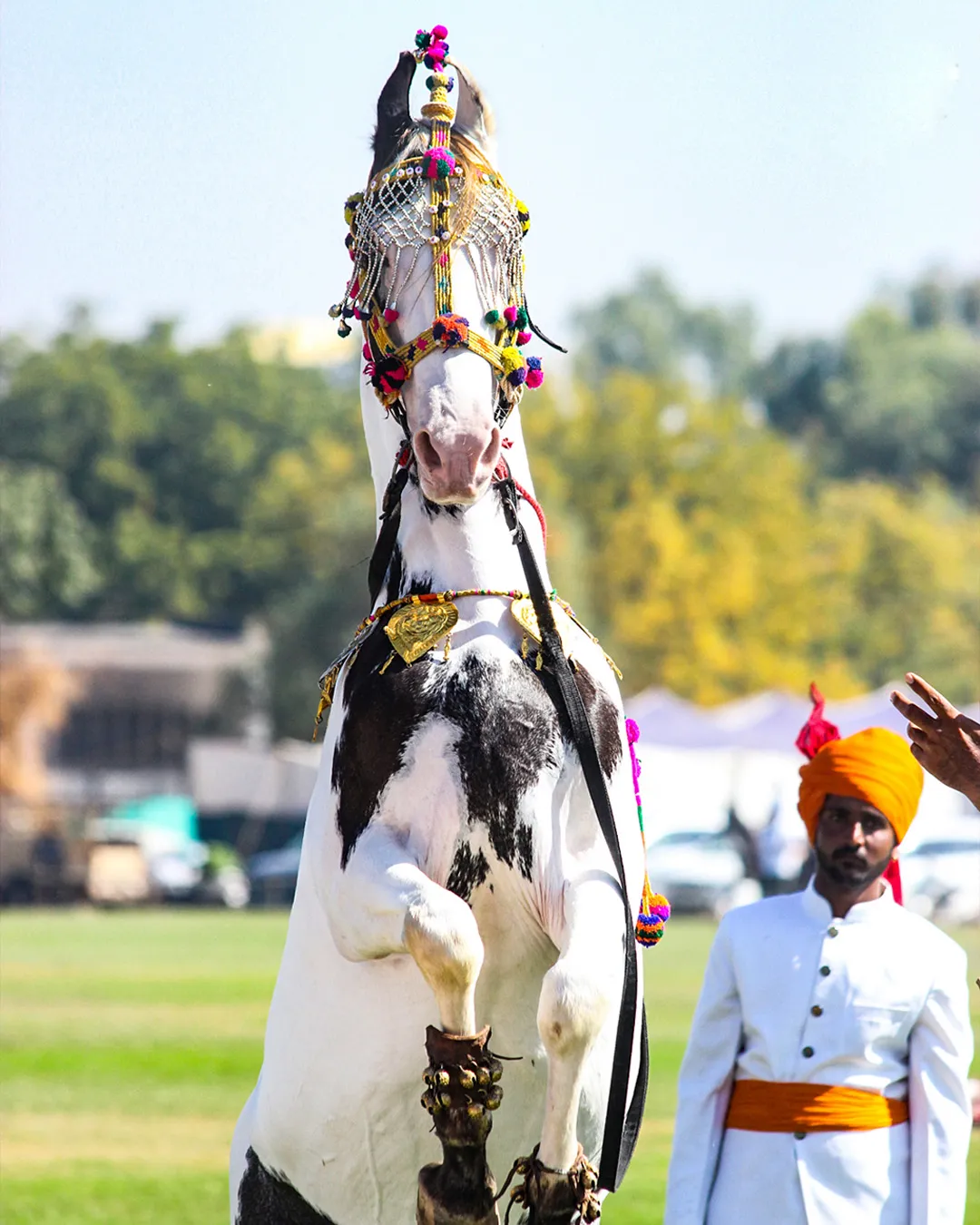
Aesthetically, the Marwari horse is characterized by a refined head, notably wide between the eyes, often featuring a straight profile. Its most distinctive attribute lies in its unique lyre-shaped ears, which possess an uncanny ability to curve inward, frequently appearing to touch at the tips. The neck is elegantly shaped, clean at the throatlatch, slightly arched, and of moderate length. They possess well-defined withers, a short and robust back, and a gently sloped croup. The hindquarters are muscular and strong, complemented by a high-set tail. The shoulders are well-sloped and powerfully muscled, leading to long legs with smooth musculature, well-angled pasterns, and strong joints. Their hooves are remarkably hard, a vital adaptation for their native terrain. On average, Marwari horses stand between 154 and 164 cm tall.
The Marwari is renowned for its distinctive gaited nature. Foals are born with a natural “rehwal” or “revaal” gait, a rapid, four-beat lateral movement. This gait is not only smoother and more comfortable than a traditional trot but also highly efficient for covering long distances across the desert with greater ease. This unique way of going, combined with their inherent agility and intelligence, made them ideal mounts for both warfare and long-distance travel.
In the rural settings of Rajasthan, Marwari horses are frequently trained for elaborate “dances” performed at numerous festivals and weddings throughout the year. This “dancing” is a sophisticated expression of Indian equestrian artistry, a form of ‘haute école’ that traces its roots back to ancient combat maneuvers. It bears a striking resemblance to the classical dressage performances seen at the Spanish Riding School in Vienna, showcasing the breed’s inherent grace, discipline, and trainability. The close connection between the Marwari and the caste system, which historically restricted ownership to certain social classes, led to a significant decline in their numbers during British rule and continued post-independence. By the early 1990s, a government survey indicated a stark reality: only an estimated 500 to 600 Marwari horses remained. Their exportation was briefly halted under a 1992 biological conservation agreement, signaling the beginning of crucial restoration efforts to preserve this unique breed.
Recognizing the urgent need for preservation, the Marwari Horse Breeding and Research Institute was established in Chopasni, Jodhpur. This vital institution is dedicated to saving the breed from extinction and fostering greater respect for the local horse breeders who have dedicated their lives to its care. The Institute meticulously registers horses and implements educational programs aimed at maintaining and enhancing the breed’s quality. Crucially, the Institute receives essential financial support from the government of India, underscoring the national importance placed on protecting this historical equine treasure. The Marwari horse, with its storied past as a warrior’s mount and its present-day elegance, continues to be a significant symbol of India’s rich cultural and historical tapestry. Its unique characteristics and enduring spirit ensure its place as a treasured breed for generations to come.
