
Alex Colville’s “Horse and Train,” created in 1954, stands as one of the most recognizable and significant pieces in Canadian art history. This powerful casein tempera on hardboard painting masterfully encapsulates Colville’s unique artistic vision, exploring the perpetual tension between opposing forces. It’s a work that invites viewers to ponder the complexities of nature versus machine, order versus chaos, and the delicate balance between the tangible reality and the unsettling realms of our subconscious. While its striking juxtapositions might evoke comparisons to Surrealism, the genesis of “Horse and Train” can be traced to a powerful poem by South African writer Roy Campbell. This seminal work delves into themes that resonate deeply with the human condition.
Genesis of a Masterpiece: Inspiration and Technique
The inspiration for “Horse and Train” directly stems from a visit by Roy Campbell to Mount Allison University in Sackville, New Brunswick, in 1953. It was during this visit that Colville encountered the poet, who penned the lines that would form the painting’s conceptual core: “And a dark horse against an armoured train.” Colville meticulously notated these lines in a March 1954 sketchbook, accompanied by preparatory images for the painting. This direct link to Campbell’s verse underscores Colville’s practice of drawing from literature and poetry to inform his visual narratives.
In 1954, Colville was still experimenting with various mediums. While some works from this period utilized oils, “Horse and Train” is executed in casein tempera. This choice of medium allowed Colville to employ his signature pointillist style. The surface of the painting is meticulously constructed from thousands of tiny, precisely applied strokes of pure color. Though muted, these colors interact with light to create a profound sense of atmospheric depth, despite the absence of any discernible surface texture. This technique contributes significantly to the painting’s compelling visual and emotional impact.
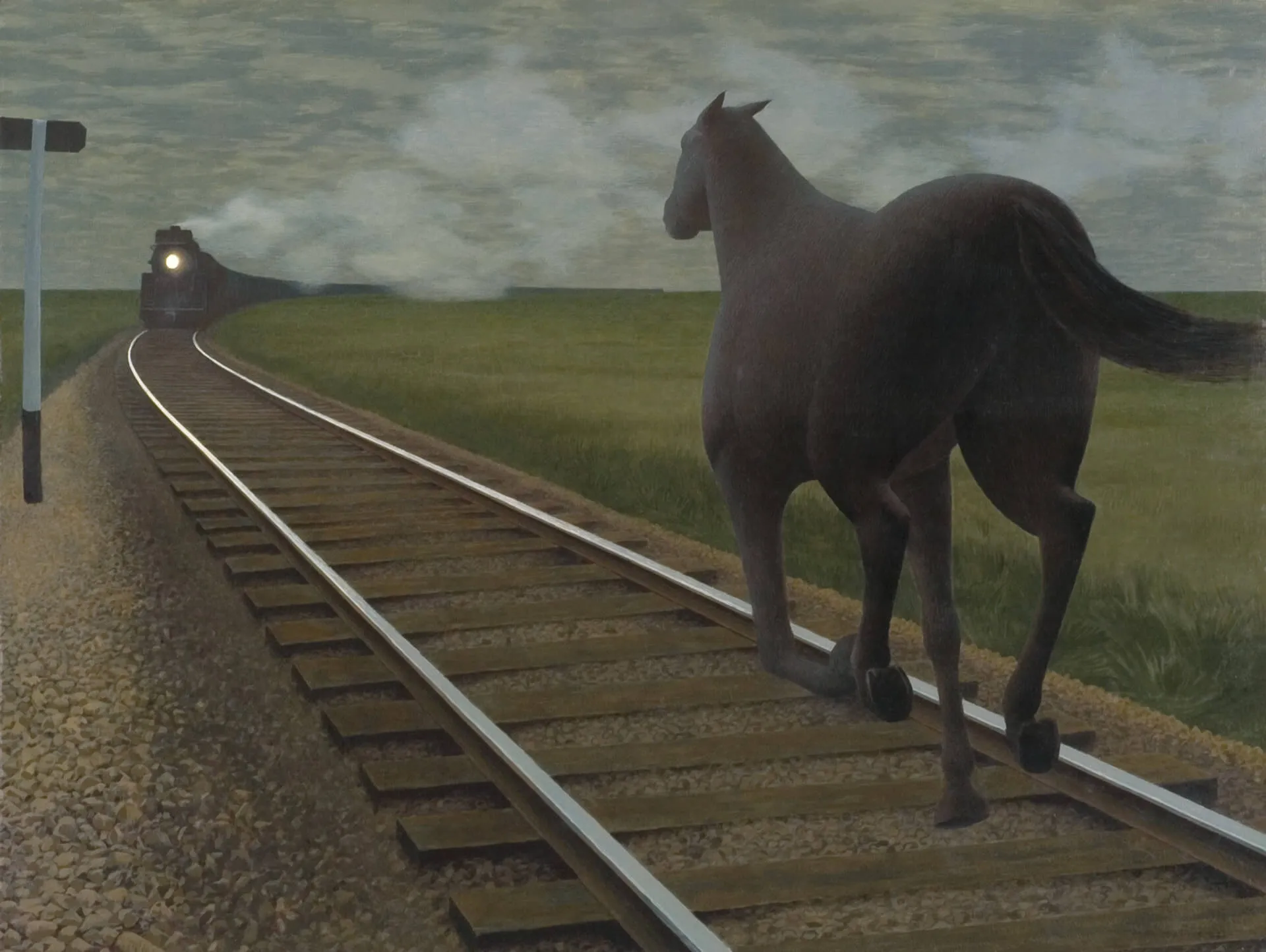 Alex Colville, Horse and Train, 1954
Visualizing Tension: Composition and Symbolism
The moment captured in “Horse and Train” is one of extreme tension, frozen just as the train begins to round a curve, its light poised to illuminate the solitary dark horse. Colville’s imagination is clearly at play here, as the scenario is highly improbable; no horse would willingly venture onto treacherous railroad tracks. The composition, however, is intentional, drawing a stark parallel to Campbell’s poem. It pits an individual, symbolized by the horse, against the overwhelming, mechanized force of progress, represented by the train. This theme likely carried significant weight for Colville, who had firsthand experience with the grim realities of war and the casualties of mechanized conflict during his service in World War II. His wartime sketches, such as Sketch Drawing, A Dead Horse (1945), offer a somber testament to the suffering of animals used in warfare.
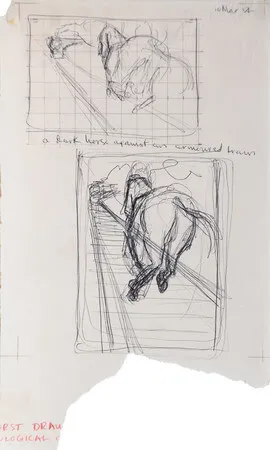 Alex Colville, Study for Horse and Train, 1954
Despite the potentially bleak outlook of individual will pitted against historical inevitability, “Horse and Train” possesses a deeply romantic quality. It depicts a charge, perhaps into oblivion, but it is also a testament to thoughtful contemplation. During the 1950s, Colville was deeply engaged with existential philosophy, absorbing the ideas of thinkers like Jean-Paul Sartre and Albert Camus. The concept of individual agency through opposition and rebellion was a significant philosophical current, and Colville, like many artists of his time, explored these ideas in his work.
“Horse and Train” is open to numerous interpretations. One compelling reading suggests the horse represents the individual, the tracks symbolize the passage of time, and the train embodies death, creating a metaphor for the human life cycle. Alternatively, the painting could serve as a lament on the relentless mechanization of the world and its detrimental impact on the natural environment. Curator David Burnett aptly notes that the multiplicity of readings does not diminish the painting’s profound impact. He observes, “One way of thinking of a dark horse does not preclude others…. And all readings (viewings) are poetically sharpened by the natural shock and surprise of the image.” This enigmatic quality ensures that “Horse and Train” continues to captivate and provoke thought decades after its creation.
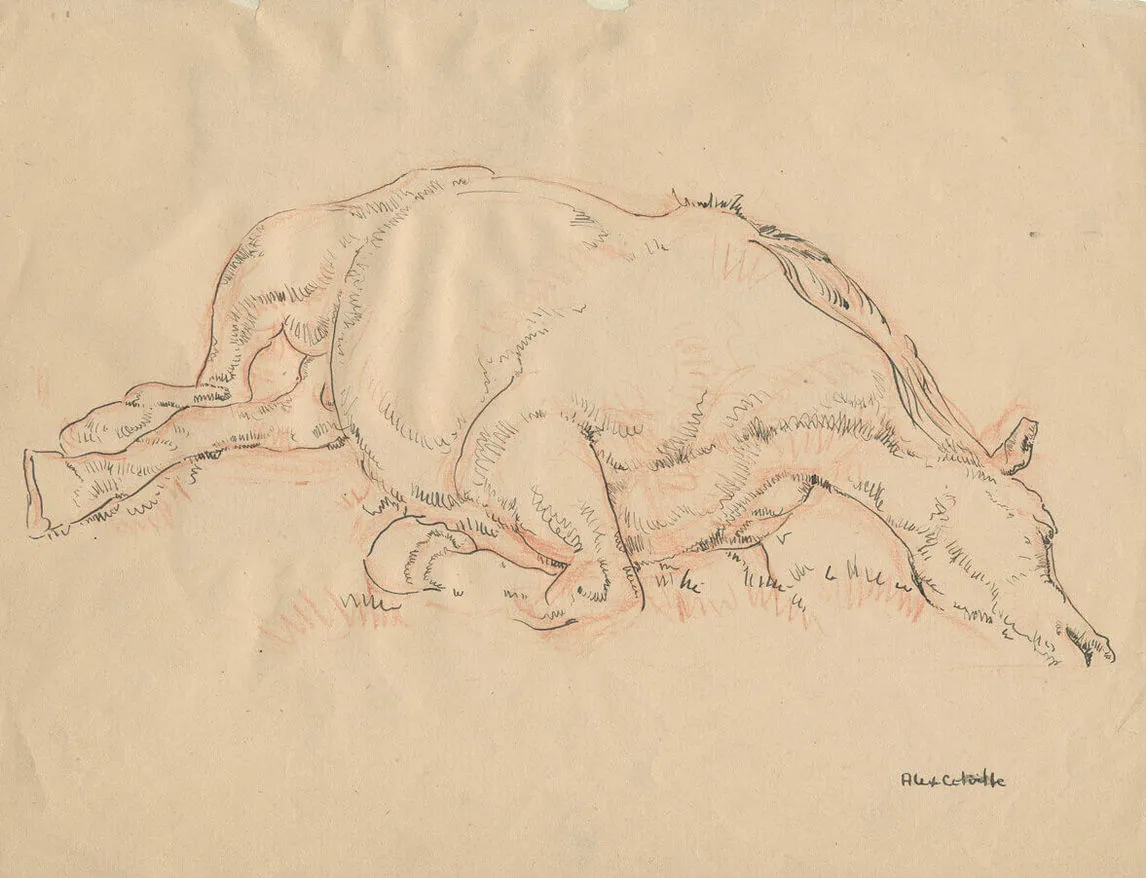 Alex Colville, Sketch Drawing, A Dead Horse, 1945
