
Noticing skin reactions and itching in your dog can be concerning, and it’s always best to consult a veterinarian for proper diagnosis. While both skin allergies and mange can cause similar skin issues, mange, if left untreated or misdiagnosed, can be far more dangerous. Successful mange treatment often begins with an accurate diagnosis, as the approach differs significantly between types. Demodectic mange is generally less severe and might only require an immune boost for your canine companion. Sarcoptic mange mites, however, pose a greater risk, as they are highly contagious and can even transmit to humans.
Fortunately, several effective home remedies can help dogs manage and eliminate these troublesome parasites. While these methods are generally simple to apply, it’s crucial to proceed with caution and always seek veterinary guidance for a definitive diagnosis and comprehensive treatment plan. Combining professional veterinary care with carefully administered home treatments can yield the best results for your furry friend. If you’re looking for ways to support your dog’s skin health, consider exploring options for canine allergy medicine to alleviate related irritations.
Essential Diagnosis Before Home Treatment
Regardless of your familiarity with demodectic or sarcoptic mange, it is imperative not to initiate any treatment without a professional diagnosis from your veterinarian. Skin scrapings can quickly identify demodectic mange but might be misleading for sarcoptic mange, as these mites burrow deeply into the skin. You should only proceed with treatment once a clear diagnosis is made, especially if you observe symptoms such as hair loss, intense itching, or signs of secondary infections.
Over-the-counter medications are available for mange, and these drugs are often potent. Your veterinarian is the best resource for recommending suitable products and guiding their use. Nevertheless, for milder cases of demodectic mange, certain home remedies can prove effective, often used in conjunction with your vet’s prescribed treatment. Mange treatment at home is not exclusive to young animals; dogs of all ages can benefit from these complementary approaches. Below are eight home remedies for dog mange you can consider today.
Boosting Your Dog’s Immunity
Demodectic mange mites are commonly found on dogs and typically do not cause immediate health issues. A robust immune system is critical in helping your pet manage demodectic mange and prevent it from escalating to a severe state. Therefore, maintaining your dog’s immune strength with multivitamins and other immune-enhancing supplements is essential. Allergy support supplements can also help reduce skin irritation, and this combined approach might be sufficient for less severe cases of mange.
 A cute dog happily eating out of its food bowl
However, in extreme situations like sarcoptic mange, simply boosting the immune system is insufficient. Further treatments will be necessary to address any resulting secondary bacterial infections. You cannot rely solely on enhancing your pet’s immune system to eliminate sarcoptic mites, as they require more aggressive intervention.
Honey Application
Honey stands out as an excellent natural ingredient for mange treatment due to its inherent antibacterial and antifungal properties. It is safe for both handling and canine application. However, avoid covering your dog’s entire body with honey, as they might quickly lick it off. While adding honey to your dog’s food can also support their immune system, topical application directly to sore spots is often more effective. Honey can help smother mange mites in small, localized areas, providing your dog with much-needed relief from irritation and discomfort.
 Natural honey pouring into a rustic bowl
Apple Cider Vinegar
Apple cider vinegar remains a home remedy that sparks debate within the broader health community. While it possesses properties potent enough to combat mite infestations, even a small amount can cause skin irritation in dogs. Consequently, it must be used with extreme caution. Some proponents argue that apple cider vinegar is effective for treating skin problems primarily due to its pH balance. If you are unsure about how to proceed with this or any other home remedy, always consult your veterinarian for expert advice.
Olive Oil for Localized Relief
Olive oil can be an effective treatment for localized cases of mange mites. Applying a thin layer of olive oil to the affected areas of your dog’s skin can provide relief. However, this treatment becomes ineffective when dealing with more severe, highly contagious, and potentially life-threatening mange situations. Olive oil is beneficial for re-moisturizing dry skin and alleviating itching. It is generally harmless when applied topically and does not cause irritation, but it should not be consumed orally by your dog.
Lemon and Citrus Power
Lemon is another widely recognized Home Remedy For Mange treatment. It is most effective when applied directly to your dog’s skin, particularly on the affected areas. A mixture of one or more whole lemons with two liters of water can be used, though the concentration can be adjusted. The acidity of this mixture helps to kill mites on the skin, as well as any bacteria or fungi that could lead to secondary infections. Furthermore, citrus fruits are well-known for their natural antiseptic properties. Some individuals also choose to add garlic to the lemon mixture, as natural additions can sometimes enhance the effectiveness of these remedies.
Unsweetened Yogurt
Arguments against the effectiveness of yogurt as a mange treatment are common. Nevertheless, unsweetened yogurt has demonstrated its utility as a home treatment. It is considered a safer option, and its probiotic properties can help ease itching. Yogurt works by smothering mites on the skin and can also assist in combating secondary bacterial infections, contributing to the overall healing process.
Aloe Vera for Soothing Skin
Unlike some other natural remedies, Aloe Vera can be harmful if ingested by your dog. When applying it to the skin, you should use an e-collar to prevent your dog from licking it off. Aloe vera is excellent for soothing your pet’s skin and reducing itching and irritation caused by mites. However, it is not suitable for treating widespread conditions and is most effective for localized mite populations. If your dog is dealing with a full-blown mange situation or sarcoptic mange, you should seek more comprehensive solutions. Apply aloe vera a few times a week until the skin begins to clear up, as it also helps prevent other infections from developing.
 Freshly cut aloe vera slices for skin care
Anti-Parasitic Herbs
Certain anti-parasitic herbs are known to be effective against ear mites or sarcoptic mange. These include:
- Barbados nut oil: This oil possesses anti-parasitic, anti-fungal, and insecticidal properties, making it an effective treatment for mange and other skin problems in dogs. For maximum effect, it can be mixed with niaouli essential oil. Apply this mixture two to three times daily, ensuring it is used externally only.
- Turmeric plus neem oil: Heat a sliced turmeric root in water for 30 minutes (one small root for 8 ounces of water). Then, mix it with a leaf infusion and use it as a rinse for your dog twice daily for 14 days. Alternatively, a neem herbal tincture (30 ml of water per tincture) can be used.
- Karanja oil: This oil can be used as a substitute for neem oil, offering similar beneficial anti-parasitic properties.
- Neem plus essential oil: Essential oils like geranium and palmarosa are safe for treating mange, particularly the sarcoptic type. Neem oil, derived from the neem plant, also aids in treatment by forcing mites to migrate to the skin’s surface, where they can be suffocated. Neem oil is known for its antibacterial, antiparasitic, and antifungal qualities, disrupting the mites’ reproductive cycle. Regular bathing with neem oil can also be very helpful.
House Fumigation for Sarcoptic Mange
Demodectic mange mites cannot survive long outside a dog’s skin. However, sarcoptic mange mites are more resilient, capable of living for two to three days off a living host. This means they can infect other dogs or even other animals in your home, such as cats. Eliminating these mites from the environment is crucial to prevent further infection in other pets. This includes areas like your yard where dogs play.
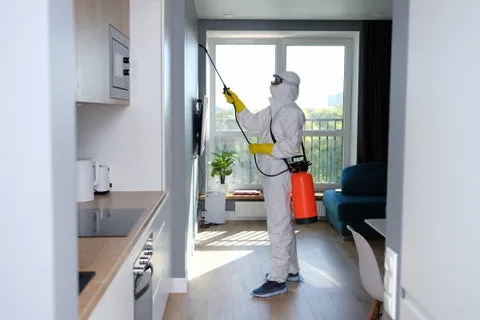 A person in a protective suit treating a room with disinfectant
House fumigation also helps to eliminate other pests within the home. Therefore, while it is a vital step in preventing mange transmission, it can also aid in eradicating other potential infections. Skin sores can attract various types of infections, making a clean environment paramount. Remember to fumigate or completely change your dog’s bedding, choosing whichever option works best for your situation.
When to Isolate Your Furry Friend
Mange is a skin condition often recognizable by visible signs, even if the mites themselves are microscopic. You may observe hair loss, persistent itching, and irritation on your dog’s skin. In its generalized form, demodectic mange is typically harmless, and a dog with a robust immune system can usually manage it effectively. Therefore, incorporating supplements into your dog’s meals is crucial for preventive care, preventing the condition from worsening. Demodectic mange is not contagious to other pets, and a simple skin scraping is usually sufficient for its diagnosis.
Sarcoptic mange, however, is much more insidious. These mites burrow deep into the skin, laying eggs within the tunnels they create, which is why skin scrapings may not always detect their presence, often leading people to mistake it for a different skin condition. If you notice signs indicative of sarcoptic mange, immediate isolation of your dog from other animals and people is highly recommended. Keep your dog separated until the full course of treatment is completed and subsequent skin scrapings yield negative results. Remember, sarcoptic mange is highly contagious to both other animals and humans.
Conclusion
While some people consider borax (hydrogen peroxide) as a home remedy for mange, it’s essential to note that this laundry detergent can kill mites on a dog’s coat and other objects but can cause skin drying and is toxic if ingested.
Ultimately, while home remedies can offer supportive care, visiting a veterinarian remains the best course of action. A thorough skin scraping can reveal not only mange but also other underlying skin diseases, allowing for a comprehensive treatment plan. Additionally, powerful over-the-counter and prescription treatments are available for effective mange management.
Combine professional veterinary care with careful home care for optimal results. If your dog is diagnosed with the sarcoptic variant of mange, it is crucial to isolate them until treatment is complete. Furthermore, pay close attention to your dog’s diet, providing multivitamins and other supplements to bolster their immune system, which is vital in the fight against demodectic mange. For more insights into managing your dog’s health, explore articles on topics such as medicine for dogs to stop vomiting and all natural flea and tick killer.
References
- Medical News Today. (n.d.). Can human scabies spread to dogs? https://www.medicalnewstoday.com/articles/321379
- River Landing Animal Clinic. (2017). What Does a Skin Scraping Reveal in Dogs? http://www.riverlandingsanimalclinic.com/news/2017/7/25/what-does-a-skin-scraping-reveal-in-dogs#:~:text=A%20skin%20scraping%20can%20reveal,disorder%20leads%20to%20appropriate%20treatment.
- National Center for Biotechnology Information (NCBI). (n.d.). Honey and Health: A Review of Recent Clinical Research https://www.ncbi.nlm.nih.gov/pmc/articles/PMC6958461/
- Pet Honesty. (n.d.). Dog Mites: Everything You Need to Know https://www.pethonesty.com/blogs/blog/dog-mites
- National Center for Complementary and Integrative Health (NCCIH). (n.d.). Probiotics: What You Need To Know https://www.nccih.nih.gov/health/probiotics-what-you-need-to-know
- Pet Honesty. (n.d.). Creating and Maintaining a Dog-Friendly Yard https://www.pethonesty.com/blogs/blog/creating-and-maintaining-a-dog-friendly-yard?utm_campaign=Creating%20and%20Maintaining%20a%20Dog-Friendly%20Yard&utm_source=blog
- Moving.com. (n.d.). How to Fumigate and Get Rid of Pests Once and For All https://www.moving.com/tips/how-to-fumigate-and-get-rid-of-pests-once-and-for-all/
- Pet Honesty. (n.d.). All Supplements https://www.pethonesty.com/collections/all
