
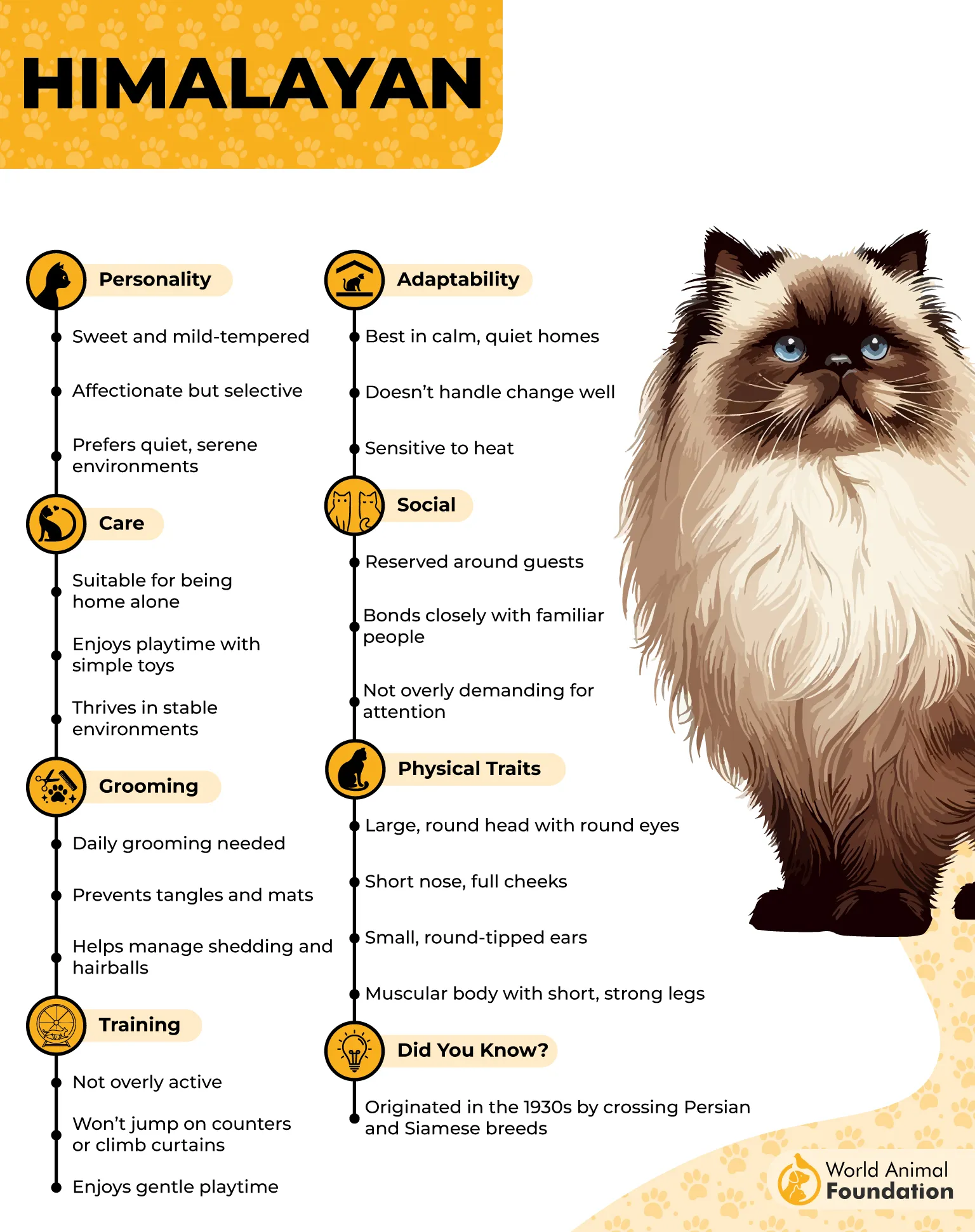
Himalayan cats, often affectionately nicknamed “Himmies,” are a captivating breed that blends the luxurious coat of the Persian with the striking colorpoint markings and blue eyes of the Siamese. While their distinct appearance might lead some to playfully dub them “Persians in a Siamese costume,” these sweet and docile longhairs possess a unique set of characteristics that make them truly special companions. This guide delves into the history, attributes, care needs, and intriguing facts about the Himalayan cat, offering valuable insights for both prospective and current owners.
A Closer Look at the Himalayan Cat
Himalayans are essentially a sub-breed of longhaired cat, closely resembling Persians but distinguished by their vibrant blue eyes and the characteristic colorpoint pattern—a creamy body adorned with darker hues on the face, ears, paws, and tail. Typically weighing between 7 to 12 pounds, they enjoy a lifespan of 9 to 15 years. Known for their calm and devoted nature, Himalayans thrive in quieter home environments, making them ideal companions for those seeking a gentle and affectionate feline friend. They are also recognized by other names, including Himalayan Persians and Colourpoint Persians, with “Himmies” being a popular term of endearment.
A Journey Through Himalayan History
The origins of the Himalayan cat are steeped in a blend of myth and dedicated research. While some speculate a lineage tracing back to Pallas’s cat, a wild Central Asian feline known for its long fur, the more widely accepted account places their development in the United States during the 1930s. Researcher Clyde Keeler, collaborating with enthusiast Virginia Cobb at Harvard, embarked on a study to merge the desirable traits of Siamese and Persian cats. Their initial success, a cat named Newton’s Debutante, paved the way for future development. The breed gained further traction in the 1950s as breeders sought to create a longhaired cat with the distinctive Siamese colorpoint markings and brilliant blue eyes.
Independently, in the United Kingdom, Brian Sterling-Webb successfully crossbred cats he named Longhaired Colourpoints in 1955. Just two years later, in the U.S., Margaret Goforth achieved similar results and officially named the breed “Himalayans,” inspired by the Himalayan rabbit’s comparable markings.
Distinctive Attributes of the Himalayan
Himalayan cats are characterized by their “cobby” body type, which signifies a sturdy and strong physique despite their rounded, plush appearance. They possess short, thick legs and tails, complemented by a broad chest and shoulders.
Beyond their captivating blue eyes, the Himalayan’s face can present in two distinct styles: the traditional or “doll face,” featuring a more elongated nose, and the extreme or “peke-face,” known for its flattened, smooshed appearance, akin to that of a Pug.
The most striking feature, however, is their exquisite double coat. This fine, glossy fur is presented in a range of base colors from white to fawn, with colorpoint markings that can manifest in various shades, including blue, lilac, seal, chocolate, tortoiseshell, red (flame), and hot cream. The term “longhair” is no exaggeration; these cats boast a luxurious mane around their neck, a deep ruff between their front legs, prominent ear and toe tufts, and a full, bushy tail.
Temperament and Personality
Himalayans are renowned for their exceptionally pleasant demeanor. They are intelligent, affectionate, and deeply devoted to their families, often considering their owner’s lap the ultimate sanctuary. While they can tolerate being left alone for reasonable periods, they are not shy about expressing their desire for attention when their humans return. Fortunately, their vocalizations are described as melodious, adding to their charm.
These cats tend to be somewhat shy and prefer a tranquil home environment. They generally get along well with children and may even tolerate being gently handled or paraded in toy buggies. However, they do not appreciate rough play and can be timid around strangers or in noisy settings.
Essential Grooming and Care for Himalayans
The Himalayan’s glorious coat necessitates a consistent grooming routine. Their dense double coat is prone to matting, making daily combing essential. Monthly baths are also recommended to maintain the coat’s natural oils and prevent excessive oiliness. It’s important to note that their long fur can easily trap litter, so maintaining a meticulously clean litter box is crucial to prevent the cat from seeking alternative elimination spots.
As a brachycephalic breed, Himalayans have a short-nosed facial structure that can lead to excessive tear production. Regular daily wiping of their face with a warm, damp cloth is necessary to keep the eyes clean and prevent staining. This facial structure can also affect their ability to regulate body temperature, making them susceptible to overheating. In warm weather, providing them with a cool environment, such as air conditioning, is highly advisable. Basic grooming practices, including regular nail trimming and dental care, are also important components of their overall health regimen. The good news is that most Himalayans are very affectionate and often enjoy grooming sessions with their owners.
Common Health Concerns in Himalayan Cats
The distinctive “smooshy” face of the Himalayan, while endearing, predisposes them to several health issues. As brachycephalic cats, they may experience breathing difficulties and dental malocclusions. Eye conditions, such as cherry eye, are also common. Furthermore, Himalayans have a genetic predisposition to Polycystic Kidney Disease (PKD) and a neurological condition known as Feline Hyperesthesia Syndrome. They can also be susceptible to ringworm. Regular veterinary check-ups and keeping vaccinations up-to-date are vital for monitoring and managing these potential health concerns.
Five Fun Facts About Himalayan Cats
Despite their quiet nature, Himalayan cats are full of interesting quirks:
- In 2012, a Himalayan named Colonel Meow achieved a Guinness World Record for having the longest fur among cats.
- Himalayans have graced the silver screen, with notable appearances including Sassy (voiced by Sally Field) in the “Homeward Bound” film series and Mr. Jinx in the comedy “Meet the Parents.”
- These cats form deep bonds with their human families and are known for their loving and attached nature.
- Famed television personality Martha Stewart is a devoted owner of three Himalayan cats—Beethoven, Mozart, and Bartôk—who have frequently featured in her media productions.
- The Guinness World Record for the world’s smallest cat was held by a Himalayan named Tinkertoy, measuring a mere 2.75 inches tall and 7.5 inches long.
Naming Your Himalayan Companion
Given their unique charm, Himalayan cats deserve names that are equally special. Owners might consider names reflecting their luxurious coat, such as Rapunzel or Cher. Alternatively, honoring the individuals who played a role in the breed’s development—like Clyde, Ginny, Cobb, Sterling, or Maggie—could be fitting. Drawing inspiration from renowned composers like Wolfgang, Chopin, or Wagner, or artists such as Frida or Georgia, also offers creative naming avenues.
For those considering bringing a Himalayan into their home, exploring pet health insurance is a prudent step to ensure comprehensive care for your new feline family member.
