
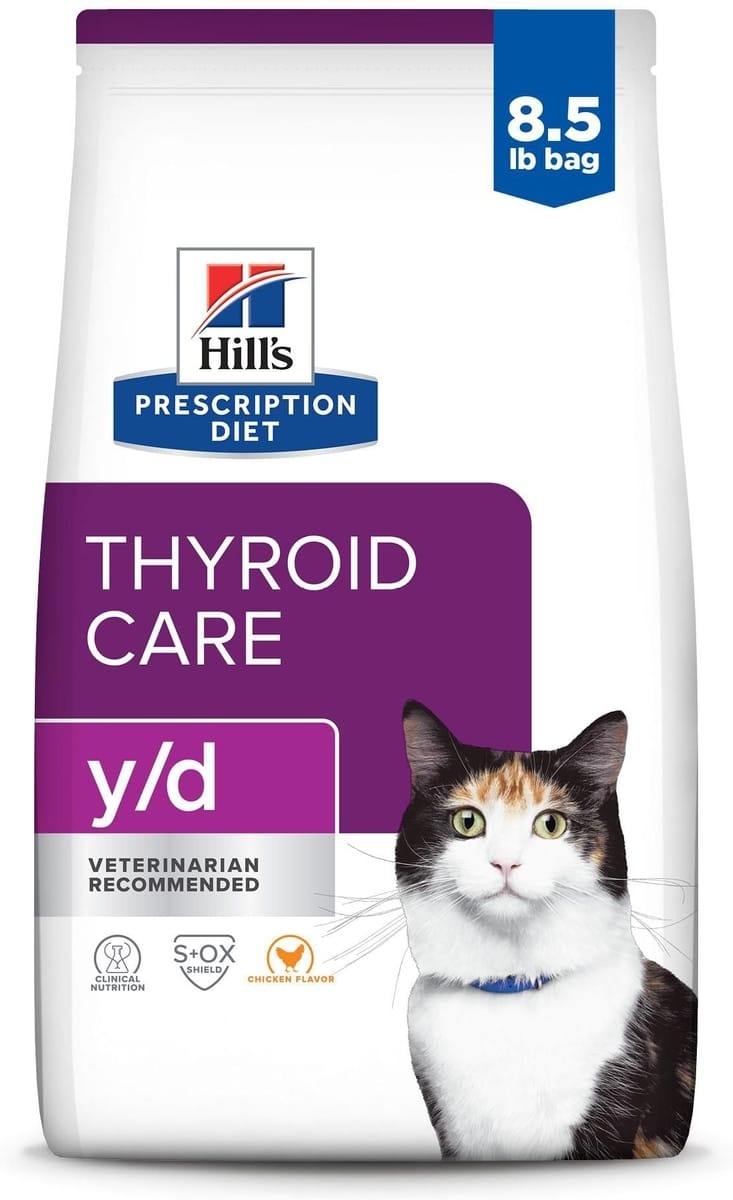
Hyperthyroidism is a common endocrine disorder in adult cats, and managing this condition effectively is crucial for their long-term health and well-being. While traditional treatments like radioactive iodine (I-131) therapy and medication (methimazole) are well-established, a newer dietary approach, Hill’s Prescription Diet y/d, has emerged. This article provides an in-depth analysis of y/d, evaluating its efficacy, limitations, and potential long-term implications for feline health, drawing upon expert opinions and scientific considerations.
Understanding Hill’s Prescription Diet y/d
Hill’s Prescription Diet y/d is specifically formulated to manage hyperthyroidism in cats by significantly restricting iodine intake. Iodine is a critical component in the production of thyroxine, a thyroid hormone. By limiting dietary iodine to a maximum of 0.32 ppm, y/d aims to reduce the thyroid gland’s ability to produce excess thyroid hormones. This dietary intervention may be considered for older hyperthyroid cats who cannot afford or tolerate other treatment options, such as I-131 therapy or methimazole.
Key Considerations and Limitations of y/d
Despite its purported benefits, several important considerations and unanswered questions surround the use of y/d.
Does Not Restore Thyroid Health
It is crucial to understand that y/d does not cure or restore the underlying health of the thyroid gland. According to Dr. Mark Peterson, a leading authority on feline hyperthyroidism, y/d merely limits the thyroid’s functional capacity by withholding iodine. The thyroid pathology itself, whether an adenoma or adenocarcinoma, remains unchanged. Unlike radioactive iodine or surgery, which can destroy or remove thyroid tumors and allow remaining normal thyroid cells to function properly, y/d does not address the root cause of the disease. Dr. Peterson advises that y/d should only be considered for cats intolerant to methimazole or when owners cannot afford or choose not to pursue radioactive iodine or surgery.
Potential Long-Term Cost Implications
While the upfront cost of I-131 therapy might seem higher, the long-term financial implications of managing hyperthyroidism with y/d can be substantial.
Food Costs:
Hill’s y/d is significantly more expensive than standard cat food. The recommended retail price for a case of 24 cans is approximately $50.00. Given that a single medium-sized, cachectic cat may require more than one can per day to regain weight, the estimated daily cost can reach $2.60, equating to about $78.00 per month and nearly $1000.00 per year for a single cat. If multiple cats in the household consume y/d, these costs are compounded.
Monitoring Costs:
Similar to methimazole management, cats on y/d require lifelong monitoring of thyroid function through regular blood work and veterinary examinations. Hill’s recommends checks at 4 and 8 weeks after initiating y/d, followed by every six months thereafter. The combined cost of food and ongoing monitoring for a hyperthyroid cat on y/d for the first year can easily exceed $1500-$1750, approximating the cost of managing the condition with methimazole.
In contrast, I-131 treatment, with an initial cost of around $850 plus consultation fees, offers a potential cure. While two follow-up rechecks are advised, once the thyroid gland is normalized, owners can revert to standard veterinary care and feeding practices dictated by the cat’s age, rather than a progressive disease. Although post-I-131 cats still incur food costs, they can be fed high-quality foods at a significantly lower price point than y/d, leading to substantial annual savings per cat. As hyperthyroidism is increasingly diagnosed in younger cats, the cumulative costs of lifelong dietary management and monitoring with y/d can become more significant over time.
Suitability as a Long-Term Diet for Cats
The formulation of y/d raises questions about its suitability for cats, who are obligate carnivores.
Dry y/d Formulation:
The dry version of y/d contains no meat, with protein primarily sourced from corn gluten meal and eggs, as animal protein is believed to contain too much iodine. This raises concerns about whether it adequately meets the nutritional needs of cats. While the canned formula includes more meat, it’s unclear how the iodine is depleted. Hill’s compares the protein content to their g/d formula, which is moderately protein-restricted. This level of protein may not be sufficient for emaciated cats recovering from hyperthyroid malnutrition, nor is it low enough for cats with advanced renal failure. Protein restriction is generally not recommended for debilitated carnivores unless they have moderately azotemic renal failure.
Iodine Deficiency:
Iodine is an essential nutrient, and the long-term effects of chronic iodine deficiency in cats are not fully understood. Dr. Peterson highlights that while thyroid hormone production would decrease, this deficiency could lead to thyroid hyperplasia and goiter. Furthermore, iodine is actively accumulated in various tissues beyond the thyroid, including salivary glands, gastric mucosa, mammary glands, choroid plexus, and the ciliary body of the eye. In humans, iodine deficiency has been linked to an increased risk of gastric and breast cancer. Iodine also plays a role as a local antioxidant and in immune function. While these effects haven’t been definitively proven in cats, it is prudent to question the exclusive use of an iodine-deficient diet.
Practicality in Multi-Cat Households
The exclusive nature of the y/d diet presents significant challenges in multi-cat households. To be effective, y/d must be the sole source of nutrition for the hyperthyroid cat, as even minimal iodine from other foods, treats, or medication aids can reduce its efficacy. This necessitates separate feeding arrangements for hyperthyroid cats. While Hill’s suggests that normal cats can consume y/d if supplemented with maintenance foods, feeding y/d to an entire household could be prohibitively expensive, adding hundreds of dollars annually per cat.
Limited Research and Unanswered Questions
Hill’s conducted a study involving nine cats over two to three years. However, these cats were not experiencing the severe clinical distress often seen in general practice. The limited sample size, short duration, and controlled setting make it difficult to extrapolate these findings to a broader population of hyperthyroid cats.
Thyrotoxic Heart Disease:
The impact of y/d on thyrotoxic heart disease remains largely uninvestigated. Even with controlled thyroid hormone levels through methimazole, hypertrophic cardiomyopathy and hypertension can progress. Some veterinary specialists have observed cases where heart disease continued to worsen despite controlled T4 levels on methimazole, stabilizing only after I-131 treatment. It is unclear whether merely reducing hormone production with y/d can prevent or delay the progression of cardiovascular disease in cats with intact thyroid adenomas.
Renal Function:
Treatments that reduce thyroid hormone levels can lower glomerular filtration rates to normal levels, potentially “unmasking” pre-existing renal insufficiency. Hill’s y/d is not an exception to this, and it does not offer any specific benefits for kidney health.
Conclusion: I-131 Remains the Gold Standard
While Hill’s Prescription Diet y/d may serve as a viable option for a select group of hyperthyroid cats unable to tolerate or afford other treatments, its long-term effects and overall suitability are not yet fully understood. The high cost, potential nutritional inadequacies, and practical challenges in multi-cat households warrant careful consideration. Clients must be thoroughly informed about the unknowns associated with this dietary management approach.
Ultimately, for most cats, eliminating the thyroid disease with I-131 therapy remains the most effective, safest, and, in the long run, the least costly treatment option.
