
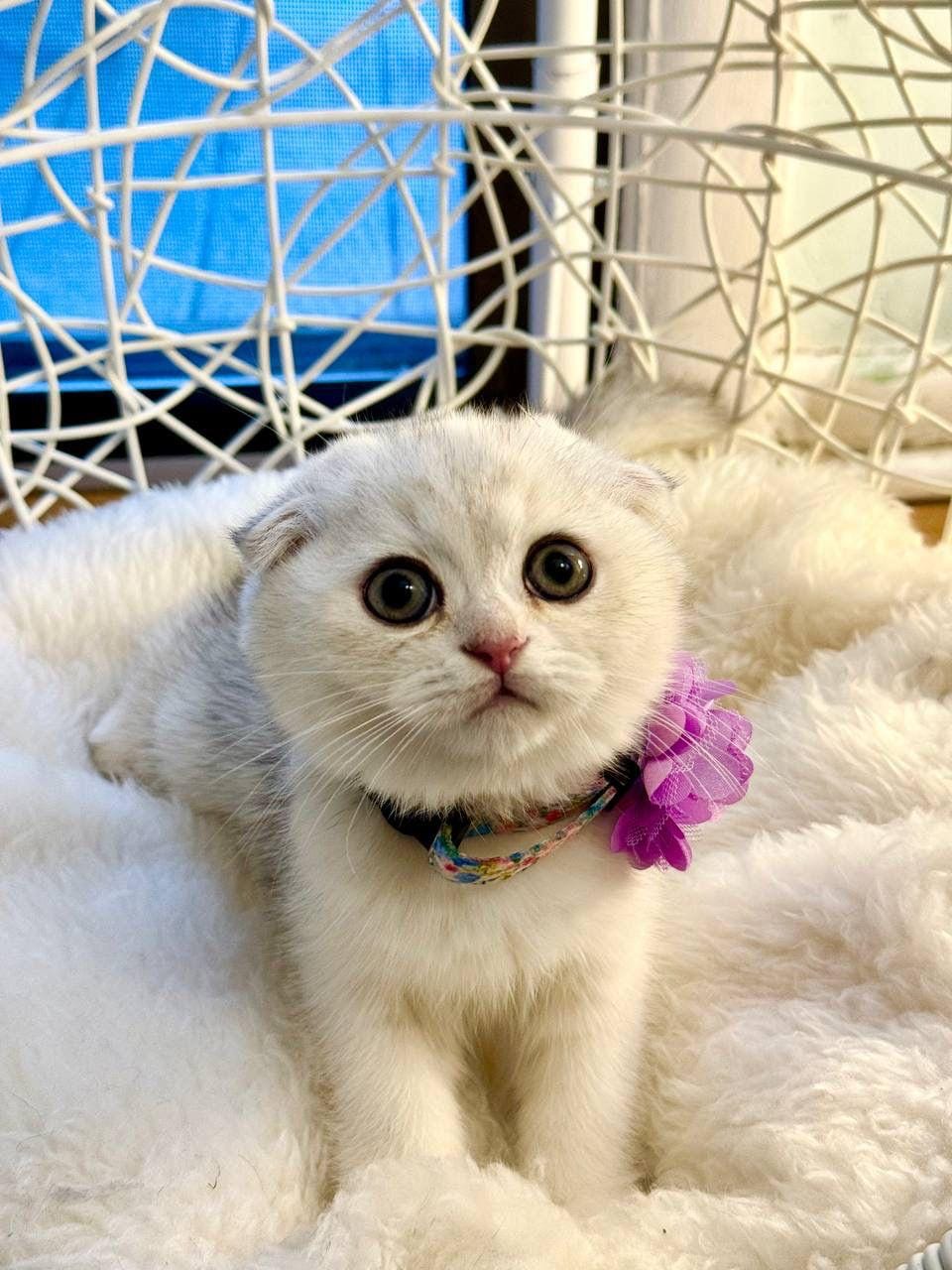
The Scottish Fold is a unique and beloved breed, originating from a spontaneous genetic mutation in farm cats in Scotland. Known for their distinctive folded ears, these cats have captured the hearts of many. This guide delves into the breed’s standards, covering physical characteristics, coat types, and an extensive range of recognized colors and patterns, making it an invaluable resource for breeders, enthusiasts, and potential owners.
Breed Standard: Physical Characteristics
The Scottish Fold’s appeal lies in its charming appearance, meticulously defined by breed standards.
Head
The head is well-rounded, featuring a firm chin and jaw. Prominent cheeks, especially in males, contribute to a distinctive jowly appearance. The muzzle is characterized by well-rounded whisker pads, and the head seamlessly blends into a short neck. The overall head shape aims for a rounded, pleasing aesthetic.
Eyes
Eyes are large, well-rounded, and set wide apart, contributing to a sweet expression. The broad nose ensures adequate separation between the eyes. Eye color is expected to correspond with the cat’s coat color, with exceptions for all-white, bi-color, and van patterns, where blue or odd eyes (one blue and one of another color) are permissible.
Nose and Profile
The nose is short with a gentle curve, and a brief stop is permitted. The profile presents a moderate appearance, complementing the rounded head.
Ears: The Defining Feature
The hallmark of the Scottish Fold is its ears, which fold forward and downward. These ears are small, with tightly folded ears being preferred over those with a loose fold or a larger size. The ears are set in a cap-like fashion, allowing the rounded cranium to be exposed. Ear tips should be rounded.
For the Scottish Straight, a variation of the breed, the ears are medium to small with rounded tips and are set well apart, also showcasing a rounded cranium.
Body Structure
The body is medium in size, well-rounded, and uniform from the shoulders to the pelvic girdle. The cat should possess a firm stance and a well-padded body. The legs are described as neither too short nor coarse, ensuring mobility. Toes are neat and well-rounded, with five in the front paws and four in the hind. Females may be slightly smaller than males.
Tail
The tail is medium to long, proportionate to the body, and flexible. It tapers to a rounded tip, with a longer, tapering tail being preferred. A kinked tail, a foreshortened tail, or a tail lacking flexibility due to abnormal vertebrae are considered disqualifications.
Coat Types
The Scottish Fold comes in two coat varieties: shorthair and longhair.
Shorthair Coat: This coat is dense, plush, and even, ranging from short to medium-short in length. It possesses a soft texture and appears full of life, standing away from the body due to its density rather than lying flat. Minor variations in texture may occur based on color and seasonal changes.
Longhair Coat: The longhair variety features medium-long to long hair. A full coat on the face and body is desirable, though shorter hair on the face and legs is permissible. Essential furnishings include britches, a tail plume, toe tufts, and ear furnishings, with a ruff being desirable. A cottony coat is a serious fault, except in kittens.
Colors and Patterns
Scottish Folds are recognized in a vast array of genetically possible colors and patterns, offering a stunning variety for admirers of the breed.
Solid Colors
These include White, Black, Blue, Red, Cream, Chocolate, Lilac, Cinnamon, and Fawn. Each color has specific requirements for nose leather, paw pads, and eye color. For instance, pure white cats have pink nose leather and paw pads, and their eyes can be blue, copper, or gold. Black cats feature coal-black coats, black nose leather, and black or brown paw pads, with copper or gold eyes. Blue cats are a solid, lighter shade of blue with blue nose leather and paw pads, and copper or gold eyes. Red cats are a deep, rich, clear red, with brick-red nose leather and paw pads, and copper or gold eyes. Cream cats are a single shade of buff cream, with pink nose leather and paw pads, and copper or gold eyes. Chocolate cats are a rich chestnut brown, with brown nose leather and brown or cinnamon paw pads, and copper or gold eyes. Lilac cats are a frosty grey with a pinkish tone, with lavender-pink nose leather and paw pads, and copper or gold eyes. Cinnamon cats are a light reddish-brown, with cinnamon nose leather and paw pads, and copper or gold eyes. Fawn cats are a light lavender with pale cocoa overtones, with pale fawn nose leather and paw pads, and copper or gold eyes.
Silvers and Shaded Variations
- Chinchilla Silver: A pure white undercoat with black tipping, creating a sparkling silver appearance.
- Shaded Silver: White undercoat with black tipping that shades down the body, resulting in a darker overall effect than chinchilla.
- Chinchilla Golden: A rich warm cream undercoat with black tipping for a golden appearance.
- Shaded Golden: Similar to Shaded Silver but with black tipping on a warm cream undercoat.
- Shell Cameo (Red Chinchilla): White undercoat with red tipping.
- Shaded Cameo (Red Shaded): White undercoat with red tipping that shades down the body.
- Dilute Shell Cameo (Cream Chinchilla): White undercoat with cream tipping.
- Dilute Shaded Cameo (Cream Shaded): White undercoat with cream tipping that shades down the body.
Smoke Colors
These colors feature a white undercoat that is deeply tipped with the main color, making the cat appear solid when in repose but revealing the white undercoat when in motion. Examples include Black Smoke, Blue Smoke, Cameo Smoke (Red Smoke), Chocolate Smoke, Lilac Smoke, Cinnamon Smoke, Cream Smoke, Fawn Smoke, Tortoiseshell Smoke, Blue-Cream Smoke, Chocolate Tortoiseshell Smoke, Lilac-Cream Smoke, Cinnamon Tortoiseshell Smoke, and Fawn-Cream Smoke.
Tabby Patterns
The breed standard recognizes several tabby patterns:
- Classic Tabby: Dense, clearly defined, and broad markings, including swirls on cheeks and a distinct “M” on the forehead.
- Mackerel Tabby: Narrow, penciled markings resembling fish bones.
- Spotted Tabby: Distinct spots that can be round, oblong, or rosette-shaped.
- Ticked Tabby: Individual hairs are ticked with different shades, with tabby striping visible on the face, legs, and tail.
- Patched Tabby (Torbie): A combination of tabby markings with patches of red and/or cream.
Specific tabby color variations include: Silver Tabby, Blue-Silver Tabby (Pewter Tabby), Blue-Silver Patched Tabby, Red Tabby, Brown Tabby, Blue Tabby, Cream Tabby, Cameo Tabby, Cream Cameo Tabby (Dilute Cameo), Chocolate Tabby, Chocolate Silver Tabby, Cinnamon Tabby, Cinnamon Silver Tabby, Lilac Tabby, Lilac Silver Tabby, Fawn Tabby, Fawn Silver Tabby, and Tabby & White.
Parti-Color and Bi-Color Patterns
These include Tortoiseshell, Tortoiseshell & White, Chocolate Tortoiseshell, Chocolate Tortoiseshell & White, Cinnamon Tortoiseshell, Cinnamon Tortoiseshell & White, Calico, Dilute Calico, Blue-Cream, Blue-Cream & White, Lilac-Cream, Lilac-Cream & White, Fawn-Cream, Fawn-Cream & White, and various Bi-Colors (white with patches of other colors).
Pointed Patterns
Inspired by the Siamese, these cats have a lighter body color with darker points (ears, mask, legs, and tail). Variations include:
- Seal Point: Pale fawn to cream body with deep seal brown points.
- Seal Lynx Point: Ticked seal brown points and a pale cream to fawn body with distinct tabby markings.
- Chocolate Point: Ivory body with milk chocolate points.
- Chocolate Lynx Point: Ivory body with warm milk-chocolate points and tabby markings.
- Blue Point: Bluish-white body with blue points.
- Blue Lynx Point: Bluish-white body with light, silvery blue points and tabby markings.
- Blue-Cream Point: Bluish-white or creamy white body with blue and cream points.
- Blue-Cream Lynx Point: Bluish-white body with blue tabby points and cream patches.
- Lilac Point: Glacial white body with frosty grey points.
- Lilac Lynx Point: Glacial white body with frosty grey tabby points.
- Lilac-Cream Point: Glacial white body with frosty grey and cream points.
- Lilac-Cream Lynx Point: Glacial white body with frosty grey tabby points mottled with cream.
- Flame (Red) Point: Creamy white body with deep orange flame to red points.
- Flame (Red) Lynx Point: Creamy white body with red tabby points.
- Cream Point: Creamy white body with buff cream points.
- Cream Lynx Point: Clear white body with pale buff cream tabby points.
- Tortie Point: Creamy white or pale fawn body with seal points mottled with red and/or cream.
- Tortie-Lynx Point: Creamy white or pale fawn body with seal tabby points and red patches.
- Chocolate-Tortie Point: Ivory body with chocolate and red points.
- Chocolate-Tortie Lynx Point: Ivory body with chocolate tabby points mottled with red.
- Cinnamon-Tortie Point: Ivory body with cinnamon and red points.
- Cinnamon-Lynx Point: Ivory body with cinnamon tabby points.
- Cinnamon-Tortie Lynx Point: Ivory body with cinnamon tabby points mottled with red.
- Fawn-Cream Point: Ivory body with fawn and cream points.
- Fawn-Lynx Point: Ivory body with fawn tabby points.
- Fawn-Cream Lynx Point: Ivory body with fawn tabby points mottled with cream.
Other Scottish Fold Colors (OSFC)
This category encompasses any other genetically possible color or pattern not specifically listed, with eye color appropriate to the dominant color.
Color Class Numbers and Divisions
The provided information includes a comprehensive breakdown of color class numbers for both longhair and shorthair divisions, as well as for Scottish Straight Ear cats. These numbers are used for registration and show purposes. The allowable outcross breeds for Scottish Folds are British Shorthair and American Shorthair.
This detailed guide aims to provide a thorough understanding of the Scottish Fold breed standard, highlighting the intricacies of its physical traits, coat variations, and the extensive spectrum of colors and patterns recognized, ensuring a well-informed appreciation for this unique feline breed.
