
Have you ever watched a skilled handler and their dog move in perfect sync, communicating with just a glance or a subtle gesture? It’s not magic; it’s a language. Welcome to the world of Hand Signals Dog Training, a powerful method that taps into your dog’s natural ability to read body language. This silent form of communication builds a profound connection, enhances focus, and makes training more effective in almost any situation. Moving beyond verbal cues opens up a richer, more intuitive dialogue with your canine companion, transforming your partnership into something truly special. For a deeper dive into how visual and verbal cues work together, understanding dog obedience commands and hand signals is a great place to start.
Why Bother with Hand Signals? The Silent Advantage
Dogs are masters of non-verbal communication. They watch our bodies constantly, picking up on subtle shifts in posture and movement to understand our intentions. Using deliberate hand signals leverages this innate skill, making it one of the most effective training tools available.
Overcome Noisy Environments
Imagine you’re at a bustling park. Dogs are barking, kids are yelling, and traffic is roaring in the background. Shouting “Sit!” or “Come!” might be completely useless as your voice gets lost in the noise. A clear visual cue, however, cuts through the chaos instantly. Hand signals ensure you can reliably communicate with your dog, no matter how loud the environment gets.
Communicate Across Distances
When your dog is playing a good distance away from you off-leash, a hand signal is far more effective than yelling. A simple, clear gesture can recall your dog or ask them to stay put without you having to raise your voice. This is fundamental for safety and gives your dog more freedom to explore responsibly.
An Essential Tool for Deaf or Senior Dogs
For dogs who are deaf or experiencing age-related hearing loss, hand signals aren’t just a training bonus—they are a lifeline. They provide a clear, consistent way to communicate, ensuring these dogs can continue to live safe, enriched, and well-integrated lives. Learning how to adapt these methods is crucial, and the principles behind training a deaf dog hand signals can be applied to any dog.
Sharpen Your Dog’s Focus
Hand signals require your dog to watch you and pay attention to what you’re “saying.” This act of looking for visual cues strengthens their focus and engagement during training sessions. A dog that is visually “tuned in” to its owner is less likely to be distracted by squirrels, other dogs, or interesting smells on the ground.
Getting Started: The Foundations of Silent Training
Before you start teaching specific signals, it’s important to set the stage for success. Creating a positive and clear learning environment is the first step toward mastering silent communication with your furry friend.
Start your sessions in a quiet area with minimal distractions, like your living room or backyard. Your goal is to be more interesting than anything else around. Keep your training sessions short, upbeat, and fun—five to ten minutes a couple of times a day is far more effective than one long, tedious session. Most importantly, rely on positive reinforcement. Use high-value treats, enthusiastic praise, or a favorite toy to reward your dog the moment they get it right.
“When we introduce hand signals, we are not just teaching a command; we are inviting the dog into a more nuanced conversation,” says Dr. Ethan Clarke, a leading canine behaviorist. “We are asking them to focus on us, not just our words. This deepens their cognitive engagement and strengthens the human-animal bond in a remarkable way.”
The Core Vocabulary: 7 Basic Hand Commands for Dogs
Just like learning any new language, you start with the basics. These seven foundational hand signals form the bedrock of your silent communication system. For an overview of common cues, exploring basic hand commands for dogs can provide a helpful starting point.
Watch Me (The Focus Cue)
- The Signal: Simply point your index finger to your eye.
- Why it’s important: This is the most crucial command. It teaches your dog to check in with you and wait for the next instruction. It’s your way of saying, “Pay attention, I have something to tell you.”
Sit (The Classic Command)
- The Signal: With your palm open and facing up, move your hand from your waist upward in a gentle scooping motion.
- Why it’s important: “Sit” is a foundational obedience cue that helps manage excitement and is the starting point for teaching more complex behaviors like “stay.”
Down (The Relaxation Cue)
- The Signal: Start with your hand open at chest level, palm facing down. Move your hand straight down towards the floor.
- Why it’s important: “Down” is a calming position. It’s perfect for settling your dog in public places like a café or when you have guests over.
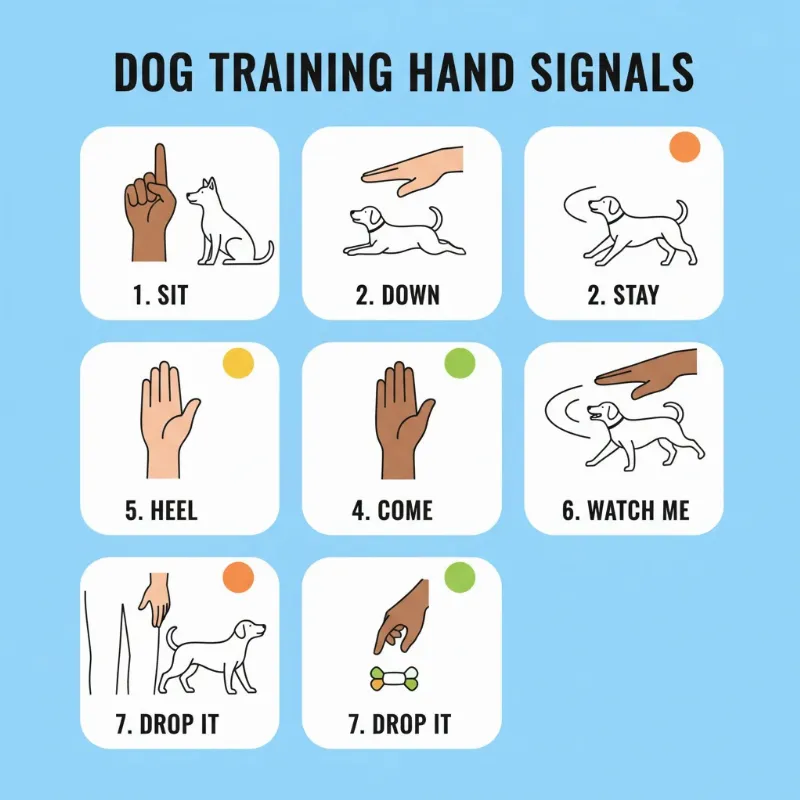 An infographic showing a diverse set of hands demonstrating the 7 basic hand signals for dog training, with icons for sit, stay, come, and down.
Stay (The Impulse Control Builder)
- The Signal: Hold your hand out with your palm flat and facing your dog, like a “stop” sign.
- Why it’s important: This command is vital for safety. It teaches your dog impulse control and can prevent them from darting into a busy street or approaching an unknown dog.
Come (The Lifesaving Recall)
- The Signal: Start with your arm extended out to your side, then sweep it in towards your chest or shoulder.
- Why it’s important: A reliable recall is non-negotiable for any dog owner. This signal can bring your dog back to you, keeping them safe from potential dangers.
Heel (The Loose-Leash Walk Enhancer)
- The Signal: Gently tap your thigh or hip on the side you want your dog to walk on.
- Why it’s important: This cue encourages your dog to walk politely by your side without pulling on the leash, making walks more enjoyable for both of you.
Drop It (The Safety Command)
- The Signal: Make a fist at chest level, then quickly open your hand with your palm facing down, as if you’re dropping something.
- Why it’s important: This command can save your dog from ingesting something harmful they’ve picked up off the ground.
How to Teach Hand Signals: A Step-by-Step Guide
Teaching hand signals is a straightforward process built on pairing, repetition, and positive reinforcement. The key is to be patient and consistent.
Step 1: Pair the Signal with a Known Verbal Cue
Start with a command your dog already knows well, like “Sit.” Ask for their attention. First, give the new hand signal, and then immediately follow it with the verbal cue they already know (“Sit”). The moment your dog sits, reward them with a treat and praise. Repeat this several times. The pattern is: Signal -> Word -> Action -> Reward.
Step 2: Lure and Reward
For new behaviors, you can use a treat to lure your dog into position while making the hand signal. For example, to teach “Down,” hold a treat in your hand and make the “Down” gesture, moving the treat from their nose to the floor between their paws. As they follow the treat into a down position, reward them.
Step 3: Fade the Verbal Cue
After many successful repetitions of pairing the signal and the word, it’s time to see if your dog has made the connection. Give the hand signal without saying the word. Be patient and give them a moment to process. The instant they perform the action, give them a jackpot of treats and lots of praise. This is a big moment! If they don’t respond, that’s okay—simply go back to Step 1 and practice a few more times before trying again. The journey of learning various dog training hand signals is about patience.
Step 4: Practice and Proof
Once your dog reliably responds to the hand signal in a quiet environment, it’s time to “proof” the behavior. Gradually start practicing in different locations with slightly more distractions—the backyard, a quiet street, and eventually a park. This generalization step teaches your dog that the signal means the same thing everywhere, not just in the living room.
Advanced Cues and Troubleshooting
Once your dog has mastered the basics, you can apply the same teaching principles to more complex or fun cues like “spin,” “roll over,” or “go to your mat.” The possibilities are endless.
If you find your dog is struggling, don’t get discouraged. The most common pitfall is inconsistency. Ensure your hand signals are always clear and distinct from one another. A sloppy “Sit” signal might look too much like your “Stay” signal, confusing your dog. Always be patient and end on a positive note. For those interested in a more structured approach, looking into akc hand signals for dog training can offer standardized cues used in formal obedience.
Remember that your entire body is part of the conversation. Your posture, eye contact, and energy all influence how your dog interprets your signals. Training with hand signals isn’t just about your hands; it’s about becoming a more conscious and effective all-around communicator.
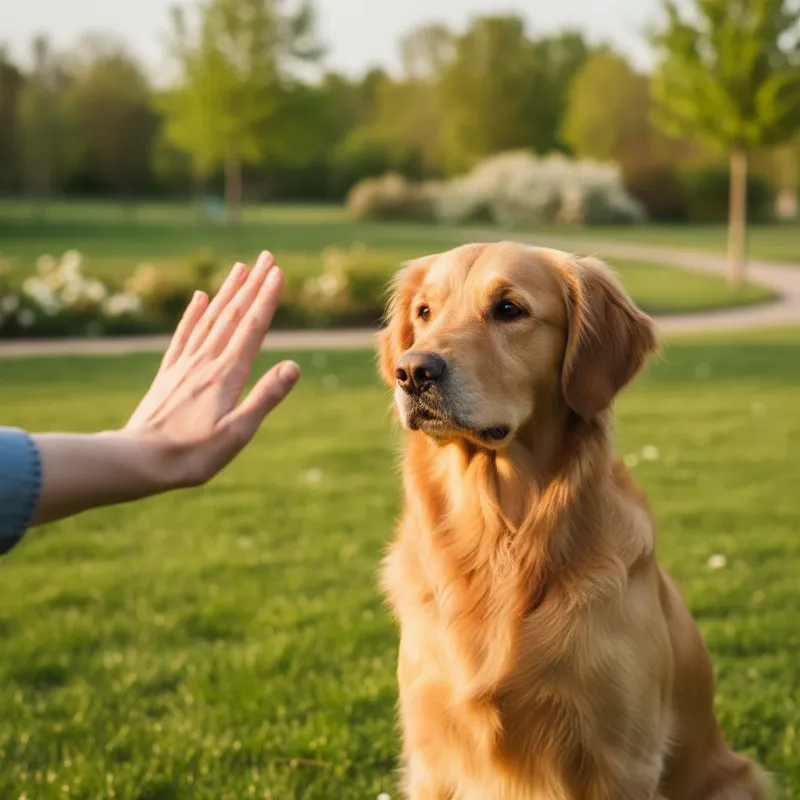 A golden retriever looking intently at its owner's outstretched hand giving the 'stay' signal in a sunny park.
Frequently Asked Questions (FAQ)
Can I teach an old dog new hand signals?
Absolutely! Dogs can learn at any age. While it might take a bit more patience, senior dogs are fully capable of learning hand signals. It’s also a fantastic way to keep their minds sharp and engaged.
What if my dog is not deaf? Are hand signals still useful?
Yes, they are incredibly useful for all dogs. They work in loud environments where a verbal command would be lost, allow you to communicate from a distance, and deepen your dog’s focus on you.
How long does it take to teach hand signals?
This varies greatly depending on the dog, the trainer’s consistency, and the complexity of the signal. Basic commands like “Sit” can be learned in just a few short sessions, while more complex cues will take longer. Consistency is more important than speed.
Should my hand signals be exactly like the standard ones?
No, the most important thing is that you are consistent. While using standard signals is helpful if others will be handling your dog, you can create your own signals as long as they are clear, distinct, and you use them the same way every time.
Can I use hand signals for puppy training?
Yes, it’s an excellent idea to start puppies with both verbal cues and hand signals from the beginning. They are like little sponges and will pick up on the visual cues very quickly.
What are the most important hand signals to teach first?
Start with “Watch Me” to build focus. After that, “Come” and “Stay” are arguably the most critical for your dog’s safety.
Do I always need to use treats?
Treats are a powerful tool for teaching a new behavior quickly. Once your dog knows the signal well, you can transition to intermittent rewards and use other things your dog loves, like praise, petting, or a favorite toy, to keep them motivated.
Conclusion
Embarking on the journey of hand signals dog training does more than just teach your dog obedience; it opens a new channel of communication and deepens the bond you share. It transforms training from a series of commands into a silent, intuitive dance built on mutual focus and understanding. By tapping into your dog’s natural ability to read body language, you create a more attentive, responsive, and connected companion. So start today, be patient, keep it positive, and watch as you and your dog learn to speak a beautiful, silent language all your own.
