
As a devoted pet owner and editor for “Dog Care Story,” I’ve spent years understanding the nuances of pet care, especially when it comes to our canine companions. Walking a dog should be a joyful experience, but for many, it can quickly turn into a test of strength and endurance, especially with a dog that pulls. This challenge became particularly evident in my own household after welcoming Chris and Danny, two strong Rottweiler and Rottweiler cross Dobermann adult males, to join our calmer Rottweiler, Mia. While Mia has always been a gentle walker, the boys, despite their training, often exhibit bursts of excitement and pulling, particularly during the initial minutes of a walk.
It’s a common scenario: you open the gate, and the world of enticing smells and sights becomes an irresistible magnet, momentarily overriding all polite walking manners. These brief, strong pulls, while usually self-corrected, made me seek a reliable solution to ensure maximum control and peace of mind. That’s why I was keen to review the HALTI No-Pull Harness and its accompanying Halti Lead. HALTI is a well-established brand with a solid reputation in the dog training and accessory market, leading me to believe this could be the answer for better-controlled walks. The promise of the HALTI No-Pull Harness, combined with a specialized lead, offered hope for more pleasant outings. If you’re looking for solutions to manage your dog’s pulling, the halti no pull harness is often a top consideration.
Does the HALTI No-Pull Harness Really Stop Pulling?
The short answer is yes, the HALTI No-Pull Harness can significantly help in managing a dog that pulls, but it’s not a magical fix. Its effectiveness hinges on several factors: proper fitting, consistent application of calm training techniques, and the handler’s familiarity with how to use it correctly.
Unlike a standard collar and lead setup, the HALTI harness is specifically engineered to deter pulling. Its design works to redirect your dog’s momentum and discourage forward pulling, making it a more effective tool for teaching calmer leash manners. If you’re dealing with a persistent puller, this harness will undoubtedly assist you in your training efforts, helping your dog learn to walk more serenely by your side. For dog owners who are frustrated with constant pulling and are seeking a practical aid, the HALTI No-Pull Harness is a worthwhile investment designed to facilitate more enjoyable and controlled walks.
In-Depth Look at the HALTI No-Pull Harness
The HALTI No-Pull Harness is offered in three sizes: small, medium, and large. For my boys, Chris and Danny, we received a large and a medium respectively. Both arrived in environmentally friendly, minimal packaging, which is always a welcome bonus. Overall, the harness feels like a well-constructed product. I particularly appreciate the thoughtful padding around the leg loops and the mesh material across the chest area, designed to ensure maximum comfort and safety for dogs during use. The harness features two points for lead attachment: one on the padded chest section and another on the back, situated around the middle of your dog’s spine.
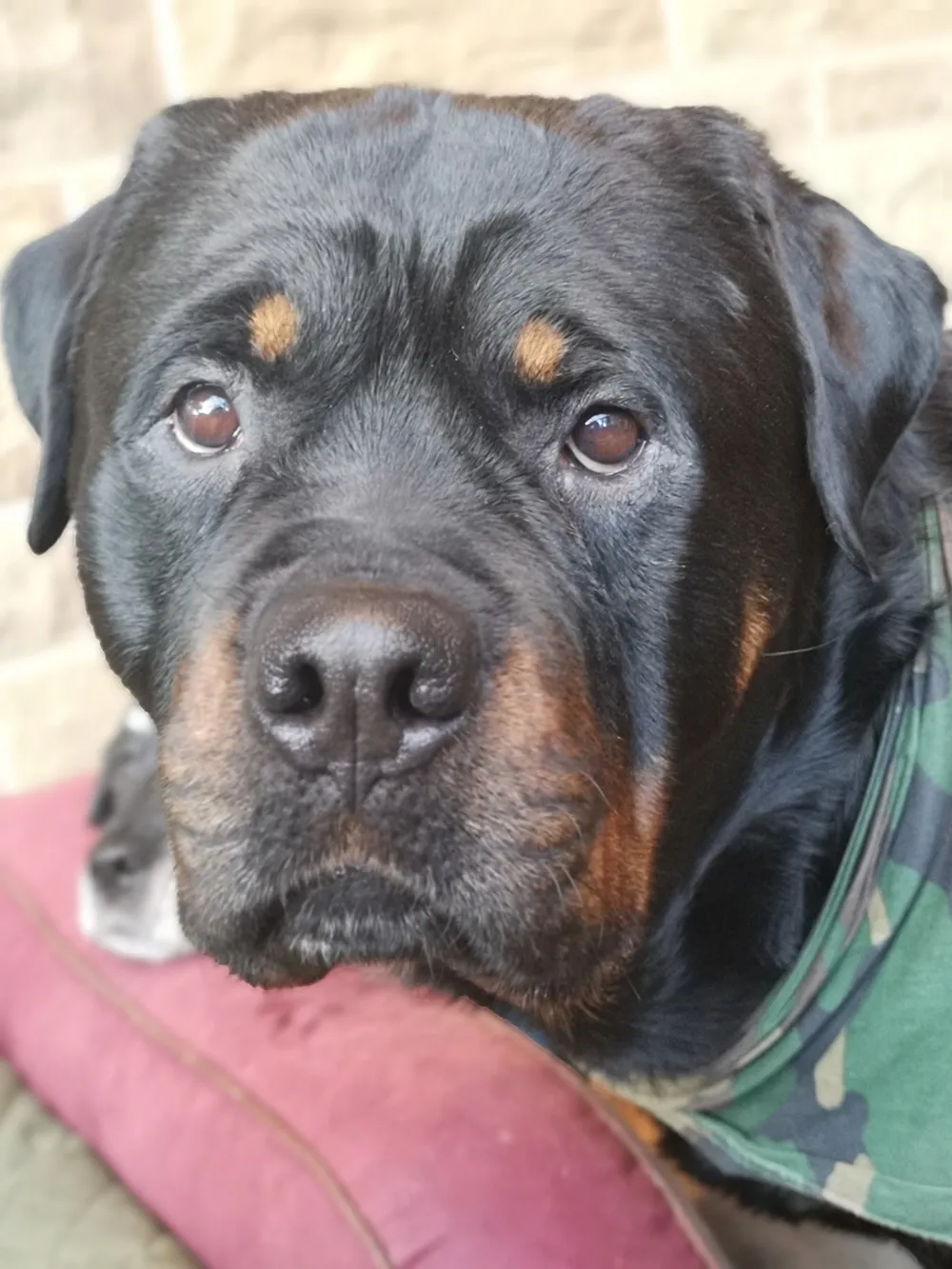 Chris, a Rottweiler, wearing the HALTI No-Pull Harness during a review.
Initially, understanding how to quickly and efficiently put on the harness proved to be a bit of a puzzle. My routine often involves getting one dog out for a walk before the others notice their absence, so a quick setup is crucial. Despite consulting the instructions, I found myself, and even my husband, struggling to grasp the correct method. It wasn’t until I inadvertently held the harness in a specific way that its logical placement around the dog’s legs became apparent. The main challenge stemmed from the chest pad, which, when the collar was placed over the dog’s neck, didn’t naturally align with the leg loops as expected.
Here’s the fitting method that worked best for me:
- Initial Placement: Spread the harness over your dog’s back, allowing the leg loops to fall naturally. Temporarily, the chest pad will be on the back. Then, secure the collar section around your dog’s neck.
- Repositioning: Rotate the harness so the chest pad is correctly positioned at the front, then guide your dog’s legs through the appropriate loops.
- Adjustment: Finally, adjust the neck size and other straps as needed to ensure a snug, comfortable fit without being too tight.
While I initially questioned my own dexterity, subsequent research into other reviews revealed that I wasn’t alone in finding the fitting process somewhat counterintuitive. Several users reported similar struggles with the leg loops and the inconvenience of fitting it quickly when an excited dog is eager to go for a walk. Despite these initial hurdles, once the HALTI harness is on, it appears to be comfortable for the dog. My walks with the boys often include long stretches at the park and games of football, so their comfort during activity is paramount. The HALTI harness has consistently proven to be comfortable for both walking and running. A quality no pull harness should always prioritize your dog’s comfort and safety.
The effectiveness of the HALTI No-Pull Harness lies in its “squeezing and lifting” mechanism. According to the brand, when a dog pulls on the lead, the harness gently tightens, which discourages pulling and helps guide them back into a controlled walking pattern. A sliding security cord lock is integrated into the design to prevent any over-tightening, ensuring the dog’s safety and comfort.
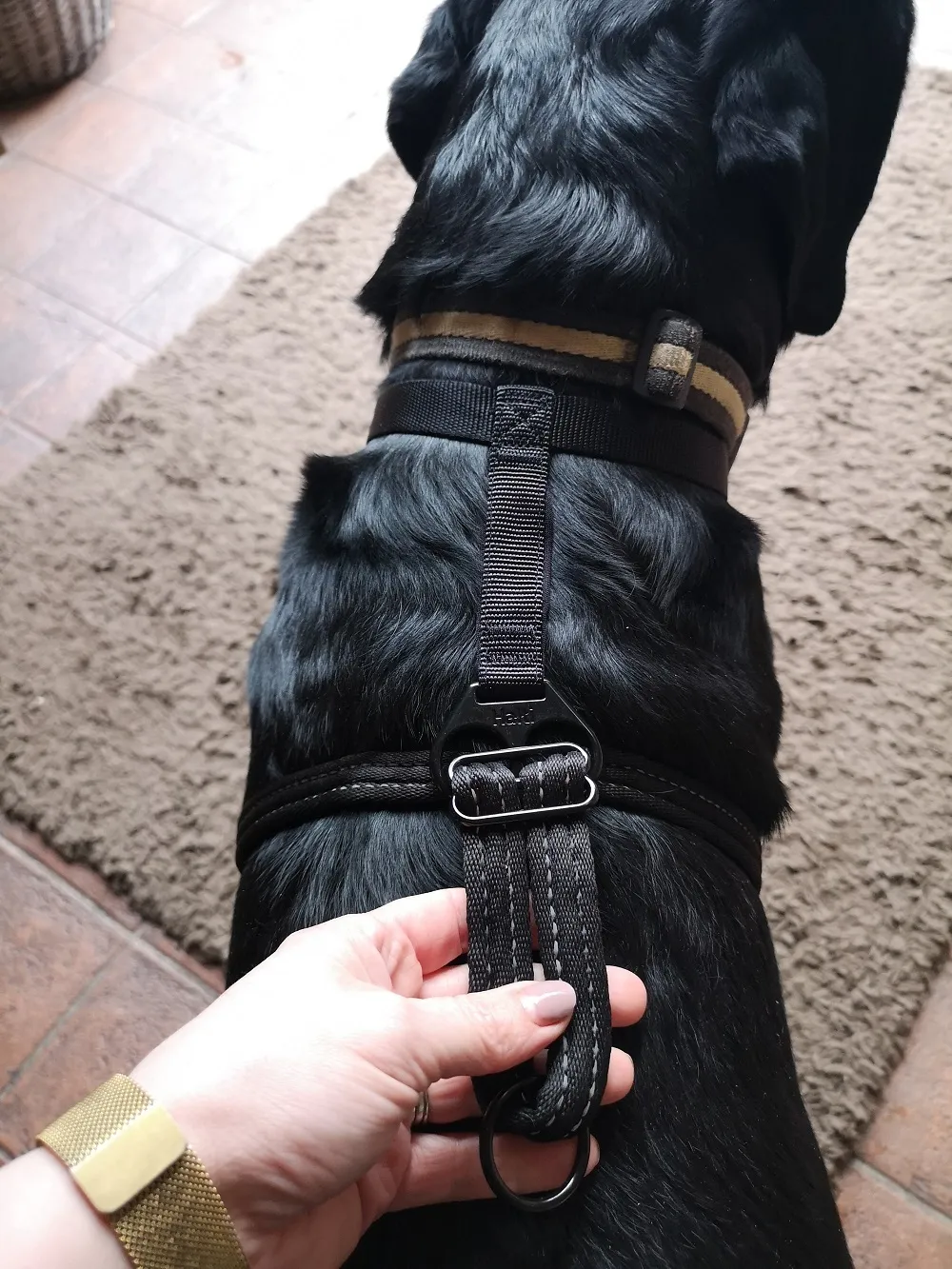 Danny, a Rottweiler cross Dobermann, wearing the HALTI No-Pull Harness.
One of the first things I did after ensuring the leg padding was correctly positioned was to adjust the sliding security lock, reducing the flexibility of the straps to activate the “squeeze and lift” effect. However, I observed that this adjustment frequently shifted during walks, especially with Chris. I would set it at the beginning of our walk, only to find it looser 10 minutes later, necessitating constant monitoring and readjustment. The inclusion of a simple toggle or a more secure locking mechanism to prevent this movement could significantly improve the user experience and maintain consistent effectiveness.
Reviewing the HALTI Double-Ended Lead
Alongside the harness, we also received two HALTI double-ended leads, one for each dog. These leads were sent to us in black and a vibrant red, with other striking color options like blue and purple also available. A noticeable enhancement in the design is the new style of metal clip, which HALTI claims offers added security – a crucial feature for any dog owner. Furthermore, the leads boast a reflective strip woven into one of their outer edges, significantly enhancing visibility during early morning or late evening walks in dim light conditions, and they are also conveniently machine washable.
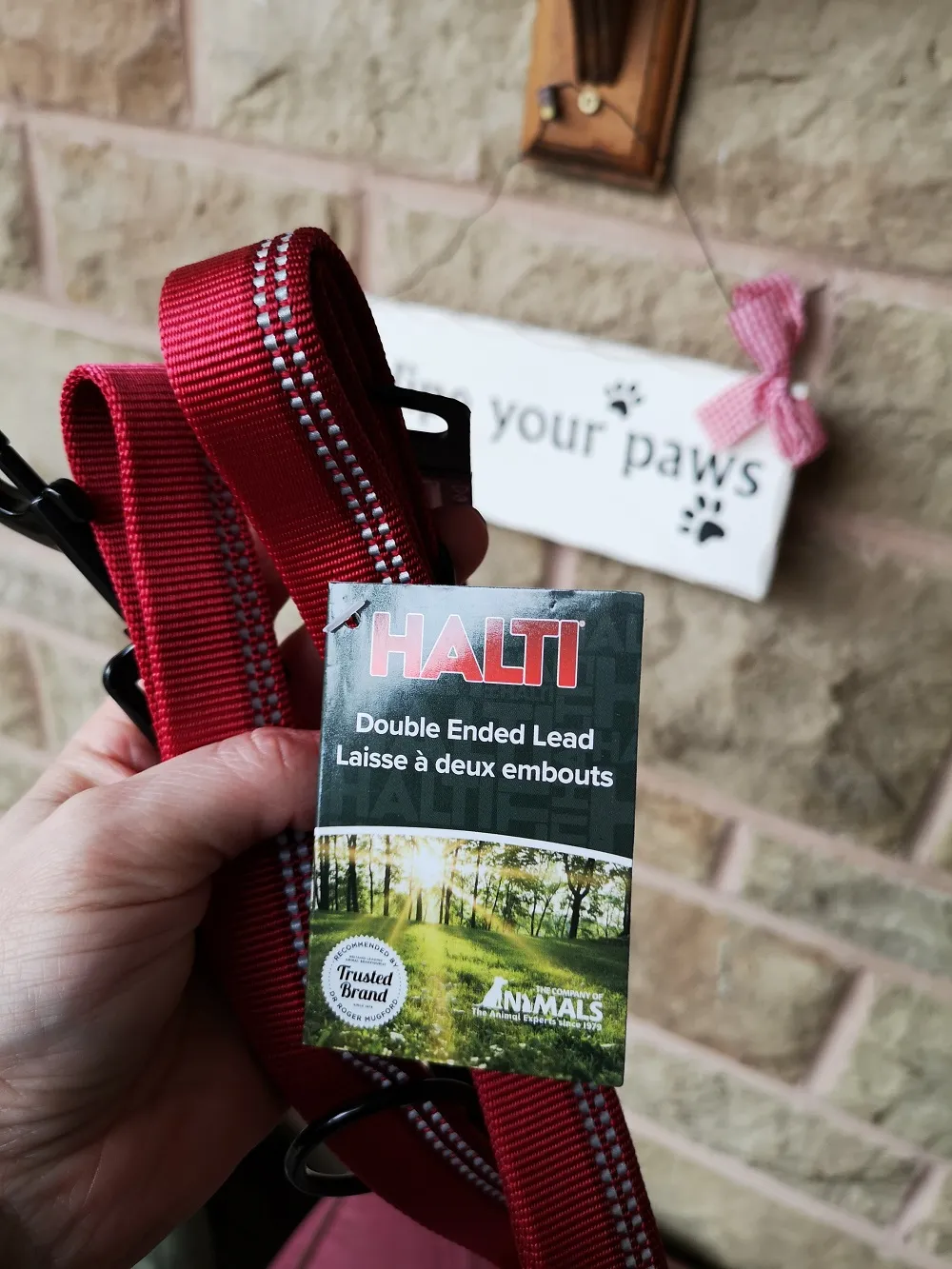 Close-up of the HALTI Double-Ended Lead's reflective strip and metal clip.
However, the primary issue I encountered with the HALTI lead was its considerable length. At around 5 feet tall myself, and even my taller husband agreeing, the lead felt excessively long. Despite having multiple metal hoops designed to shorten it, even at its shortest, essentially halved, it remained much longer than what I would consider a practical “short/road length” as described in the instructions. This excessive length meant I often had to wrap the lead four or five times around my hand, which made it quite slippery and less secure to hold.
The lead is advertised as having eight different ways it can be used, offering versatility for various walking scenarios. However, due to its unwieldy length, I found it challenging to fully benefit from these different configurations. Furthermore, the tethering option, which allows you to secure your dog temporarily, is something I would personally avoid using as described, especially given the current concerns regarding increased dog thefts. For those seeking specialized gear for powerful dogs, understanding the nuances of a dog harness for pulling is essential.
One of the suggested uses is to clip both ends of the double-ended lead into both hoops on the HALTI harness. When I attempted this, it created an incredibly awkward walking experience for my dogs. Danny, in particular, outright refused to walk with this setup. Seeking advice, I consulted our local vet nurse, who confirmed they stock HALTI products. Even she seemed somewhat perplexed by this configuration, eventually suggesting that I simply use the back clip and twist the excess lead around my hand, effectively bypassing the dual-clip functionality.
Balancing Control and Comfort: The HALTI Experience
HALTI products are generally well-priced within the market, often more affordable than comparable alternatives. This cost-effectiveness alone might make them an appealing option for dog owners seeking enhanced control over a pulling dog, regardless of their size or strength. In my experience, and perhaps influenced by a degree of psychological reassurance, the HALTI No-Pull Harness did seem to subtly reduce pulling during moments of heightened excitement. While I can’t definitively quantify its impact, it undeniably provided me with greater peace of mind and confidence that I possessed additional control to counteract my dogs’ formidable strength when necessary, even if the actual reduction in pulling was marginal.
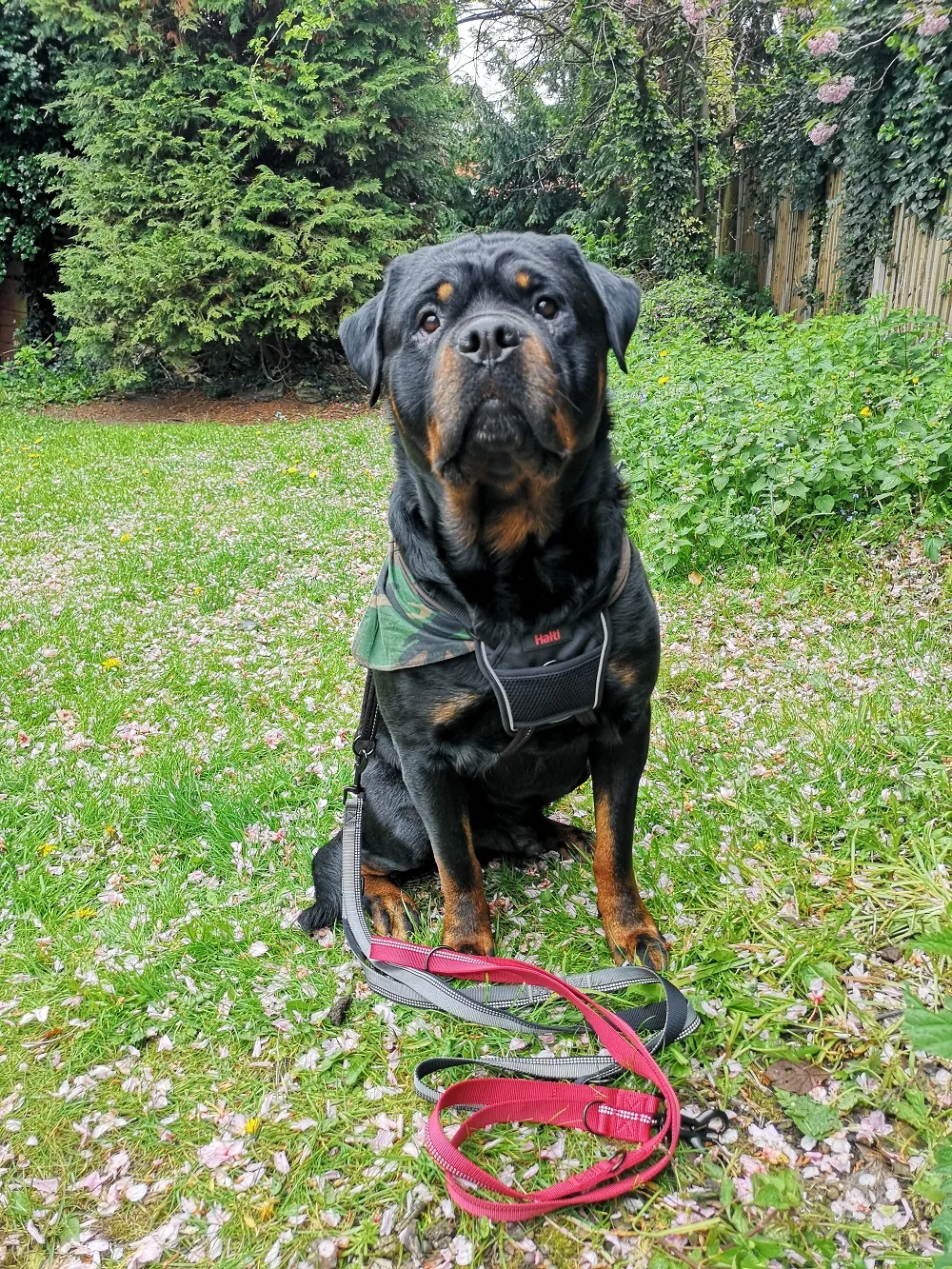 HALTI No-Pull Harness and Double-Ended Lead displayed together on a grassy surface.
It’s a significant decision to switch to new safety equipment for your dog, as their well-being is paramount. The option to personalize the harness with custom patches, featuring unique designs, colors, or your dog’s name, is a nice touch for those who wish to make their gear distinctive. However, the core functionality and safety aspects remain the most critical considerations.
Conclusion
In summary, the HALTI No-Pull Harness presents a compelling solution for managing dogs that pull, offering a design that, with proper fitting and consistent training, can lead to more controlled and enjoyable walks. Despite some initial challenges with understanding the fitting instructions and the recurring issue of the sliding security cord loosening, its comfort for the dog and its perceived effectiveness in reducing pulling make it a worthwhile consideration for many dog owners. The harness provides a sense of added security and control that can significantly boost a handler’s confidence during walks.
Conversely, the HALTI Double-Ended Lead, while featuring good quality materials and practical elements like reflectivity and washability, falls short due to its excessive length. This characteristic severely compromises its usability and the practicality of its various configurations, making it cumbersome to handle. While the harness may earn a permanent place in my dog-walking arsenal for its ability to provide an extra layer of control, the lead, unfortunately, is likely to be set aside in favor of other alternatives that offer similar functionality without the impractical length. For dog owners grappling with pulling issues, exploring the HALTI No-Pull Harness is recommended, but consider pairing it with a lead that better suits your handling preferences.
