
Working with a gun dog in the field is a partnership built on trust, communication, and split-second obedience. For many handlers, achieving that seamless off-leash reliability requires a tool that bridges the distance between them and their dog. This is where Gun Dog Training Collars, often called e-collars, come into play. Forget the outdated myths of “shock collars”; modern training collars are sophisticated communication devices designed to refine commands, ensure safety, and build a more responsive hunting companion. When used correctly, they are not tools of punishment, but of clear and consistent conversation.
This guide will walk you through everything you need to know, from how these collars work to choosing the right one and implementing it humanely and effectively into your training regimen. Proper use of these tools can elevate your training, making your field work safer and more successful. For a complete setup, consider pairing your collar with other essential hunting dog training equipment to ensure you’re prepared for any scenario.
What Exactly Are Gun Dog Training Collars?
At its core, a gun dog training collar is a remote training system. It consists of a wireless remote held by the handler and a receiver worn on the dog’s collar. It allows you to provide instant, clear feedback to your dog from a distance—whether they are holding steady in a blind, quartering a field, or tracking a downed bird hundreds of yards away.
The term “shock collar” is largely a relic of the past, referring to older, cruder devices that offered only a single, high level of static correction. Today’s e-collars are vastly different.
“Modern e-collars offer a spectrum of stimulation that allows for nuanced communication. We’ve moved from a sledgehammer to a scalpel. The goal is to use the lowest possible level to get the dog’s attention, essentially a ‘tap on the shoulder’ from a distance, not to cause pain.” – Dr. Mark Jennings, Canine Behaviorist
These systems are designed to reinforce commands your dog already knows. They are not for teaching new behaviors but for ensuring reliability when distractions are high and distance is a factor.
How Do Modern E-Collars Work?
Contemporary gun dog training collars operate on a principle of layered communication. Most high-quality models offer three distinct modes, accessible via the remote transmitter.
- Tone: An audible beep that can be used as a marker, a warning, or a positive signal, much like a clicker. For instance, you can condition a dog to understand that the tone means “good job, keep doing that” or “look to me for the next command.”
- Vibration: A vibration similar to a silent cell phone alert. This is an excellent non-static way to get a dog’s attention, especially for sensitive dogs or for correcting a minor infraction without breaking their focus.
- Static Stimulation: This is the most misunderstood feature. Modern collars offer a wide range of stimulation levels, often from 1 to 100. The lowest levels are barely perceptible to a human hand but are enough to get a dog’s attention. The correct working level is one that your dog feels but that doesn’t cause a vocal or fearful reaction. It’s a tool for emphasis, not intimidation.
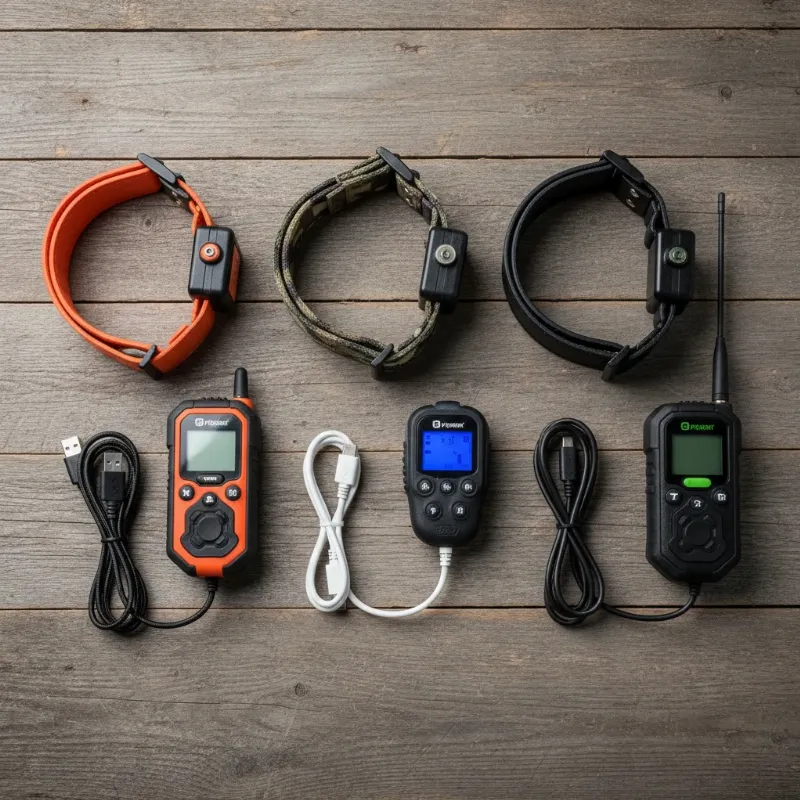 A collection of modern gun dog training collars with remote transmitters, showcasing their sleek design and various button configurations.
Choosing the Right Gun Dog Training Collar
Selecting the right collar is crucial. The market is filled with options, but focusing on the specific needs of a working gun dog will narrow your choices. Look for features that support the demanding environment of hunting.
Key Features for a Gun Dog Collar
- Range: The effective range of a collar can vary from a few hundred yards to over a mile. Consider your typical hunting environment. A waterfowl retriever working in a marsh may not need the same range as a big-running pointer in open prairies. Always choose a collar with more range than you think you’ll need, as terrain and weather can affect the signal.
- Waterproofing: This is non-negotiable for any gun dog, especially retrievers. Ensure both the collar receiver and the remote transmitter are fully waterproof and submersible, not just “water-resistant.”
- Durability: The collar will be exposed to mud, thick brush, and extreme temperatures. Look for rugged construction and high-quality materials like Biothane for the collar strap, which resists moisture and odors.
- Battery Life: Long-lasting, rechargeable lithium-ion batteries are the standard. You need a system that can last a full day in the field without needing a charge. Many models feature rapid-charge capabilities.
- Multiple Stimulation Levels: A quality collar will have at least 20 levels of stimulation, with many offering over 100. This allows you to find the precise “working level” for your dog and make micro-adjustments based on the situation.
How to Properly Introduce and Use an E-Collar
The success of any e-collar training hinges on a proper introduction. Rushing this process is the single biggest mistake a handler can make. The goal is for the dog to associate the collar with positive training experiences, not pressure or punishment.
The Conditioning Phase (1-2 Weeks)
- Collar On, Fun On: For the first week or two, have your dog wear the e-collar (turned off) during all fun activities: meal times, walks, playing fetch, and praise sessions. The collar should be snug, with the contact points touching the skin on the side of the neck, not the trachea.
- Collar Off, Fun Off: When the fun activity is over, take the collar off. The dog quickly learns to associate the collar with positive things. During this phase, you should never activate the collar.
- Finding the Working Level: Start with the stimulation at level zero. With the dog on a leash in a low-distraction environment, press the button. Watch for any reaction—an ear twitch, a turn of the head, a change in expression. Increase the level by one increment at a time until you see this first, subtle sign of recognition. This is your dog’s working level. It should not be a yelp or a jump.
- Connecting Stimulation to Command: Now, overlay the stimulation with a command your dog knows perfectly, like “Here.”
- Give the verbal command “Here.”
- Immediately apply the low-level, continuous stimulation.
- Guide the dog toward you with the leash.
- The instant the dog starts moving toward you, release the button.
- Lavish the dog with praise and reward upon arrival.
The dog learns that they control the stimulation by complying with the command. It becomes a simple form of guidance. This conditioning process is fundamental and shares principles with other focused training programs, such as a dedicated 2 week dog training intensive.
 A handler using a remote while a focused gun dog, wearing a training collar, stands at attention in a golden field.
Common Mistakes to Avoid with Gun Dog Training Collars
An e-collar is a powerful tool, and with power comes responsibility. Avoiding these common errors will ensure your training is fair, humane, and effective.
- Using It for Punishment: The collar should never be used to punish a dog out of anger or frustration. Its purpose is to guide and reinforce known commands. Using high levels to stop unwanted behavior without proper conditioning will only create fear and confusion.
- Starting with Too High a Level: Always start at the lowest perceptible level. Using a level that is too high is overwhelming and counterproductive.
- Poor Timing: The feedback from the collar must be instantaneous. Correcting a dog even two seconds after the fact is too late; they won’t connect the stimulation to their action.
- Becoming a “Remote Nag”: Don’t just press buttons. The collar should supplement your verbal commands and body language, not replace them. Your primary connection is always your voice and relationship.
- Using It to Teach New Commands: The collar reinforces what the dog already knows. Teach commands like “Sit,” “Stay,” and “Heel” with positive reinforcement methods first. The collar comes later to ensure reliability at a distance. Just like you need specialized dog training launcher dummies for retrieving, you need a foundation of knowledge before introducing advanced tools.
Frequently Asked Questions (FAQ)
Are gun dog training collars safe and humane?
When used correctly by a knowledgeable handler, modern e-collars are both safe and humane. The key is proper introduction, using the lowest effective stimulation level, and pairing it with positive reinforcement. They are communication tools, not punishment devices.
At what age can I start using a training collar on my gun dog?
Most professional trainers recommend waiting until a dog is at least 6 months old and has a solid foundation of basic obedience commands. The dog should be mentally mature enough to understand the connection between the stimulation and the command.
Will a training collar make my dog afraid of me?
No, if introduced properly. The conditioning phase is designed to create a positive association with the collar. The dog learns to turn off the low-level stimulation by complying with a command, which is an empowering experience. The fear and anxiety often associated with e-collars stem from improper use, such as using it as punishment or starting at too high a level.
Can I use the collar on more than one dog?
Many systems are expandable, allowing you to control multiple dogs from a single remote. Each dog will have its own collar receiver, and the remote can be switched to control each one independently. This is ideal for handlers who run more than one dog in the field.
What is the difference between momentary and continuous stimulation?
Momentary stimulation delivers a single, brief pulse of static, regardless of how long you hold the button. It’s like a quick tap. Continuous stimulation delivers a pulse for as long as you hold the button (usually with an automatic safety shut-off after 8-10 seconds). Continuous is most common for teaching as it allows the dog to “turn off” the pressure by complying.
Do I need other training tools with an e-collar?
Absolutely. An e-collar is just one of many gun dog training accessories in your toolbox. You will still need leashes, check cords, bumpers, and a solid positive reinforcement strategy built on praise and rewards. A holistic approach to how to train a dog for hunting integrates various tools and techniques.
Conclusion: A Tool for Communication and Safety
Ultimately, gun dog training collars are about enhancing communication and ensuring safety. They provide a reliable way to guide your dog’s decisions when they are beyond the reach of your voice or a leash. By investing the time to understand the tool, choose the right model, and introduce it with patience and positive reinforcement, you can forge a stronger, more dependable partnership with your canine hunting companion. The result is a confident dog that understands its job and a handler who can trust their partner to perform safely and effectively in any situation.
