
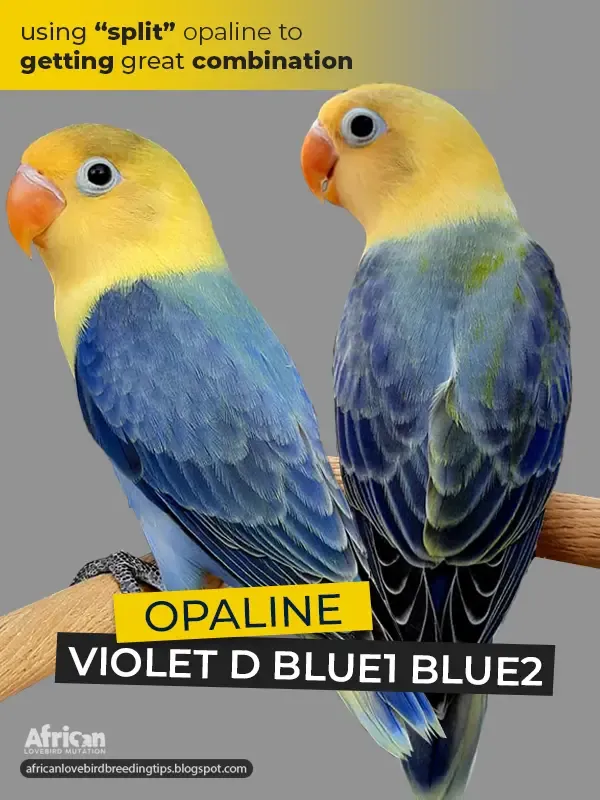
Opaline is a highly sought-after mutation among lovebird enthusiasts, appealing to both novice and experienced breeders. This article delves into the fundamental knowledge and distinct characteristics of opaline split lovebirds, providing clarity on their genetics and appearance. Understanding these traits is crucial for successful breeding and expanding your lovebird collection.
The inheritance pattern of the opaline mutation is sex-linked recessive. This can be more complex to grasp for those new to avian genetics, particularly when distinguishing between opaline and “split” opaline birds.
Sex-Linked Recessive Inheritance in Agapornis Fischeri Opaline
“Sex-linked recessive” describes a genetic trait located on the sex chromosomes. For this trait to be expressed, an individual must inherit two copies of the recessive gene. In the context of sex-linked recessive mutations, the gene resides on the X chromosome. Its effects are observable in males possessing one copy of the recessive gene on their X chromosome, and in females possessing two copies.
The term “split” refers to lovebirds that have inherited only one copy of the recessive opaline allele from a parent. Visually, these birds appear phenotypically normal, meaning they do not exhibit the opaline coloration.
In genetic notation, the symbol ” / ” is used to denote a “split” gene. Throughout this article, this symbol will signify the presence of a split gene.
When comparing sex-linked recessive mutations to autosomal recessive mutations, a key difference emerges. In autosomal recessive inheritance, crossing a mutant with a normal bird can result in both male and female chicks displaying the mutant trait or appearing normal.
However, with sex-linked recessive mutations, only male chicks can be “split” for the trait, while female chicks will definitively display the mutant coloration.
For instance, a cross between an opaline and a normal green lovebird typically yields green/opaline males and green opaline females.
Similarly, when working with “split” birds in sex-linked mutations, such as crossing a green/opaline male with a normal green female, the offspring will include green/opaline males and green opaline females.
It is important to note that even if a green phenotype appears to lack the opaline gene, it may still carry it. If a bird does not inherit a copy of the opaline allele from its parents, it is considered a normal green.
Identifying Opaline Split Lovebirds by Phenotype
Visual identification of opaline split lovebirds can be aided by examining specific feather patterns. A comparison between wild-type tail feathers and those of a green/opaline bird can reveal differences. Wild-type green lovebirds, particularly those without the opaline gene, often have narrower red patterns on their tail feathers. In contrast, green/opaline individuals may exhibit a wider red pattern on their tail feathers, especially in the red patches. Some green opaline birds display entirely red tail feathers with a black stripe.
However, relying solely on visual cues for tail feather patterns is not a foolproof method to confirm a “split” opaline status. Definitive conclusions often require breeding tests to ascertain the genetic makeup of the birds. For young chicks where sex determination is uncertain, DNA sexing can provide a reliable answer.
Achieving Combinations of Opaline Mutations
To achieve specific opaline color combinations, a combination of genetic factors, including variations in blue coloration (Bleu1Blue2), the presence of a Violet Factor, and the opaline mutation itself, is necessary. When working with split opaline birds, several crossover configurations can be employed. These often involve crossing a male with a specific genetic makeup, such as Green/Opaline/blue1, with a female possessing different color factors, like Blue1Blue2 SF Violet. Numerous other crossover configurations exist, provided they incorporate the aforementioned genetic combinations.
A thorough understanding of what a “split” gene signifies and how it functions within the opaline mutation can lead to significant savings in both time and financial resources during breeding.
When purchasing “split” birds, it is paramount to establish trust with the seller or breeder. If any doubts arise regarding the seller’s credibility, it is advisable to forgo the transaction immediately.
References
- Opaline Lovebirds Genetics.
- Sex-Linked Mutations in Birds.
- Lovebird Color Mutations Explained.
