
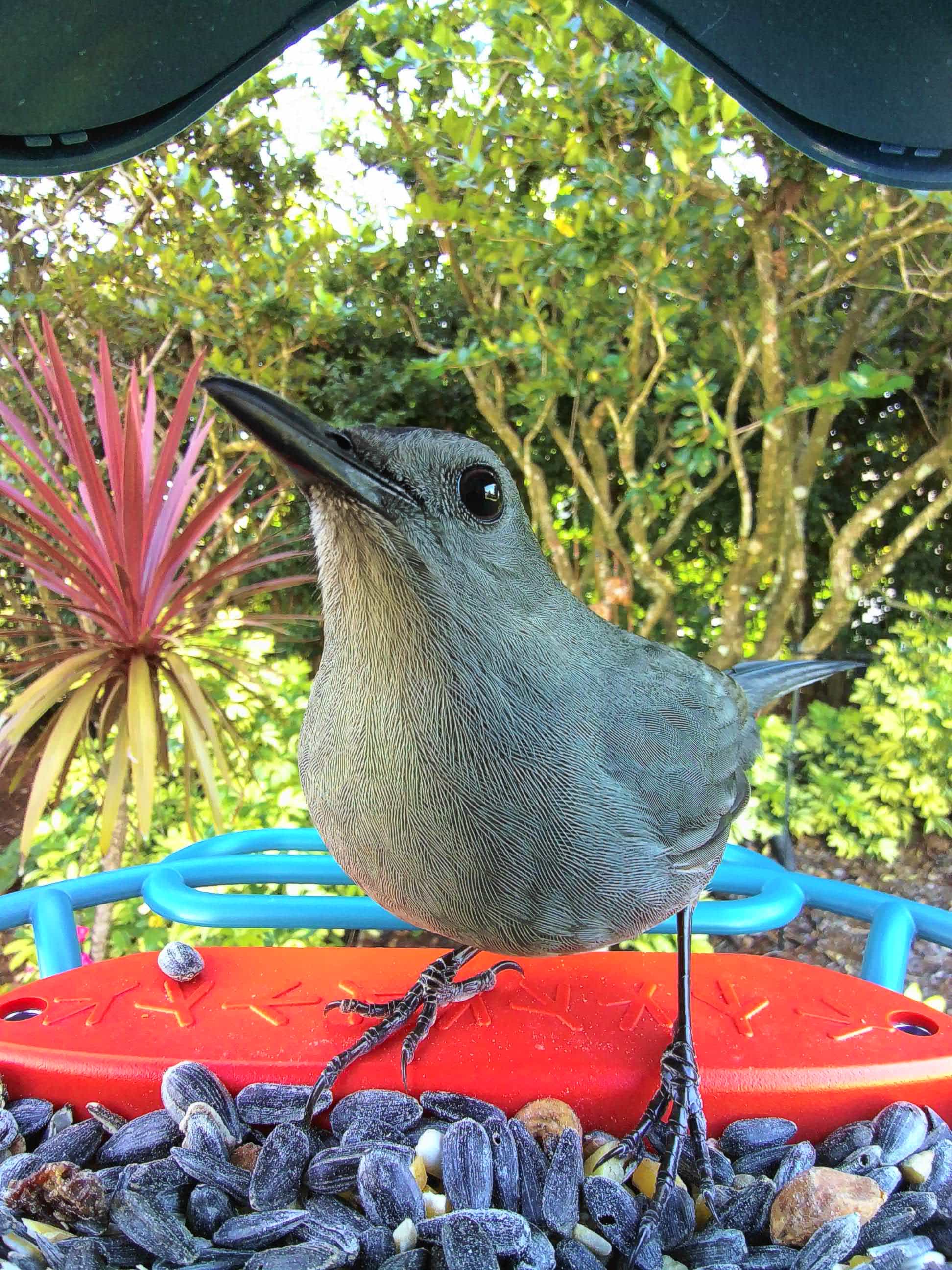
The Gray Catbird (Dumetella carolinensis) is a medium-sized songbird native to the Nearctic region, known for its distinctive “mew”-like call and its adaptability to various habitats. This guide delves into the fascinating world of the Gray Catbird, exploring its geographic range, preferred habitats, physical characteristics, reproductive strategies, behavioral patterns, dietary habits, ecological roles, and its complex relationship with humans.
Geographic Range and Habitat
Gray Catbirds breed across north, central, and eastern parts of the United States, extending into south-central and western Canada, including provinces like British Columbia, Alberta, Saskatchewan, and Manitoba. During winter, they migrate to the southeastern United States, the east coast of Mexico, and the Caribbean Islands.
These adaptable birds thrive in dense thickets of shrubs and vines within woodlands. They are also commonly found in residential areas, forest edges, clearings, roadsides, fencerows, abandoned farmlands, and along streams. Their habitat preference leans towards areas with minimal conifer trees, favoring a more deciduous environment.
Physical Description
Adult Gray Catbirds are characterized by their dark gray plumage, a striking black cap, and black tail feathers. A notable feature is the chestnut patch located underneath the tail coverts. While generally uniformly gray, subtle regional variations exist, with eastern populations often appearing darker than their western counterparts.
Physically, they possess short, rounded wings and a long, rounded tail. Their bill, eyes, feet, and legs are all black. Gray Catbirds typically measure between 21 to 24 cm in length and weigh between 23 to 56 grams. A key aspect of their biology is sexual monomorphism, meaning males and females are visually indistinguishable. Chicks are born covered in downy brown or dark gray feathers.
Reproduction and Lifespan
Gray Catbirds are monogamous, forming breeding pairs shortly after arriving at their breeding grounds in the spring. The breeding season typically spans from April to early August, during which they usually raise two broods.
The female constructs a bulky, open nest, usually situated low to the ground (within 2 meters), using twigs, scraps, and even paper. She then lays one to five turquoise-colored eggs, measuring approximately 17 mm by 24 mm. The incubation period lasts for 12 to 14 days.
Upon hatching, the young are altricial, meaning they are born in a highly underdeveloped state and are dependent on their parents for survival. Both male and female parents diligently feed the altricial young, whose diet consists solely of small invertebrates. To protect the vulnerable chicks from the sun, parents will perch on the nest rim, spreading their wings and fluffing their breast feathers. The young fledge (leave the nest) 10 to 11 days after hatching, and parental feeding continues for up to an additional 12 days. Gray Catbirds reach sexual maturity and can breed for the first time by the following summer.
The lifespan of a Gray Catbird can extend to nearly eleven years, with the oldest recorded individual living for ten years and eleven months.
Behavior and Communication
Gray Catbirds are diurnal, meaning they are active during the day, and are migratory. During both the breeding and winter seasons, breeding pairs exhibit territorial behavior. Males defend a small area around their nest during the breeding season, though they do not frequently return to the same breeding site in successive years. In winter, males and females maintain separate territories. For migration, Gray Catbirds congregate in flocks of 10 to 15 individuals, preferring to fly short distances between perches and avoiding wide, open spaces.
Communication in Gray Catbirds is multifaceted, involving visual cues and acoustic signals. Visual communication includes postural displays, such as how they hold their head or position their feathers. Their acoustic communication is particularly noteworthy. They are renowned for their characteristic “mew”-like song, which can be compared to the sound a domestic cat makes. However, their vocal repertoire is far more extensive, encompassing over 100 different sounds, including whistles, harsh chatters, and squeaks. Remarkably, they are skilled mimics, capable of imitating other birds, tree frogs, and even mechanical sounds. This impressive vocal ability stems from the unique structure of their syrinx, which allows both sides to operate independently, enabling them to sing with two voices simultaneously. Gray Catbirds are also known to engage in vocal duets.
Diet and Predation
As omnivores, Gray Catbirds forage primarily in treetops and on the ground, consuming a diverse diet of insects and fruits. Their insectivorous prey includes ants, beetles, flies, caterpillars and moths (such as gypsy moths), spiders, and aphids. They supplement their diet with small fruits from various plants, including genera like Myrica, Sassafras, Prunus, Cordea, and Trema.
Gray Catbirds face predation from a variety of animals. Their eggs and chicks are preyed upon by snakes, rats, foxes, domestic cats, squirrels, chipmunks, raccoons, blue jays, American crows, and common grackles. Adult catbirds are occasionally hunted by raptors, including red-tailed hawks, Cooper’s hawks, and peregrine falcons.
In response to perceived threats, Gray Catbirds exhibit aggressive behavior. They will flash their wings and tails at predators and emit “quirt” and “mew” calls. They may even directly attack and peck at predators that venture too close to their nest.
Ecosystem Roles and Human Interactions
Gray Catbirds play a significant role in their ecosystem as predators of insects, potentially helping to control populations of pest species like gypsy moth larvae. They also serve as a food source for their own predators. They are hosts to various ectoparasites, including lice, hippoboscid flies, and ticks.
Nests of Gray Catbirds are frequently targeted by brood parasites, such as the brown-headed cowbird. However, Gray Catbirds are among the few bird species that have developed the ability to recognize cowbird eggs and eject them from their nests. Even when cowbird eggs are not removed, cowbird chicks rarely survive to fledge from Gray Catbird nests.
Economically, Gray Catbirds offer positive benefits to humans by preying on insects that are often considered pests. They are particularly noted for their impact on controlling damaging moth and butterfly larvae. Conversely, they can also be viewed as a nuisance due to their consumption of cultivated fruits like blueberries and raspberries, making them a crop pest in some contexts.
Conservation Status
The conservation status of the Gray Catbird is generally considered common, with an estimated global population of 10 million individuals. Interestingly, human activities such as deforestation and subsequent regrowth can create the dense, scrubby habitats favored by these birds. However, habitat destruction due to agricultural expansion also poses a threat. While considered common, there have been recent observations suggesting a decline in their numbers. Gray Catbirds are protected under the U.S. Migratory Bird Act, ensuring their continued presence in the Nearctic region.
