
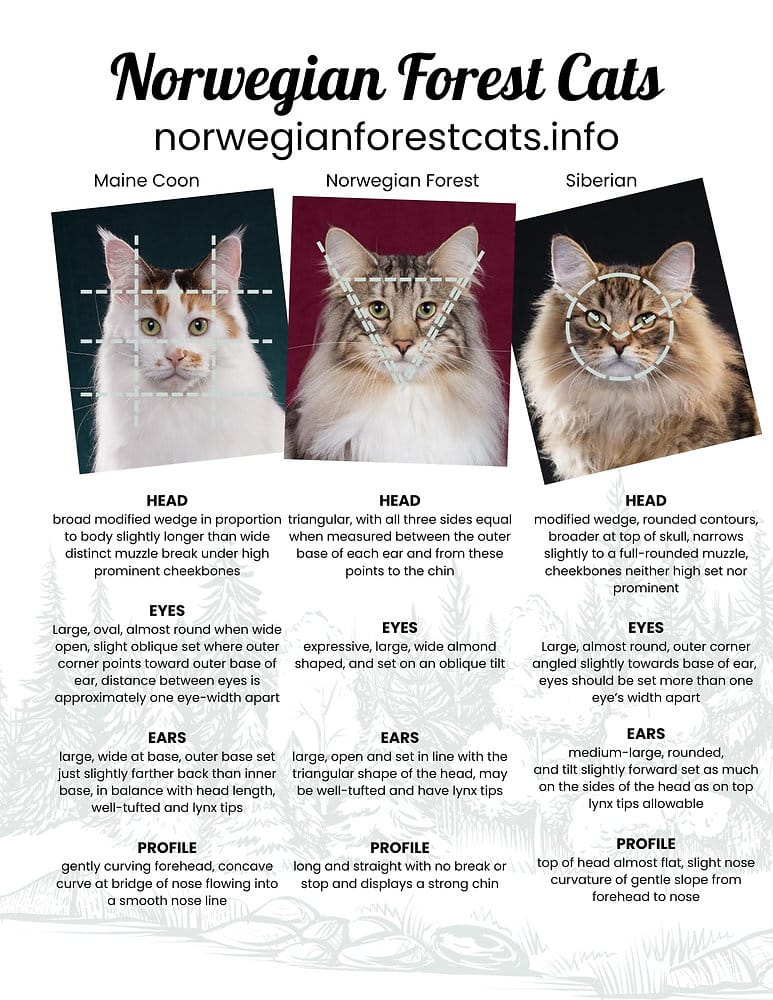
For many cat enthusiasts, distinguishing between the Maine Coon, Norwegian Forest Cat, and Siberian can be a delightful challenge. Often referred to collectively as “forest” cats due to their origins in wooded regions, these breeds share a majestic presence but possess unique characteristics that set them apart. This guide aims to provide a clear and concise comparison, helping you identify these magnificent felines with confidence.
Understanding the “Forest” Cat Lineage
The term “forest cat” broadly encompasses breeds that originated in heavily wooded areas, including the Maine Coon from the northeastern United States, and the Norwegian Forest Cat and Siberian from Northern Europe and Russia, respectively. While all three are known for their substantial build and impressive coats, subtle differences in head shape, body structure, and coat texture are key to identification.
The Maine Coon: A Rectangular Powerhouse
The Maine Coon is characterized by a distinctly rectangular head shape, often described as boxy, with a squared-off muzzle and a strong jawline. This gives the breed a robust and intelligent appearance, reminiscent of a lion. Its body is heavily boned, muscular, and the longest and largest of all pedigreed cats, further emphasizing its powerful physique. The Maine Coon’s coat is full, noticeably shaggy, and complemented by a long, flowing, plumed tail, completing its image of strength and length. Historically, Maine Coons are believed to have descended from cats that were essential for rodent control on ships and farms in Maine during the 19th century, with competitions even held to award the biggest and best mousers.
The Norwegian Forest Cat: The Elegant Triangle
In contrast to the Maine Coon’s rectangular features, the Norwegian Forest Cat, often called a “Wegie,” is defined by a wedge-shaped head. This triangular shape is so distinctive that it accounts for a significant portion of the breed’s standard points. The ears often follow the line of the head, creating a dramatic triangular effect. A straight nose profile, large almond-shaped eyes, and a prominent ruff under the chin further accentuate this unique head shape. While sturdy and strong, the Wegie’s body is moderate in length, built for harsh climates. Their coat is voluminous and dense, naturally water-resistant, and ideal for surviving Scandinavian winters. Tufts of fur between their toes help them navigate snowy terrain. The tail is broad at the base and bushy, equal in length to the body but distinct from the Maine Coon’s flowing tail. The Norwegian Forest Cat has a history intertwined with the Vikings, contributing to Norse mythology and possibly to the genetic makeup of the Maine Coon.
The Siberian: The Gentle Curve
The Siberian, Russia’s national cat, presents the most subtle distinctions and can be the most challenging to identify. Unlike the clear rectangular or triangular shapes of the other two breeds, Siberians are characterized by gentle curves throughout their build. Their head is a broad, modified wedge, but the muzzle is rounded rather than squared or sharply pointed. Large, soulful, almost round eyes contribute to a sweet expression that helps set them apart. The Siberian’s body is medium in length, with a slight arch to the back and a barrel-shaped torso. Their tail is typically slightly shorter than the body and tapers to a blunt tip. While the Norwegian Forest Cat’s coat may appear more voluminous, a mature Siberian’s coat is generally thicker and denser, featuring a true triple coat that, though difficult to discern, is a hallmark of the breed. Siberians are relative newcomers to the international cat show scene, gaining significant popularity in recent decades.
Testing Your Identification Skills
With these key differences in head shape, body structure, and coat characteristics, you should now be better equipped to identify the Maine Coon, Norwegian Forest Cat, and Siberian. Observing these distinctive features will not only enhance your appreciation for these breeds but also impress fellow enthusiasts. For further details on these and other breeds, resources like the Cat Fanciers’ Association (https://cfa.org/breeds/) offer comprehensive profiles. Discovering these magnificent “forest” cats is a rewarding journey for any cat lover.
