
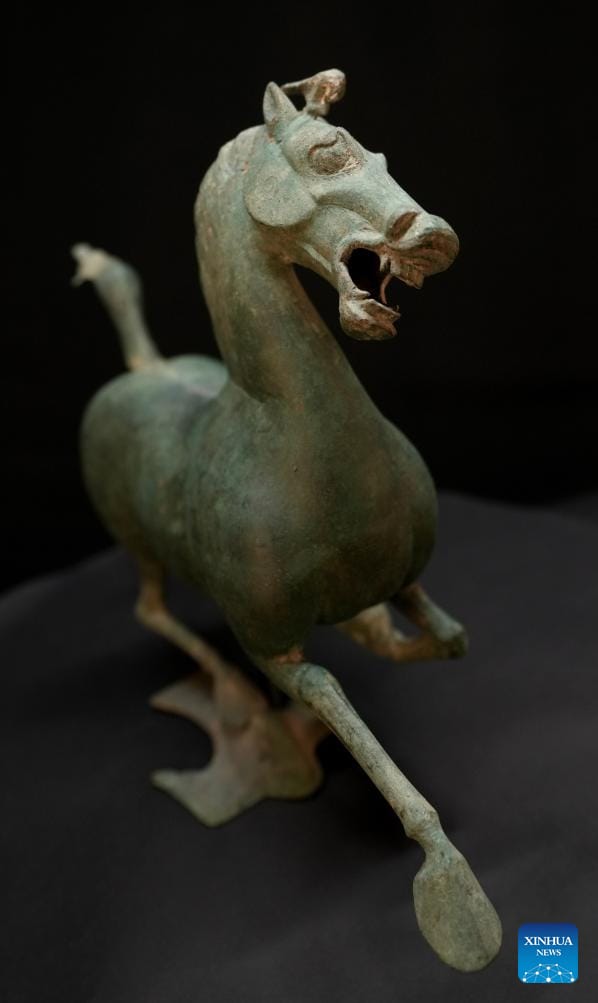
Imagine a horse moving with such impossible speed that it doesn’t stride upon the earth, but on the back of a bird in mid-flight. This is the breathtaking image captured forever in bronze by an unknown master craftsman nearly two thousand years ago. The Flying Horse Of Gansu Story is not just about a sculpture; it’s a tale of imperial ambition, artistic genius, and a chance discovery that unearthed one of China’s most iconic national treasures. This single object, known officially as the Galloping Horse Treading on a Flying Swallow, encapsulates the power and dynamism of the Han Dynasty and remains a powerful symbol of the nation’s enduring spirit.
Found in 1969, this bronze masterpiece has captivated the world with its perfect balance, vibrant energy, and profound symbolism. It speaks of heavenly steeds, the legendary Silk Road, and an era when the horse was the ultimate emblem of power and prestige. More than just an artifact, it is a frozen moment of poetry in motion, a testament to an artist’s ability to defy gravity and capture the very essence of speed. Join us as we uncover the incredible journey of this bronze steed, from its creation and burial to its rediscovery and rise to global fame.
The Accidental Discovery of a Buried Treasure
The story of the Flying Horse’s return to the world is as dramatic as its pose. In September 1969, amidst escalating border tensions with the Soviet Union, communities across China were instructed to prepare for conflict by digging air-raid shelters. In the village of Leitai, within the city of Wuwei in Gansu province, a group of farmers began their excavation. As they dug into a hillside, their tools struck not just earth, but the hard, hollow structure of a forgotten tomb.
They had stumbled upon a brick-chambered tomb that had lain undisturbed for nearly 1,800 years. Inside, they found a stunning collection of over 200 bronze artifacts, a miniature army to accompany its occupant into the afterlife. There were chariots, soldiers, and lanterns, but most spectacularly, a cavalry of 39 bronze horses. Among them was one that stood out, a masterpiece of unparalleled grace and dynamism: the Galloping Horse Treading on a Flying Swallow.
Archaeologists later identified the tomb as belonging to a General Zhang of Zhangye from the late Eastern Han Dynasty (25–220 CE). He was a military official tasked with defending this crucial section of the Hexi Corridor, a vital part of the Silk Road. The buried army of bronzes was a clear display of his status and the importance of cavalry in maintaining the empire’s borders. The local farmers who found it, perhaps unaware of its immense historical value, simply packed the figures into bags and took them home. It was only when word reached authorities that the true significance of the find was realized, and the artifacts, including the now-famous flying horse, were secured for the nation.
An Artistic and Engineering Marvel
To look upon the Flying Horse of Gansu is to witness a paradox. It is an object of immense weight and solidity that conveys an almost ethereal lightness. The sculpture, measuring 34.5 cm in height and 45 cm in length, is a marvel of both artistic vision and technical skill.
The horse is captured in a “flying gallop,” a posture where all four hooves are off the ground. Its body is arched forward, its head held high with an open mouth as if neighing with effort and spirit. The tail is elegantly knotted and flying high, adding to the sense of incredible velocity. But the true genius lies in its balance. The entire weight of the bronze horse is poised delicately on a single point: its right hind hoof, which rests gently on the back of a surprised swallow.
“The composition is a stroke of pure genius,” notes Dr. Alistair Finch, a historian specializing in Han Dynasty art. “To achieve this level of dynamic balance with cast bronze in the second century is an extraordinary feat of engineering. The artist didn’t just sculpt a horse; they sculpted the idea of speed. The swallow acts as both a physical pivot and a brilliant narrative device—the horse is moving so fast it’s out-pacing the birds of the air.”
The swallow itself is rendered with remarkable detail, its head turned back in what appears to be a look of astonishment. This clever interaction transforms the base of the statue into an integral part of the story, emphasizing the supernatural speed of the steed.
What is the Story Behind the Flying Horse of Gansu?
The statue is more than a beautiful object; it is a rich historical document that tells a larger story about the Han Dynasty’s power, its connection to the wider world, and its cultural values. The key to understanding its meaning lies in the type of horse it represents.
The Quest for “Heavenly Horses”
The horse is believed to be one of the “heavenly horses” (tianma), a prized breed from the Ferghana Valley in Central Asia (modern-day Uzbekistan, Tajikistan, and Kyrgyzstan). These horses were larger, stronger, and faster than the native Chinese breeds. Emperor Wu of Han launched major military campaigns in the 2nd century BCE specifically to acquire these magnificent animals for his cavalry, recognizing their critical importance in fighting the nomadic Xiongnu tribes to the north.
Owning a Ferghana horse was a massive status symbol, a sign of wealth, power, and connection to the imperial court. General Zhang, buried in the Leitai tomb, was showcasing his elite standing by having a whole bronze retinue of these powerful steeds accompany him to the afterlife.
A Symbol of the Silk Road
The very presence of a Ferghana horse in a tomb in Gansu is a testament to the Silk Road. The Hexi Corridor, which General Zhang was tasked to protect, was the bottleneck through which all trade, ideas, and culture flowed between China and Central Asia. The heavenly horses were one of the most valuable “imports” to travel this route. The sculpture, therefore, symbolizes the cultural exchange and imperial expansion that defined the Han Dynasty’s engagement with the world beyond its borders.
A National Symbol’s Enduring Legacy
After its rediscovery, the Flying Horse of Gansu quickly transitioned from an archaeological find to a national icon. Its fame was cemented when the influential historian and official Guo Moruo saw it during a visit to the Gansu Provincial Museum. Struck by its beauty, he championed it, leading to its exhibition both nationally and internationally in the 1970s.
The world was captivated. The sculpture’s image became synonymous with the rich history and artistic achievements of China. In 1983, it was officially adopted as the logo for the China National Tourism Administration, becoming an instantly recognizable symbol inviting the world to explore the country’s vast cultural heritage.
Today, the original Flying Horse of Gansu resides in the Gansu Provincial Museum in Lanzhou, where it is a centerpiece of the collection. In 2002, it was placed on the exclusive list of 64 grade-one cultural relics that are forbidden from ever leaving mainland China for exhibition. This designation underscores its immense cultural value and its status as an irreplaceable piece of China’s artistic legacy. The flying horse of gansu story continues to inspire, reminding all who see it of a golden age of art, power, and cultural fusion along the ancient Silk Road.
Frequently Asked Questions (FAQ)
What is the Flying Horse of Gansu?
The Flying Horse of Gansu is a bronze sculpture from China’s Eastern Han Dynasty (c. 2nd century CE). It depicts a galloping horse with one hoof resting on a flying swallow, celebrated for its artistic beauty and technical balance. It’s also known as the Galloping Horse Treading on a Flying Swallow.
When and where was the sculpture discovered?
It was discovered in 1969 by local farmers digging an air-raid shelter in a tomb at Leitai, located in Wuwei city, Gansu province, China. The tomb belonged to a Han Dynasty military general.
What does the Flying Horse of Gansu symbolize?
The sculpture symbolizes speed, power, nobility, and the enterprising spirit of the Han Dynasty. The horse is believed to be a “heavenly horse” from Ferghana, representing imperial power and the cultural exchange that occurred along the Silk Road.
Why is one hoof on a swallow?
The artistic choice of placing one hoof on a flying swallow is a metaphor for the horse’s incredible speed. It suggests the horse is moving so fast that it can overtake a bird in flight, creating a visual representation of an animal that outruns the wind.
Where can I see the original Flying Horse of Gansu?
The original sculpture is permanently housed in the Gansu Provincial Museum in Lanzhou, China. It is considered a national treasure and is prohibited from being exhibited outside of the country.
What is the horse’s pose called?
The pose is known as the “flying gallop,” where all four of the horse’s hooves are depicted off the ground simultaneously. This artistic convention brilliantly captures a sense of dynamic, forward motion.
What is the statue made of?
The Flying Horse of Gansu is cast from bronze, a popular and durable material for high-status objects during the Han Dynasty. The complete find in the tomb included over 200 bronze items.
Conclusion
The flying horse of gansu story is a remarkable journey through time. From its creation as a prized possession for a Han Dynasty general to its quiet repose for centuries and its dramatic rediscovery, this bronze statue is far more than an ancient artifact. It is a symbol of artistic innovation, a relic of the legendary Silk Road, and a timeless representation of power, grace, and the relentless spirit of forward motion. Its perfect, impossible balance on the back of a tiny swallow continues to capture the imagination, proving that true works of art can not only freeze a moment in time but can fly beyond it, carrying their stories and inspiring wonder for generations to come.
