
Preventative care is crucial for maintaining your dog’s health and happiness. A primary strategy for preventing potential health issues involves the consistent use of monthly flea and tick preventatives. This guide delves into the importance of flea and tick prevention, when to administer it, and factors to consider when choosing the right products for your canine companion.
The Importance of Flea and Tick Prevention
Fleas and ticks are external parasites that survive by feeding on their host’s blood. These bites can lead to a range of health problems for your dog, including allergic reactions, dermatitis, anemia, intense itching, and infections. Ticks, in particular, can transmit serious diseases such as Lyme disease, Rocky Mountain spotted fever, ehrlichiosis, and anaplasmosis, which can cause severe illness, paralysis, and even death. Furthermore, some of these diseases are zoonotic, meaning they can spread to humans, highlighting the necessity of controlling these parasites on your pet and in your home.
When Your Dog Needs Protection
Fleas and ticks are resilient parasites found in various environments. Given the significant health risks they pose to both dogs and humans, it is recommended to begin flea and tick prevention for your dog as early as 8 weeks of age. This preventative measure should be administered year-round to ensure continuous protection throughout your dog’s life.
Choosing the Right Flea and Tick Medication
A wide array of products are available to protect your dog from these pests, including pesticides, repellents, and insect growth inhibitors, each targeting different stages of the pest’s life cycle. While some products focus solely on fleas, combination preventatives are formulated with multiple active ingredients to combat various parasites. These comprehensive options may also offer protection against heartworms, skin and ear mites, and intestinal parasites.
For instance, Credelio Quattro offers extensive protection against six types of parasites: fleas, ticks, heartworms, roundworms, hookworms, and tapeworms.
Before selecting any flea and tick medication, it is essential to consult with your veterinarian to ensure it is appropriate for your dog. Always review the product label and discuss the following with your vet:
- Species Appropriateness: Confirm the product is designed for dogs, not cats.
- Weight Range: Ensure the product is suitable for your dog’s current weight.
- Parasite Coverage: Verify that it protects against the relevant parasites in your region.
- Administration: Understand if it should be given with food and the recommended dosage frequency.
- Efficacy Timeline: Know when the product begins to work and its duration of action.
- Bathing Restrictions: Be aware of how soon after application your dog can be bathed.
- Safety Concerns: Inquire about any potential adverse reactions and what to do in such cases.
Application Method
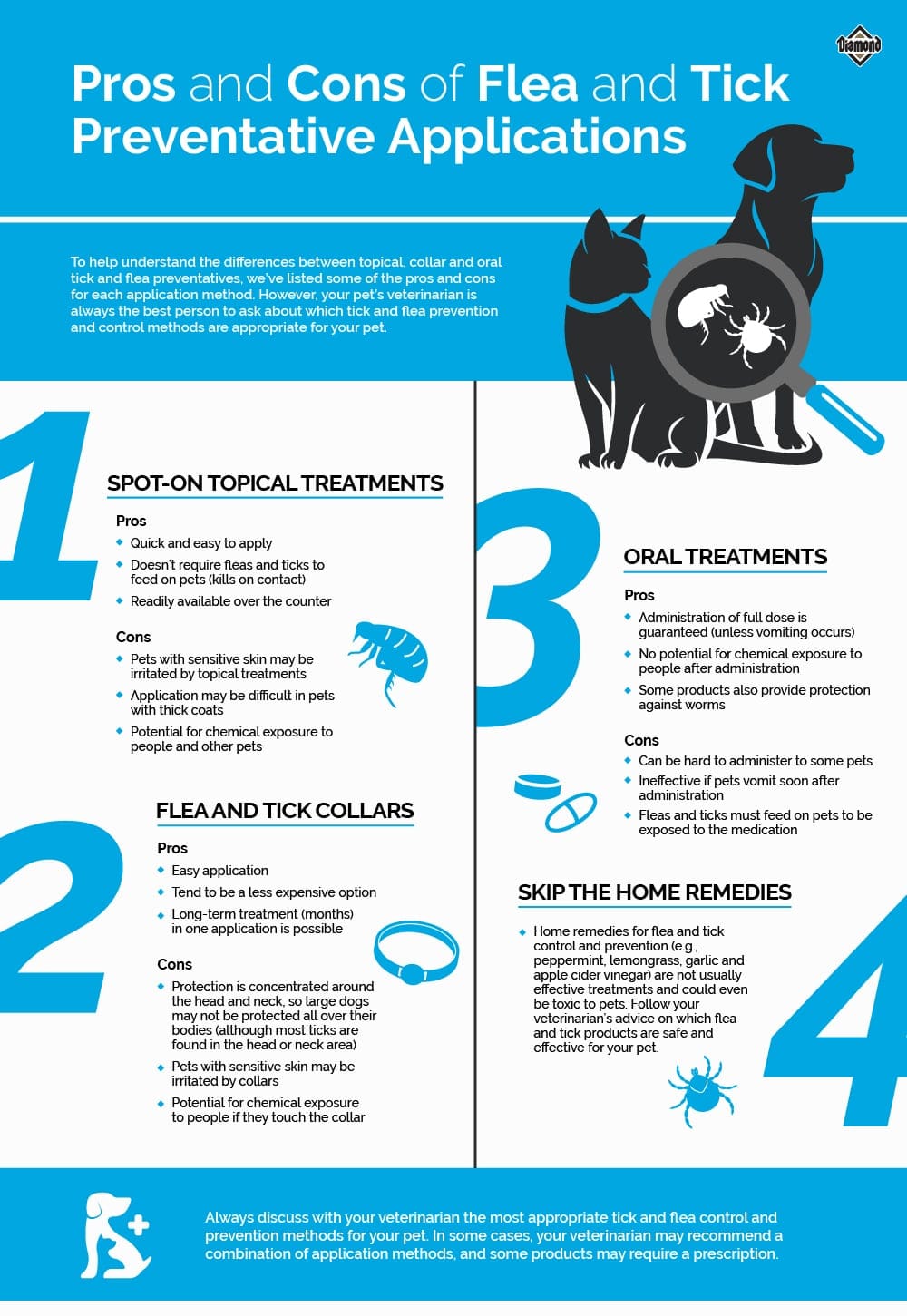
Flea and tick preventatives are available in two main forms:
- Oral: Chewable tablets that are ingested by the dog.
- Topical: Liquids applied to the skin, typically between the shoulder blades or along the back.
Topical treatments are a good choice for dogs with sensitive stomachs or picky eating habits. However, caution is necessary in households with young children or other pets to prevent accidental ingestion or licking before the product dries. Topical treatments may also be less effective for dogs that swim frequently or require regular bathing. Oral treatments, on the other hand, can be convenient, administered like a treat. It’s important to ensure your dog consumes the entire tablet to guarantee absorption.
Geographical Location
Parasite populations, including fleas and ticks, vary by region. The Companion Animal Parasite Council (CAPC) provides valuable resources to identify prevalent parasites in your area, helping you choose a preventative that offers adequate protection.
Outdoor Exposure
Consider the environments where your dog spends time. Areas like dog parks, hiking trails, wooded regions, and even backyards can harbor fleas and ticks. Dogs frequently exposed to these areas, or areas frequented by other animals, have a higher risk of infestation. Fleas can also be introduced indoors through screens, other pets, or even on clothing and shoes. Veterinarians generally recommend year-round prevention, regardless of your dog’s outdoor activity level.
MDR-1 Gene Mutation
Certain breeds, including Collies, Australian Shepherds, and Shetland Sheepdogs, may carry a gene mutation known as MDR-1. This mutation affects their ability to metabolize certain medications. While veterinarians often recommend testing for this gene mutation in susceptible breeds, many preventative manufacturers have confirmed the safety of their products for dogs with this mutation.
Lifestyle Factors
While no breed is inherently more susceptible to fleas or ticks, a dog’s lifestyle can influence their risk. Working, herding, and hunting dogs that spend considerable time outdoors may have a higher exposure rate compared to dogs that primarily stay indoors.
Life Stage and Size
For puppies or smaller dog breeds, consulting your veterinarian is crucial to select a product appropriate for their weight and age. Most flea and tick preventatives have a minimum age requirement of 8 weeks. Some products, such as Revolution Topical Solution for Kittens and Puppies, are specifically formulated for younger animals and can be used as early as 6 weeks of age.
Medical Conditions
Preventatives belonging to the isoxazoline class should be used with extreme caution in dogs with a history of seizures or neurological disorders, as they may increase the risk of breakthrough seizures. If your dog has experienced an allergic reaction to a medication, is underweight or ill, or is pregnant, nursing, or intended for breeding, any preventative should only be administered after a thorough discussion with your veterinarian.
Over-the-Counter vs. Prescription Flea and Tick Medicine
Flea and tick preventatives are available in both over-the-counter (OTC) and prescription formats.
Over-the-Counter (OTC) Products
OTC flea and tick preventatives do not require a veterinary prescription and are widely available online and in pet retail stores. However, it is still advisable to consult your veterinarian to confirm the safety and suitability of any OTC product for your pet.
Prescription Products
Prescription flea and tick medications typically offer greater efficacy and safety, though they may come at a higher cost. Most veterinarians recommend prescription options due to their proven effectiveness and targeted formulation.
Popular Flea and Tick Prevention Products for Dogs
Several reputable brands offer effective flea and tick prevention solutions:
Advantage
- Advantage II: A topical monthly treatment with imidacloprid and pyriproxyfen. It effectively kills fleas (eggs, larvae, adults) and chewing lice within hours but does not prevent ticks. Suitable for dogs and puppies over 7 weeks old and weighing more than 3 pounds.
- Advantage Multi: A topical monthly product containing imidacloprid and moxidectin. It treats fleas, sarcoptic mange, and various intestinal parasites (hookworms, roundworms, whipworms), and prevents heartworm disease. It kills fleas rapidly but may take longer for other parasites. It does not offer tick protection and is for dogs and puppies over 7 weeks old weighing more than 3 pounds.
Bravecto
Bravecto is available as a chewable tablet or topical solution containing fluralaner. It begins killing fleas within two hours and ticks within 12 hours, and is also effective against demodectic and sarcoptic mange, and ear mites. Due to its isoxazoline class, it should be used cautiously in dogs with a history of seizures.
Comfortis
Comfortis is a monthly chewable tablet with spinosad that targets fleas, killing them within 30 minutes. It is suitable for dogs and puppies 14 weeks or older weighing over 5 pounds and does not provide tick protection.
Credelio
Credelio is a monthly chewable tablet containing lotilaner, an isoxazoline. It treats fleas and ticks, starting to kill fleas within four hours. It’s for dogs and puppies over 8 weeks old weighing more than 4.4 pounds and should be used with caution in dogs with a history of seizures.
Credelio Quattro
Similar to Credelio, Credelio Quattro is a monthly chewable tablet that treats fleas and ticks with lotilaner. It additionally includes moxidectin for heartworm, hookworm, and roundworm protection, praziquantel for tapeworm coverage, and pyrantel for hookworm and roundworm control. It is available for dogs and puppies 8 weeks and older weighing at least 3.3 pounds.
Frontline
- Frontline Gold: A topical monthly product with fipronil, (s)-methoprene, and pyriproxyfen, effective against fleas, ticks, and chewing lice. It acts quickly, killing fleas and ticks within hours. Recommended for dogs and puppies over 8 weeks old weighing more than 5 pounds.
- Frontline Plus: Contains fipronil and (s)-methoprene for fleas, ticks, and chewing lice. It’s fast-acting but may take longer than Gold. For dogs and puppies over 8 weeks old weighing more than 5 pounds.
- Frontline Shield: A topical monthly treatment with fipronil, permethrin, and pyriproxyfen. It kills and repels fleas, ticks, chewing lice, and stable flies, and also repels mosquitoes. It acts rapidly, killing fleas in five minutes and ticks within one hour. For dogs and puppies over 9 weeks old weighing more than 5 pounds. Note: Highly toxic to cats.
K9 Advantix
K9 Advantix II is a topical monthly product with imidacloprid, permethrin, and pyriproxyfen. It repels and kills fleas, ticks, mosquitoes, chewing lice, and biting flies. It acts quickly, typically within hours. For dogs and puppies over 7 weeks old weighing more than 4 pounds. Note: Highly toxic to cats.
Nexgard
Nexgard is a monthly chewable tablet containing afoxolaner, an isoxazoline. It targets fleas, deer ticks, American dog ticks, brown ticks, and Lone Star ticks, and can be used for extra-label treatment of sarcoptic and demodectic mange. It begins killing fleas within four hours and ticks within 48 hours. It’s for dogs and puppies over 8 weeks old weighing more than 4 pounds and requires caution in dogs with seizure history.
Onguard Plus
Onguard Plus is a topical monthly product with fipronil and (s)-methoprene. It combats fleas, ticks, sarcoptic mange, and chewing lice. It’s intended for dogs and puppies over 8 weeks old weighing more than 5 pounds.
Seresto
Seresto is an 8-month flea and tick collar containing imidacloprid and flumethrin. It kills and repels fleas and ticks, with fleas being killed within 24 hours and ticks within 48 hours of application. Frequent bathing (more than once a month) may reduce efficacy, potentially requiring replacement every five months. Suitable for dogs and puppies over 7 weeks of age.
Simparica Trio
Simparica Trio is a monthly chewable tablet featuring sarolaner (an isoxazoline), moxidectin, and pyrantel. It treats fleas, ticks, roundworms, and hookworms, while also preventing heartworm disease. It can be used for extra-label treatment of demodectic mange, sarcoptic mange, and ear mites. It begins killing fleas and ticks within 12 hours. It’s for dogs and puppies over 8 weeks old weighing more than 2.8 pounds and requires caution in dogs with seizure history.
Trifexis
Trifexis is a monthly chewable tablet combining spinosad and milbemycin oxime. It is effective against fleas, hookworms, roundworms, and whipworms, and also prevents heartworm disease. It starts killing fleas within 30 minutes but does not offer tick protection. It is for dogs and puppies 8 weeks or older weighing over 5 pounds.
Vectra 3D
Vectra 3D is a topical monthly product containing dinitefuran, permethrin, and pyriproxyfen. It repels and kills fleas, ticks, mosquitoes, chewing lice, sand and biting flies, and some mites. It begins killing parasites within hours. It’s for dogs and puppies over 8 weeks old weighing more than 5 pounds. Note: Highly toxic to cats.
Implementing a consistent flea and tick prevention strategy is a vital component of responsible pet ownership. By understanding the risks and available options, you can effectively protect your dog from these harmful parasites and ensure their overall well-being. Always consult your veterinarian for personalized advice and product recommendations.
