
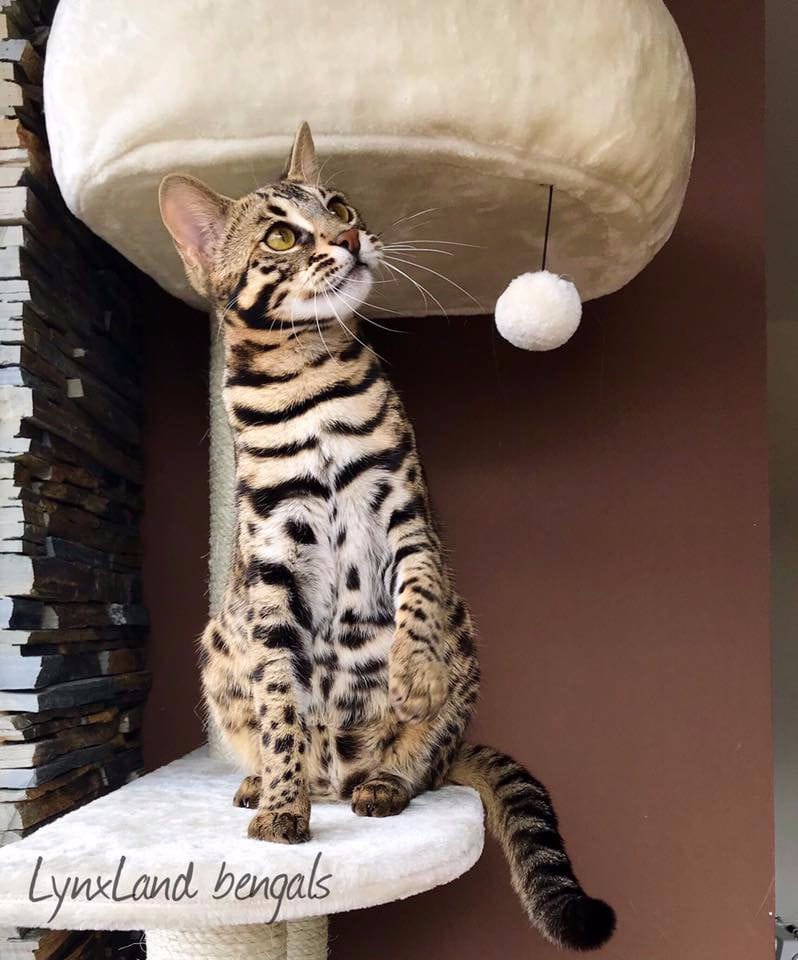
Bringing a new feline companion into your home is an exciting prospect, and for those seeking a pet with a unique and striking appearance, the Bengal cat often comes to mind. Within the Bengal breed, the “F” or Foundation generations, particularly the F1 Bengal Cat, represent a fascinating lineage. This article delves into what an F1 Bengal cat entails, exploring its origins, characteristics, and suitability as a domestic pet.
Understanding Filial Generations in Bengal Cats
The designation “F1” signifies the first filial generation. This means the cat is a direct offspring resulting from the crossbreeding of an Asian Leopard Cat (ALC) with a domestic cat, which today is predominantly another Bengal cat. Consequently, an F1 Bengal cat possesses a blend of traits from both its wild ancestor and its domestic lineage. The filial line continues with subsequent generations: an F1 female bred with a Bengal cat produces F2 Bengal cats, and so on. It’s important to note that males in the early filial lines (F1 to F3) are typically infertile. This infertility resolves by the fourth filial generation (F4), though occasional exceptions can occur even beyond this.
The International Cat Association (TICA) uses “2G” and “3G” instead of F2 and F3 to denote generations removed from a non-domestic feline. This terminology aids in estimating a cat’s personality and temperament. Generally, cats closer to the F1 generation exhibit more “wild” characteristics, while those in higher filial lines are considered more domesticated. However, individual personality is highly variable and influenced by numerous factors.
What to Expect from an Early Generation Bengal Cat
If you are considering bringing an early generation Bengal cat, such as an F1, F2, or 2G, into your family, a deep commitment to the breed and an understanding of their unique behaviors are essential. These cats require a special kind of owner, one willing to provide dedicated care to an animal that will be a long-term family member. The temperament of F1 Bengal cats, and to some extent F2 and 3G as well, can be quite varied. It can be challenging to predict which parent’s genetics will have a more significant influence on the offspring.
When an F1 Bengal cat displays a pronounced “wildness” and energy, it indicates a stronger influence from the ALC genetics. The behavior of F1s can be unpredictable and demanding, and changes may occur as they age. While sharing similarities with other Bengal cats, early generations exhibit distinct traits. They may be more distrustful of strangers, and the ALC genes can influence their preference for a raw food diet. Additionally, they might be shyer or have a lesser ability to socialize initially, often requiring more time and patience. The interest in water, a characteristic often associated with Bengals, is also linked to ALC genes and is frequently observed even in higher filial generations like 2G, 3G, and 4G.
When choosing a kitten, understanding these generational differences can help potential owners select a cat that aligns with their lifestyle. Those drawn to the striking appearance and more untamed nature might lean towards F1 or 2G cats, while individuals seeking a more overtly domestic companion may prefer 4G or higher filial lines, including SBT (Stud Book Tradition) Bengals.
The “F Bengal Cat” – A Closer Look
The Asian Leopard Cat is a wild feline, and this wildness significantly influences the personality of an F1 Bengal cat, making each individual distinct. “F Bengal Cats” experience everything more intensely, from their affection and vocalizations to their playfulness. It is crucial to understand that an F1 Bengal cat should not exhibit aggressive or hostile behavior towards its owner. Such cats should be spayed or neutered and excluded from breeding programs.
While genetics play a substantial role in shaping the personality of early generation Bengals, the socialization process is equally critical. Responsible breeders prioritize breeding cats with friendly and non-aggressive temperaments, even for higher filial lines. Ideally, Bengal cats should be happy, playful, and friendly. However, they often form a strong bond with one person, showing increased loyalty and affection towards that individual. This doesn’t preclude them from interacting with others, but their primary connection may be with their chosen person.
Owning an F1 or 2G Bengal cat can be a challenging but rewarding lifestyle. It requires respecting their inherent wild side and ensuring it has an appropriate outlet. The world, in essence, begins to revolve around the unique needs and personality of your Bengal cat companion.
A testament to this adaptability can be seen in the experience of a 2G Bengal cat owner: “Update from new home. Zakiyya is completely settled here and walks all over the place… Lots of purring and playing nonstop. He does not cry at all and he sits close to me or in one of the kitchen chairs. He is very playful and not scared to come for a back scratch either. I think he is doing exceptionally well and you should be proud on him.”
It is common for F1, 2G, and 3G kittens to require more time for socialization, often involving breeders raising them from a young age. However, allowing kittens to remain with their mothers for an extended period is vital for their healthy development and socialization. Mama cats are experts in nurturing their kittens, and it’s not unheard of for them to reject kittens removed too early. While some breeders separate kittens at three weeks, this can be highly stressful for both mother and offspring. Mama cats typically begin weaning their kittens around one month of age, making the time spent with them crucial for their growth and proper socialization.
In contrast, SBT Bengal cats have undergone at least five generations of breeding exclusively between Bengals, meaning they are at least five generations removed from the ALC wild blood. This makes SBT Bengal cats fully domesticated and excellent pets, and they represent the majority of Bengal cats kept as pets today.
For those seeking a cuddly and affectionate pet, focusing on 3G or higher filial and SBT Bengal cats is recommended. However, if you are prepared for a unique companion with a distinct personality and are ready to make a full commitment, then F1 or 2G Bengal cats could be an ideal choice.
