
Horses, majestic creatures deeply intertwined with the history of the United States, once roamed the North American continent for millions of years. Their eventual disappearance and subsequent reintroduction form a fascinating chapter in natural history. This article delves into the ancient origins of horses in North America, their enigmatic extinction, and their eventual return, profoundly shaping the continent’s ecosystems and human history.
Ancient Origins and Early Dominance
The earliest known species of the Equus genus, the Hagerman horse (Equus simplicidens), emerged around 4 million years ago. This ancestor, found from modern-day Florida to Idaho, bore a striking resemblance to today’s horses, possessing similar teeth, a long face and neck, and fully fused leg bones. These early equids were highly successful, expanding their range beyond North America into South America, Asia, Europe, and Africa.
The Pleistocene Extinction Enigma
Approximately 10,000 years ago, at the close of the Pleistocene epoch, a significant die-off occurred, leading to the extinction of most of North America’s large mammals, including the native Equus species. The precise cause of this mass extinction remains a subject of considerable debate within the scientific community. Several compelling theories have been proposed, each with supporting evidence, but a definitive conclusion has yet to be reached.
Some scientists point to rapid climate change at the end of the last ice age as a primary driver. This shift in climate likely altered the continent’s habitats and vegetation patterns significantly. The rise of bison populations during this period may have also created increased competition for food resources, putting pressure on horse populations. Fossil records suggest that as food became scarcer, horses’ ranges began to shrink, and their physical size diminished.
Another prominent theory centers on the arrival of humans in North America. Evidence suggests that early human inhabitants may have hunted horses, adding another layer of pressure to already vulnerable populations. The debate often revolves around whether human overkill was the direct cause of their extinction or a contributing factor alongside environmental changes.
Other potential explanations include an extraterrestrial impact or a fundamental evolution of grassland vegetation that may not have sustained the horses as effectively. The complexity of these interconnected factors makes pinpointing a single cause challenging.
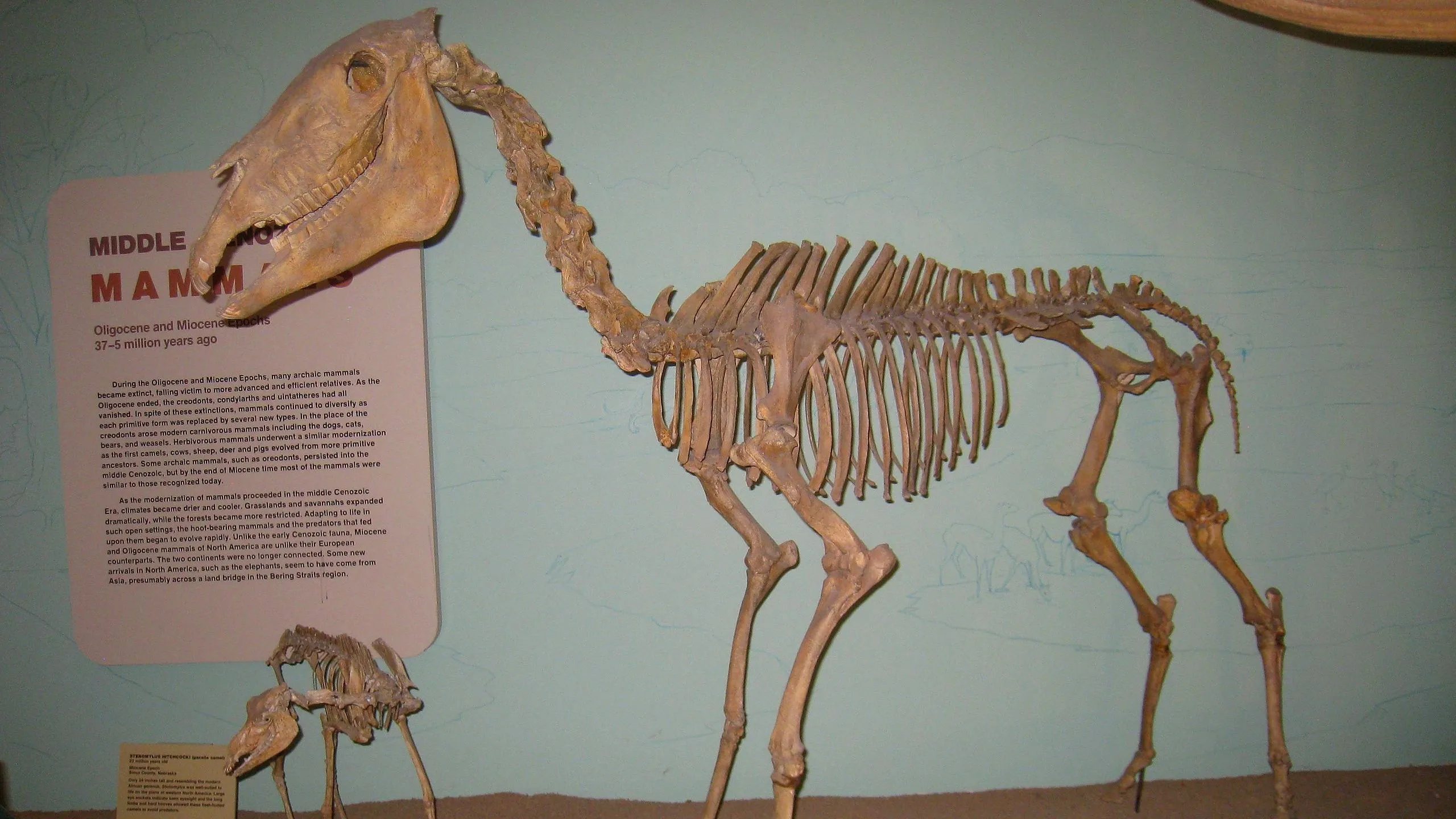 Equus simplicidens fossil in the Utah Museum of Natural History
The Remarkable Return of Equids
While horses vanished from North America, those that had migrated to other parts of the world survived and thrived. It was not until much later, approximately 4,000 years after their disappearance from the continent, that humans began to fully harness the utility of horses globally. Horses became instrumental in human history, serving crucial roles in hunting, agriculture, warfare, and transportation. This period also saw humans actively shaping horses through selective breeding, leading to larger and faster animals.
The reintroduction of horses to North America began in the late 1400s with the arrival of Spanish conquistadors. These European horses found a familiar and welcoming environment in the vast grasslands of the continent. Initially, some of these horses escaped, leading to the establishment of feral populations. Native American tribes soon recognized the value of these animals, capturing and riding them, which facilitated their spread across the continent.
Over the subsequent centuries, these reintroduced horses, particularly the Spanish Mustangs, proliferated. Other breeds, such as the Morgan, Appaloosa, and American Quarter Horse, also gained prominence, contributing to the rich equine diversity seen today. The United States now boasts over a hundred registered breeds, representing the greatest variety of Equidae in the world.
 A white wild Mustang walks through a backlit field of flowers in the mountains
Conclusion: A Legacy of Resilience
The story of horses in North America is one of profound extinction and incredible resilience. From their ancient origins and widespread presence to their mysterious disappearance and eventual reintroduction, horses have consistently played a significant role in the continent’s natural and human history. Ongoing research continues to shed light on the complex factors that led to their initial extinction, while their thriving presence today underscores their adaptability and enduring legacy.
To learn more about the fascinating history of horses in North America, explore resources such as NATURE’s “American Horses,” the PBS Eons YouTube video “How Horses Took Over North America, Twice,” and Wendy Williams’ novel “The Horse.”
