
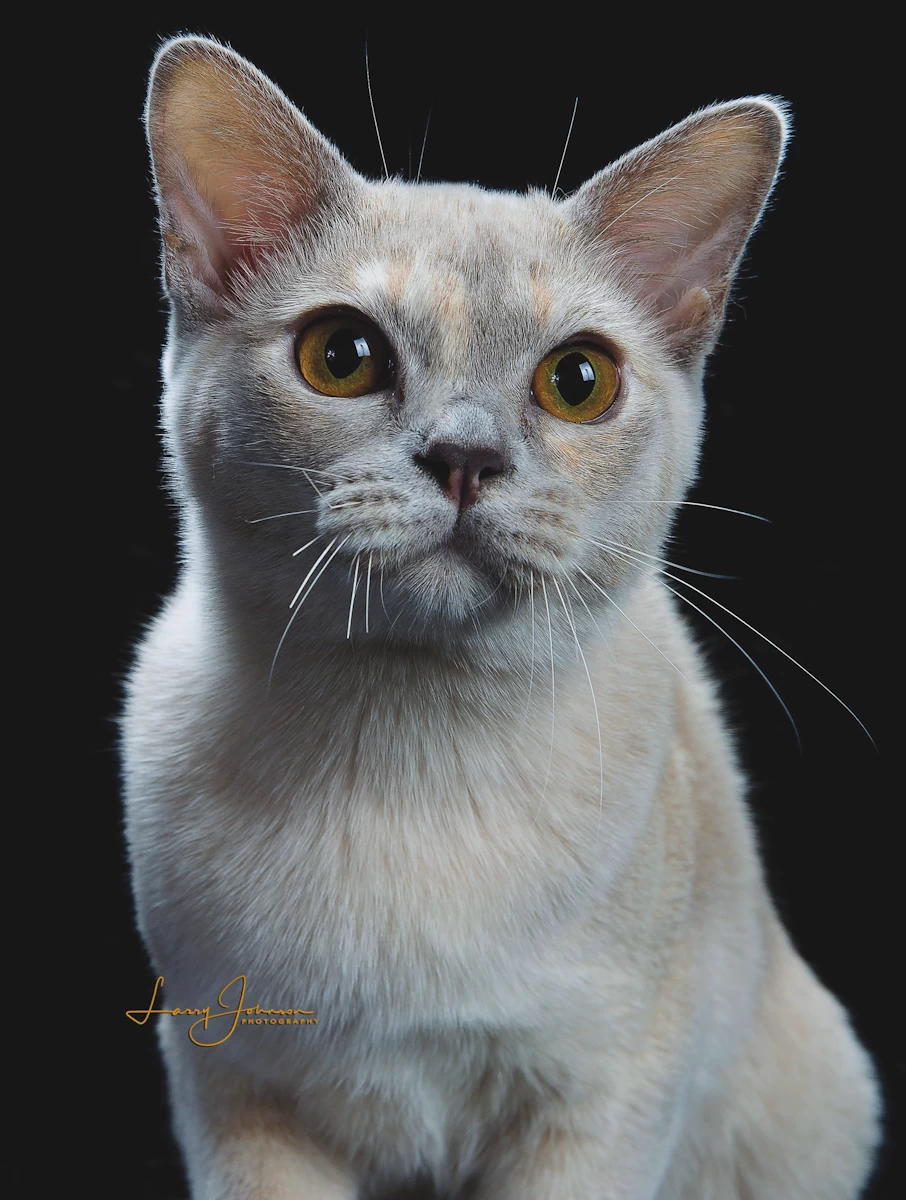
The European Burmese is an elegant and distinctive cat breed, originating from the Far East. This breed is characterized by a moderate, well-balanced build with gently rounded contours, avoiding extreme oriental elongation or cobby features. The European Burmese is a unique feline, prized for its distinctive appearance and temperament.
Head, Ears, Muzzle, and Profile
The head of the European Burmese is slightly rounded on top, with a pleasing breadth between the ears. Their cheekbones are wide, tapering gracefully to a short, blunt wedge. The ears are medium in size, set well apart, and feature a slight forward tilt. They are broad at the base with slightly rounded tips, and the outer line of the ear continues the elegant shape of the upper face. The muzzle is wide at the base, with a strong lower jaw and a firm chin. A visible nose stop is a characteristic feature of the profile.
Eyes and Eye Color
The eyes of the European Burmese are large, expressive, and alert, set well apart. The upper lid line is slightly curved, with a subtle oriental slant towards the nose, while the lower lid line is rounded. Their eye color is a striking yellow-gold to amber, noted for its lustrous and bright appearance.
Body, Legs, Feet, and Tail
The body is of medium length and size, presenting a hard, muscular appearance that belies its elegance. The chest is strong and rounded in profile, and the back is straight from the shoulder to the rump. The legs are rather slender yet proportionate to the body, with the hind legs being slightly longer. Their feet are small and oval. The tail is of medium length, not thick at the base, tapering slightly to a rounded tip.
Coat and Coat Color
The European Burmese boasts a short, fine coat that lies close to the body. It is exceptionally glossy, with a satin-like texture and very little undercoat.
Breed Penalties and Disqualifications
Certain features are considered faults in the European Burmese breed standard. These include a pronounced muzzle pinch when viewed from above, oriental or round eye shapes, and green eye color. Cats with white patches, a noticeable number of white hairs, a visible tail kink, or excessive tabby markings will be disqualified from breed shows.
European Burmese Colors
The coat of the European Burmese shades gradually towards the roots, without any smoky effect or ticking. The underparts of the body are typically slightly paler than the back, and the points may exhibit some contrast. It’s important to note that kittens and adolescents may display faint tabby markings and a lighter overall color. Adult cats that are not red or cream should be free from any tabby markings.
Solid Colors:
- Brown: This color is a rich, warm seal brown. A near-black brown is considered incorrect. The nose leather should be rich brown, and the paw pads are also brown.
- Blue: A soft, silver blue-gray with a warm tone. The nose leather and paw pads are blue-gray.
- Chocolate: This color is a warm milk-chocolate, with overall evenness highly desirable. The nose leather is a warm, chocolate brown, and the paw pads range from brick pink to chocolate.
- Lilac: A pale, delicate dove-gray with a subtle pink cast. The nose leather and paw pads are lavender-pink.
- Red: A warm, orange apricot. Slight tabby markings are permissible on the face, and small, indeterminate markings may be present elsewhere (except on the side or belly) on an otherwise excellent cat. The nose leather and paw pads are pink.
- Cream: A rich cream color. Similar to red, slight tabby markings are permitted on the face, and small, indeterminate markings may appear elsewhere on an otherwise excellent cat. The nose leather and paw pads are pink.
Parti-Color:
- Brown Tortoiseshell: A combination of seal brown and red, characterized by pure and bright color patches distributed over the entire body and extremities. The distribution of patches is less critical than the clarity of the individual colors. Except on the face, the red areas should not exhibit tabby markings and can be of various shades. The nose leather and paw pads can be seal brown, pink, or a combination of both.
- Chocolate Tortoiseshell: Features milk chocolate and red patches across the body and extremities. Similar to the brown tortoiseshell, patch distribution is secondary to color purity. Red areas, except on the face, should be free of tabby markings and can vary in shade. The nose leather and paw pads can be milk chocolate, pink, or a mix.
- Blue-Cream: A blend of blue-gray and cream with patches over the body and extremities. The distribution of patches is less important than the purity of the blue-cream colors. Cream areas, excluding the face, should not show tabby markings and may vary in shade. Nose leather and paw pads can be pink, blue-gray, or both.
- Lilac-Cream: This color combines lilac and cream patches across the body and extremities. As with other tortoiseshells, patch distribution is secondary. The cream areas, except on the face, should be free of tabby markings and can present in various shades. Nose leather and paw pads are typically lavender-pink, or a combination of lavender-pink and pink.
European Burmese Color Class Numbers
The following color class numbers are for reference only and are not an official part of the breed standard for showing.
- Solid (Blue, Brown, Chocolate, Cream, Lilac, Red): Class Numbers 1500, 1501
- Parti-Color (Brown Tortoiseshell, Chocolate Tortoiseshell, Blue-Cream, Lilac-Cream): Class Number 1521
- AOV (Any Other Variety): None.
It is noteworthy that the European Burmese has no allowable outcross breeds.
