
Fleas are more than just a nuisance; they are a common and persistent threat to the health and well-being of our canine companions. Even a light flea infestation can cause intense itching and discomfort for your dog, leading to skin irritation, allergic reactions, and even more serious conditions like anemia, especially in puppies. Beyond directly affecting your dog, fleas can also transmit tapeworms if ingested during grooming and, in heavy infestations, can make life miserable for human family members by biting them and infesting the home and yard. The most common culprit, the cat flea (Ctenocephalides felis), readily infests both dogs and cats across the United States.
Successfully tackling a flea problem requires a multi-pronged approach that targets fleas not only on your dog but also throughout their environment – specifically your home and yard. Ignoring any of these areas can lead to recurring infestations. For pet owners seeking an Effective Flea Treatment For Dogs, understanding the flea life cycle and the various control methods available is paramount. This guide will provide detailed insights into comprehensive flea management strategies to protect your dog and your home. You can also explore options for cheap flea medicine for dogs to find affordable yet effective solutions.
Understanding Flea Biology: Key to Effective Control
To effectively combat fleas, it’s crucial to understand their life cycle. Only adult fleas live on your dog, feeding on their blood. After a blood meal, female adult fleas lay numerous tiny, white, non-sticky eggs directly on their host. These eggs quickly fall off your dog, scattering into bedding, carpets, furniture, and other areas where your dog rests.
Within 2 to 6 days, these eggs hatch into slender, dirty-white larvae. Flea larvae are scavengers, feeding on organic debris such as dander, dried blood, and the dried excrement of adult fleas—all of which are conveniently concentrated in your dog’s resting spots. These larvae are typically only about a quarter-inch long and are adept at moving into cracks, crevices, or deep within carpets to avoid light and find suitable humidity.
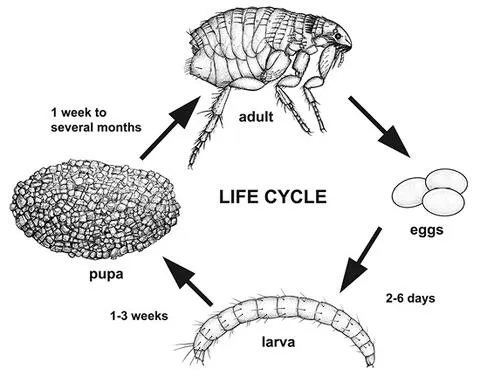 Life cycle of a flea, showing eggs, larvae, pupae, and adult stages.
Fleas have a complete life cycle that can be completed in as little as three weeks under ideal conditions. What’s important to remember is that adult fleas represent only a small fraction of the total flea population in an established infestation. The vast majority exist as eggs, larvae, and pupae. If you only treat the adult fleas on your dog, you’re missing the root of the problem.
After 1 to 3 weeks, the larvae mature and spin a small cocoon, entering the pupal stage. This stage can last anywhere from a week to several months. Pupae are incredibly resilient; newly developed adult fleas inside their cocoons can sense the presence of a host through vibrations and carbon dioxide. They will delay emergence until a host is detected, explaining why vacant homes can suddenly become “flea-infested” when new occupants (or pets) arrive. These pre-emerged adults will then readily bite humans in the absence of a canine host. Consistent cleaning, including washing bedding and regular vacuuming, is essential to disrupt this life cycle.
On-Pet Flea Treatments for Dogs
Protecting your dog from fleas is the first and most critical step in overall flea control. Fleas can be a year-round problem, but their populations typically boom in spring and summer. Fortunately, there’s a wide array of highly effective products designed for direct application to your dog. It’s vital to read product labels carefully, as some products target both fleas and ticks, some only fleas, and some even protect against internal parasites. Crucially, certain products are formulated specifically for dogs and can be dangerous or even deadly to cats, especially those containing permethrin or amitraz.
Choosing the Right Treatment for Your Dog
When selecting an on-pet flea treatment for your dog, several factors should be considered:
- Target Pests: Do you need protection solely against fleas, or also against ticks, mosquitoes, or internal parasites?
- Dog-Specific Formulation: Always confirm the product is explicitly labeled for use on dogs. Never use a product containing permethrin or amitraz on a cat, even if you have both dogs and cats in the household and think the cat won’t come into contact with the dog’s treatment.
- Dosage and Frequency: Ensure the product’s dose and application frequency are appropriate for your dog’s weight and age. Many products come in weight-specific dosages.
- Availability: Some effective treatments require a prescription from your veterinarian, while many others are available over-the-counter or online.
- Formulation Preference: Products come in various forms, including oral tablets, topical spot-ons, and collars. Consider which method is easiest and safest for you and your dog. Oral treatments like dog pills can be highly effective and convenient for many owners.
Popular On-Pet Flea Treatment Options for Dogs
Veterinarians often recommend a holistic approach, choosing products based on individual animal needs and environmental factors. Here’s a brief overview of some commonly available and effective flea control products for dogs:
- Advantage, K9 Advantix, and Advantage Multi: These topical treatments contain imidacloprid to kill adult fleas. K9 Advantix specifically includes permethrin for tick control, making it a dogs-only product. Advantage Multi combines imidacloprid with moxidectin, offering protection against adult fleas, heartworms, and various intestinal parasites in dogs.
- Capstar: A fast-acting oral product, Capstar kills adult fleas within 30 minutes. While excellent for quick knockdown, its effect lasts only about 24 hours, making it unsuitable for long-term prevention. It’s often used as a first step in a multi-pronged approach for heavy infestations.
- Comfortis: This oral tablet for dogs and cats starts killing adult fleas within 30 minutes and provides approximately 30 days of efficacy. Fleas must bite the dog to be affected. It must be administered with a meal.
- Frontline Plus: A popular topical treatment for dogs, Frontline Plus kills adult fleas, flea larvae, and eggs. It also targets chewing lice and several tick species. It’s generally water-resistant and effective for 30 days, though some reports of fipronil-resistant flea strains exist.
- NexGard: An oral chew for dogs, NexGard kills adult fleas and is effective against the most common flea species (Ctenocephalides felis), as well as four common tick species. It provides monthly protection and can be used on puppies 8 weeks and older, weighing at least 4 pounds. It’s important to note that NexGard should not be used in dogs with a history of seizures or neurological disorders.
- Revolution: This topical product for dogs offers broad protection, killing adult fleas, preventing flea eggs from hatching for a month, preventing heartworm disease, and controlling ear mites, sarcoptic mange, and American dog ticks.
- Seresto Collar: A unique collar system that slowly and continuously releases imidacloprid (for fleas) and flumethrin (for ticks) over 8 months. It works similarly to a monthly topical by spreading active ingredients across the skin surface. It’s water-resistant, but efficacy duration may be reduced with frequent bathing or swimming.
- Trifexis: A once-monthly, beef-flavored tablet for dogs only. It combines spinosad (from Comfortis) to kill fleas within 30 minutes for 30 days, with milbemycin oxime to prevent heartworm disease and treat adult hookworm, roundworm, and whipworm infections. Fleas must bite the dog to be killed. For a comprehensive approach to parasite control, consider how heartworm meds for dogs fit into your overall strategy.
- Vectra 3D: This topical treatment for dogs kills through contact, meaning parasites don’t have to bite to die. It quickly reduces flea feeding and kills fleas within 6 hours. Vectra 3D also repels and kills ticks, mosquitoes, biting flies, lice, and mites, offering month-long protection and remaining effective after bathing or swimming. It can be used on puppies as young as 7 weeks.
It’s difficult to safely treat newborn puppies for fleas due to their small size and vulnerability. It’s always best to treat a pregnant dog for fleas before she gives birth. Keep their whelping area flea-free with frequent washing of bedding, and never apply flea treatments directly to newborn puppies. For more gentle options, explore natural flea and tick prevention for puppies.
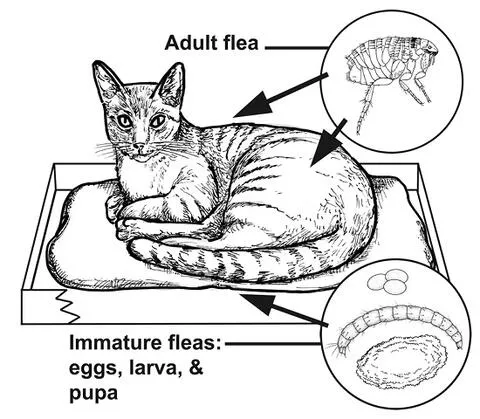 Drawing of a cat in a bed with inset drawings of an adult flea and flea eggs, larva, and pupa.
Effective Flea Control in Your Home
Given the biology of immature fleas, it’s clear why indoor flea infestations are often concentrated in pet resting areas, especially in less-cleaned rooms or those with carpets. Therefore, regular cleaning of pet bedding and floors is paramount for indoor flea management. Weekly washing of pet bedding and vacuuming surrounding areas removes eggs and immature fleas before they mature, while also eliminating the organic material they feed on.
The most effective way to prevent indoor flea infestations is to restrict pet access to the indoors. If your dogs are allowed inside, consider designating specific areas for them to sleep and rest. This allows you to focus intensive cleaning efforts on these zones. If your dogs lounge on furniture, remember that immature fleas can hide under cushions and in crevices, necessitating regular vacuuming of these areas. Don’t forget to move furniture and vacuum underneath as well. After vacuuming, immediately remove the vacuum bag, seal it in a plastic garbage bag, and dispose of it to prevent any trapped fleas from escaping.
Insecticides and IGRs for Home Flea Treatment
When dealing with established indoor flea infestations, you’ll need to target both adult and immature stages. Many insecticide sprays are available for adult flea control, containing active ingredients like permethrin, deltamethrin, or pyrethrins. While these have some effect on immature fleas, larvae are challenging to reach due to their burrowing habits.
To significantly improve control of immature fleas, use products that include an Insect Growth Regulator (IGR), such as methoprene or pyriproxyfen (nylar). IGRs disrupt flea development, causing them to die before reaching adulthood or preventing female fleas from producing viable eggs. IGRs are particularly effective indoors, where they are protected from sunlight degradation and can provide several months of long-term control against immature stages. Since IGRs don’t kill adult fleas, it’s best to use a combination treatment containing both an adulticide and an IGR for established infestations. For preventive treatment in pet-frequented areas without an active adult infestation, IGRs alone may suffice.
Most homeowner-grade indoor flea treatments come as pre-diluted, ready-to-use (RTU) sprays, often combining an adulticide and an IGR. Alternatively, you can purchase concentrates of adulticides and IGRs separately and mix them in a pump-up sprayer. If using a pump-up sprayer, ensure it delivers a fine spray, as heavy spray patterns are less suitable for indoor use. Total-release aerosol foggers are also available, but their fog often fails to penetrate adequately into the cracks, crevices, and under furniture where immature fleas hide, making them less effective than directed sprays.
Important Safety Note: Always read and strictly follow all label directions for indoor insecticide applications. Do not apply insecticides in unauthorized areas (e.g., food preparation zones) or directly to pets unless explicitly stated on the label. Observe the specified re-entry period, keeping people and pets out until sprays have dried, or for longer if the label instructs. Over-applying insecticide will not improve control and will only increase exposure risks.
The cornerstone of successful indoor flea control is thoroughness in cleaning and treating all flea-prone areas, especially where your dog sleeps or rests. A superficial treatment is unlikely to yield good results. Clean and vacuum thoroughly, moving furniture and vacuuming underneath, and treating cracks and crevices. Then, apply a combination of an adulticide and an IGR as a directed spray according to label instructions.
Keep in mind that fleas in the pupal stage are very difficult to kill, and newly emerged adults will quickly seek a host. This means you may still see adult fleas for a few weeks after treatment, even if applied correctly. For heavy infestations, you might need to repeat cleaning and treatment two or three times at 2-week intervals. Once fleas are under control, maintain prevention with consistent on-pet treatments, weekly cleaning of pet areas, and periodic IGR applications.
If a heavy infestation has developed, avoid banning your dog from the house after treatment. Remaining adult fleas will be attracted to your treated dog, where the on-pet treatment will control them, essentially using your dog as a “flea trap” to eliminate remaining emerging adults rather than having them bite people. You can also hire a professional pest control company, but remember you’ll still need to perform the essential cleaning beforehand and ensure the technician has access to all necessary areas.
Key Steps for Eliminating Heavy Indoor Flea Infestations
- Treat your dog(s) with an effective on-pet flea treatment.
- Thoroughly vacuum all pet bedding and the surrounding areas.
- Wash all pet bedding in hot, soapy water, or discard and replace it.
- Vacuum all floors, carpets, and rugs, paying special attention to cracks, crevices, under furniture, along walls, and around pet resting areas.
- Vacuum furniture where your dog rests, including under seat cushions.
- Move furniture and vacuum thoroughly underneath.
- Apply a directed spray containing both an adulticide and an IGR. Focus the spray on cracks, crevices, under furniture, along wall-floor junctions, and around/under pet bedding areas. Do not broadcast spray carpets or floors unless the product label explicitly allows it.
- Repeat cleaning and treatment in 14 days.
- If fleas are still present, repeat again in another 14 days.
- Maintain control by cleaning bedding areas weekly and consistently using on-pet treatments.
Yard Flea Control: Protecting Your Outdoor Space
Occasionally, fleas can infest outdoor areas like your yard or landscape, typically when these spaces are frequented by flea-infested pets or wild animals. For successful outdoor control, you must also manage fleas on all animals that use the area. While on-pet treatments are excellent for your own dogs, treating stray or wild animals like opossums or raccoons may not be feasible. In such cases, focus on deterring them from your property through fencing, sealing crawlspaces, or securing attic openings (while maintaining proper ventilation). If you feed your dogs outdoors, avoid free-choice feeding in areas accessible to strays, as this will attract unwanted animals and their fleas.
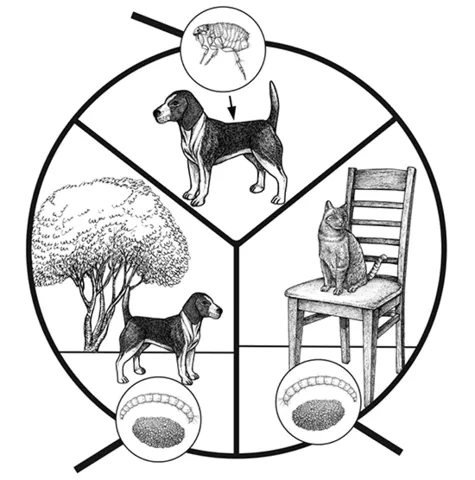 Drawing of a dog in a yard, a cat on a chair inside, and flea adult, eggs, and larva.
Fleas can exist in three primary locations: on your dog, within your home, and in your yard.
In situations where lawns become infested, broadcast insecticide treatments (sprays or granules) can help reduce flea bites on people using the area. However, remember that most immature fleas thrive in protected resting spots rather than open, sunny lawn areas. These breeding sites are often under porches, shrubs, house crawl spaces, garages, or utility sheds. Garage, storage shed, or crawlspace infestations can be particularly severe if litters of puppies or kittens have been raised there. Always check product labels, as insecticides approved for lawns may not be suitable for these other sites, and vice versa. Consider using healthy pill pockets for dogs for administering any oral treatments to your pet, making the process easier for both of you.
Successful outdoor flea control hinges more on treating your dog’s routine resting areas than on open, sunny parts of the yard. While you might need to treat sunny areas for adult fleas, direct most of your effort to identifying and treating those shaded, protected spots where your dog sleeps and immature fleas breed.
Outdoor flea treatments are available as granules or liquid sprays. Liquid sprays are generally more effective and better suited for treating under shrubs, porches, and other resting areas. For heavy outdoor infestations, consider a second application in 7 to 10 days. Always observe the restricted entry interval specified on the product label.
Conclusion
An effective flea treatment for dogs requires a holistic and persistent strategy that extends beyond just treating your pet. By understanding the flea life cycle and implementing comprehensive control measures on your dog, in your home, and in your yard, you can protect your furry friend from discomfort and health risks, while also safeguarding your household. Regular preventative on-pet treatments, meticulous cleaning, and targeted environmental applications are the keys to long-term success. If you encounter a persistent or severe infestation, don’t hesitate to consult your veterinarian for tailored advice and prescription-strength solutions. Take proactive steps today to ensure your dog lives a flea-free, happy, and healthy life.
References
This article is adapted from “Managing Fleas” (Publication 2597) by Blake Layton, PhD, Jerome Goddard, PhD, and Joe MacGown, Department of Biochemistry, Molecular Biology, Entomology, and Plant Pathology, Mississippi State University Extension. The information is for educational purposes only, and references to commercial products do not imply endorsement or discrimination against other products.
