
Walking in circles and drilling the same “sit-stay” commands can quickly turn a vibrant dog training class into a monotonous routine. Owners get bored, dogs disengage, and the real-world application of skills gets lost. But what if you could transform your training sessions into an exciting, engaging, and highly effective learning environment? The answer lies in well-structured Dog Training Games For Group Classes. These activities are not just about fun; they are a powerful tool for proofing behaviors, building confidence, and strengthening the bond between dogs and their owners.
By gamifying the learning process, you tap into a dog’s natural desire to play, making them more motivated and receptive to learning. Games create a dynamic environment where dogs learn to maintain focus and perform commands amidst the controlled chaos of other dogs and people moving around—a perfect rehearsal for real-life scenarios. This approach transforms passive listening into active participation, ensuring that both ends of the leash are excited to come back week after week. If you’re looking for specialized programs, exploring options for dog obedience training massachusetts can provide excellent foundational skills.
Why Games are a Game-Changer in Group Dog Training
Integrating games into your curriculum is more than just a novelty; it’s a strategic approach rooted in the science of animal behavior. When dogs are having fun, their stress levels decrease, and their ability to learn and retain information skyrockets. This positive association with training creates an enthusiastic learner who is eager to participate.
Key Benefits of Game-Based Learning:
- Boosts Engagement and Focus: Games are inherently more stimulating than repetitive drills. They challenge a dog to think and problem-solve, teaching them to maintain focus on their handler even with distractions.
- Proofs Behaviors in a Realistic Setting: A solid “stay” in a quiet room is one thing, but a “stay” while other dogs are racing past is another. Games simulate real-world distractions in a controlled manner, stress-testing commands and making them more reliable.
- Strengthens the Human-Canine Bond: Positive, shared experiences are the bedrock of a strong relationship. Working together as a team to win a game builds trust and improves communication between the owner and their dog.
- Reduces Stress and Anxiety: For some dogs, the group class environment can be overwhelming. Fun games help lower anxiety by changing the emotional association with the space and the presence of other dogs from stressful to enjoyable.
- Improves Handler Skills: Games aren’t just for the dogs! They teach owners better timing, clearer communication, and how to keep their dog engaged, making them more effective trainers in the long run.
As Dr. Emily Carter, a certified animal behaviorist, notes, “When you frame a training exercise as a game, you shift the dynamic from one of command-and-comply to one of cooperation and fun. This is where the most profound and lasting learning happens.”
Setting Up for Success: Tips for Group Game Management
Before you unleash the fun, it’s crucial to set the stage for a safe and productive gaming session. The goal is controlled excitement, not a free-for-all. Proper management ensures that every team can participate successfully and positively.
Safety and Space
Always start by ensuring you have adequate space for the game you’ve chosen. Remove any potential hazards from the training area. For games involving movement, make sure there’s enough distance between dogs to prevent accidental collisions or unwanted interactions. Using visual barriers can be helpful for dogs that are easily distracted or reactive.
Managing Arousal Levels
Games can quickly elevate a dog’s energy levels. It’s the instructor’s job to keep this arousal in a productive zone.
- Start with calm games: Begin the session with games that require focus and impulse control rather than high-energy running.
- Incorporate “settle” breaks: Intersperse high-action games with short periods where dogs are asked to go to their mat and relax.
- Watch for stress signals: Be vigilant for signs of over-arousal, such as frantic barking, stiff body language, or the inability to disengage. Be prepared to ask a handler to step out for a moment to help their dog calm down.
Keep it Positive and Fair
The core principle is positive reinforcement. Reward effort, not just perfection. Ensure that games can be adapted for different skill levels, so no dog or handler feels left behind. A beginner team might be rewarded for a one-second stay, while an advanced team is challenged with a 20-second stay.
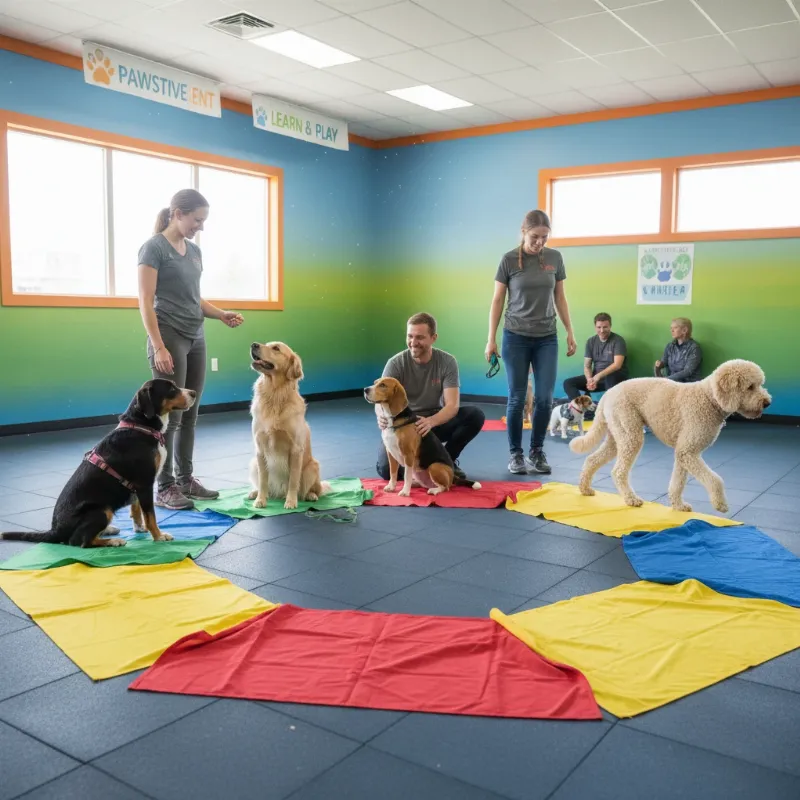 A diverse group of dogs and their owners participating in fun dog training games for group classes, looking happy and engaged.
Top Dog Training Games for Group Classes
Here are some proven, effective, and fun games you can introduce in your classes, categorized by the primary skills they help develop.
Games for Focus and Attention
These games are designed to teach dogs to keep their eyes and ears on their handlers, even when surrounded by distractions.
1. Red Light, Green Light
This classic children’s game is a fantastic tool for teaching impulse control and reinforcing the handler-dog connection.
- How to Play: All handler-dog teams line up at one end of the room. The instructor, at the other end, calls out “Green Light!” Handlers then walk with their dogs towards the instructor, rewarding for loose-leash walking and attention. After a few seconds, the instructor calls out “Red Light!” and turns to face the class. At this signal, every handler must stop and cue their dog to “sit” or “down.”
- Skills Developed: Loose-leash walking, impulse control, sit/down on cue, and handler focus amidst movement.
- Pro Tip: Any team still moving or whose dog doesn’t get into position when “Red Light” is called must go back to the starting line. The first team to reach the instructor wins.
2. Musical Mats
A canine twist on musical chairs, this game builds a dog’s ability to settle quickly in a distracting environment.
- How to Play: Place mats, cots, or hoops (one fewer than the number of dogs) around the room. Play some upbeat music and have handlers walk their dogs around. When the music stops, each handler must guide their dog to a mat and ask for a “down” or “sit.” The team left without a mat is out for that round. Remove a mat and repeat until one winner remains.
- Skills Developed: Quick response to cues, place command, and the ability to settle quickly after movement.
Games for Recall and Impulse Control
A reliable recall is one of the most important safety commands. These games make practicing it incredibly fun.
3. Round Robin Recalls
This game proofs the recall command against the ultimate distraction: other friendly humans!
- How to Play: Have the handlers form a circle and leave their dogs in a “stay” in the center (or have a helper hold the leashes). One at a time, handlers will call their dog to them with an enthusiastic voice. Once the dog arrives, the handler gives lots of praise and a high-value treat, then sends the dog back to the middle.
- Skills Developed: Reliable recall, focus on the handler’s voice, and patience while waiting for their turn.
- Variation: For a competitive edge, time each recall. The fastest recall of the day wins a prize. This concept is similar to the focused attention required in programs like zoom room dog training austin tx.
4. Temptation Alley
Can your dog come when called, even when faced with a path of temptation? This game finds out.
- How to Play: Create two parallel lines of tempting items on the floor—squeaky toys, balls, and low-value treats (like kibble). The handler leaves their dog in a “stay” at one end of the alley and walks to the other. On cue, the handler calls their dog. The goal is for the dog to run through the alley directly to their owner without getting distracted.
- Skills Developed: Strong recall, “leave it” command, and impulse control.
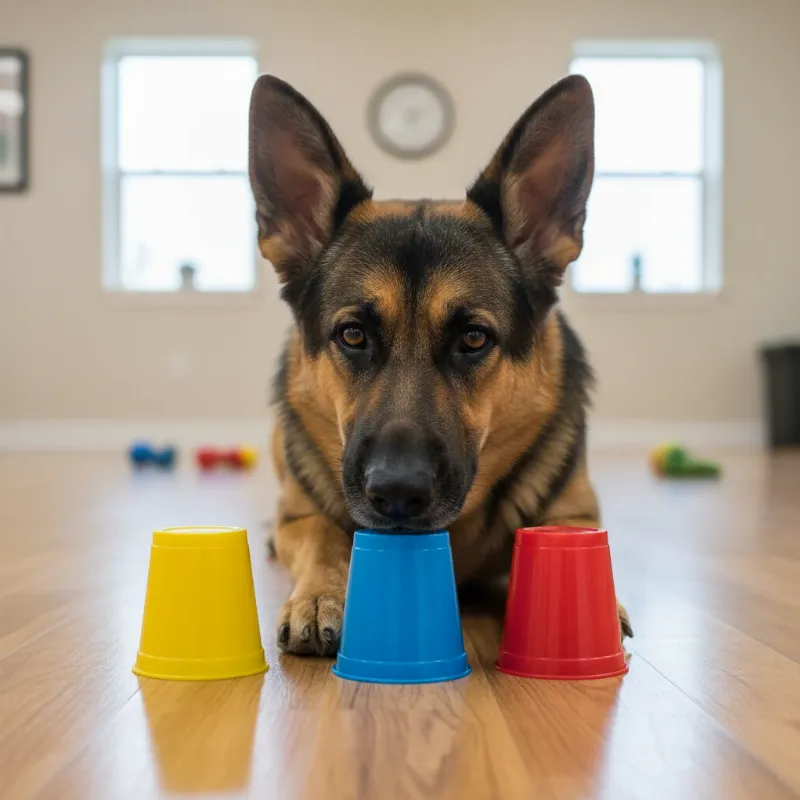 A focused German Shepherd sniffing one of three cups in a scent work game, demonstrating concentration during a dog training game for group classes.
Games for Heeling and Loose-Leash Walking
These games help make walking politely on a leash second nature, transforming it from a chore into a challenge.
5. Relay Races
A little friendly competition can supercharge loose-leash walking practice.
- How to Play: Divide the class into two teams and set up a simple course with cones to weave through. The first handler on each team navigates the course with their dog in a heel position. Once they return, the next teammate goes. The leash must remain loose the entire time; if it tightens, the handler must stop and wait for a slack leash before continuing. The first team to have all its members complete the course wins.
- Skills Developed: Heeling, attention on the handler, and maintaining a loose leash with added excitement.
- Fun Twist: For an extra challenge, have handlers carry a spoon with a tennis ball on it. If they drop the ball, they have to go back to the start. Finding a local class can also help; for example, residents in Wisconsin might search for dog training racine wi to find similar structured activities.
Frequently Asked Questions (FAQ)
How do I handle a dog that is too overexcited to play?
For dogs that get over-aroused, the key is management and modification. Keep them at a greater distance from the main group. Use higher-value treats to keep their focus. You can also modify the game for them; for example, in Musical Mats, they might only practice walking to one mat and settling without the competition aspect.
Can these games be adapted for puppies or beginner dogs?
Absolutely. The beauty of these games is their flexibility. For puppies, keep the games very short and simple. In Red Light, Green Light, you might only take two steps before “Red Light” is called. For Temptation Alley, use very low-level distractions. The goal is to set them up for success and build confidence.
What supplies do I need for these games?
Most games require minimal supplies. Good items to have on hand include cones, hula hoops or rubber-backed mats, a variety of toys, different types of treats (low and high value), and a music player.
How do I ensure the games don’t encourage aggression between dogs?
Proper management is key. All dogs should remain on leash unless in a securely fenced area with dogs that have been screened for social behavior. Ensure ample space between dogs at all times. The instructor’s role is to be a proactive referee, watching for any signs of stress or negative interactions and intervening immediately.
How often should I incorporate games into my classes?
A good balance is to use one or two short games per class. You can use a game as a fun warm-up to get the dogs engaged or as a final “jackpot” activity to end the class on a high note. Using dog training games for group classes consistently will make your sessions more memorable and effective.
Conclusion: Play Your Way to Better Obedience
Moving beyond the traditional, rigid structure of dog training classes can unlock a new level of enthusiasm and success for you and your students. By incorporating dog training games for group classes, you create a positive, dynamic, and effective learning environment that builds skilled dogs and savvy owners. These games proof essential behaviors like recall and loose-leash walking in a way that mimics the unpredictability of the real world. They strengthen the bond between dog and owner, turning training from a task into a joyful shared activity. So, get creative, start playing, and watch as your classes transform into the most anticipated event of the week.
