
Welcome to the exciting world of dog agility training! If you’re looking for a fantastic way to bond with your furry friend, improve their physical and mental well-being, and have a ton of fun, you’ve come to the right place. Dog agility training is a sport where dogs navigate an obstacle course, guided by their handler, as quickly and accurately as possible. It’s a dynamic activity that requires teamwork, communication, and a whole lot of enthusiasm from both ends of the leash. Whether you have a speedy Border Collie or a determined Dachshund, agility can be adapted for almost any breed and energy level. Let’s dive into the basics and get you and your pup ready to hit the agility course!
The Thrill of Dog Agility: Why Start Training?
So, why should you consider Dog Agility Training Basics? The benefits are numerous, extending far beyond just learning to jump over hurdles.
- Enhanced Bond: Agility is all about communication and teamwork. Spending dedicated time training together strengthens the connection and trust between you and your dog.
- Physical Fitness: It’s a fantastic full-body workout for your dog, improving their cardiovascular health, coordination, balance, and muscle strength.
- Mental Stimulation: Dogs need mental challenges just as much as physical ones. Navigating an obstacle course requires focus, problem-solving, and learning new skills, keeping their minds sharp and preventing boredom.
- Socialization: Agility classes and events provide opportunities for your dog to interact with other dogs and people in a structured, positive environment.
- Improved Obedience: While not strictly obedience training, agility reinforces commands and encourages your dog to listen and respond to your cues under exciting circumstances.
Think of it as a supercharged game of fetch and follow-the-leader, where both you and your dog are working towards a common, exciting goal.
Essential Dog Agility Training Basics for Beginners
Before you even think about hitting a full-sized agility course, there are some fundamental skills and preparations you need to cover. Safety and a solid foundation are key.
Building Blocks: Foundation Skills
- Basic Obedience: A dog that understands cues like “sit,” “stay,” “come,” and “down” will be much easier to train for agility. Having a reliable recall is especially crucial. If you’re just starting out, consider resources like dog basic obedience training near me to get your pup on the right track.
- Handler Focus: Your dog needs to be able to focus on you, even with distractions. Practice getting your dog’s attention in various environments.
- Body Awareness: Agility requires dogs to use their bodies precisely. Exercises that improve their proprioception (awareness of their body in space) are beneficial. This can include walking over low objects or navigating simple weave poles set far apart.
Getting Started with Obstacles (Safely!)
When introducing obstacles, always start low and slow. The goal is to build confidence, not fear.
Tunnels: These are often the easiest for dogs to master. Start with a short, straight tunnel. Toss a treat or a favorite toy through it, encouraging your dog to follow. Gradually increase the length and add gentle curves.
Jumps: Begin with the bar set on the ground or just a few inches high. Lure your dog over it with a treat or toy. Gradually increase the height only as your dog gains confidence and shows no signs of strain. Never force your dog to jump. Ensure the jump wings are stable and won’t easily tip over.
Contact Obstacles (A-Frame, Dog Walk, See-Saw): These are more advanced and require careful introduction. Start with the obstacles at their lowest setting. Teach your dog to touch the “contact zones” (usually painted yellow) at the bottom of the ramp. Many trainers use a method where the dog learns to pause or “two-on, two-off” on the contact zone. For the See-Saw, ensure it is extremely stable and only allows for a very slight, controlled movement initially. Patience is paramount here.
The See-Saw, in particular, can be intimidating for dogs due to its movement. Building trust and positive associations is key to success.
Weave Poles: This is often the most challenging obstacle to teach. There are several methods, including the channel method (where poles are spread wide initially) or the wing-fencing method. The goal is for the dog to enter with the first pole on their left and weave through without skipping any poles. It takes repetition and precise handling. If you’re looking for detailed instruction, exploring resources on dog training basic obedience lesson plan might offer transferable principles for structured learning.
Introducing Handler Cues and Movement
Agility isn’t just about the dog; it’s a dance between handler and dog.
Verbal Cues: Assign a specific word for each obstacle (e.g., “Tunnel!” “Jump!” “Weave!”). Use these cues consistently.
Body Language: Your body position, hand signals, and direction of movement are crucial. Learn to use your shoulders, hips, and arms to guide your dog. A confident stance and clear movements are essential.
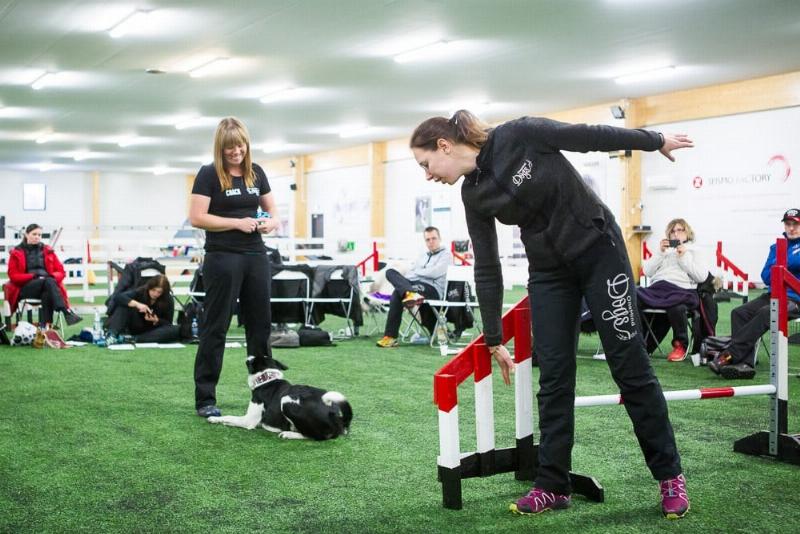
Front Cross & Rear Cross: These are fundamental handling maneuvers. A front cross involves you crossing in front of your dog as they move towards an obstacle, changing their direction. A rear cross involves you crossing behind your dog. Mastering these allows you to efficiently guide your dog through complex sequences.
 A handler demonstrating a front cross with their dog, guiding them towards a jump
What Makes a Good Agility Dog? (Spoiler: Yours!)
It’s a common misconception that only certain breeds excel at agility. While breeds like Border Collies, Australian Shepherds, and Shetland Sheepdogs often have the natural drive and athleticism, any dog with a willing attitude and a good relationship with its owner can enjoy agility.
- Enthusiasm: A dog that enjoys playing and working with its handler is halfway there.
- Trainability: Dogs that are eager to learn and motivated by rewards (treats, toys, praise) will progress more quickly.
- Physical Capability: While you can adapt agility for dogs with physical limitations, a basic level of health and fitness is required. Always consult your veterinarian before starting any new strenuous activity.
Don’t let breed stereotypes limit you. Many mixed breeds and less common breeds have proven to be fantastic agility partners. It’s the partnership and training that truly matter.
Common Challenges and How to Overcome Them
- Fear of Obstacles: If your dog is scared of an obstacle, go back to basics. Make the obstacle non-intimidating (e.g., lower the jump, shorten the tunnel). Use high-value treats and short, successful repetitions. Never punish fear; reward bravery.
- Skipping Weaves: This is very common. Ensure you are using a method that makes sense to your dog and that you are handling effectively. Sometimes, taking a break from weaves and returning later with a fresh approach can help.
- Handler Hesitation: If you’re unsure, your dog will sense it. Practice your handling skills separately. Watch experienced handlers and consider attending a basic dog training classes or workshops. Confidence breeds confidence in your dog.
The Long-Term Journey: Beyond the Basics
Agility training is a continuous learning process. As you and your dog progress, you can explore more complex sequences, different handling techniques, and even compete in organized events. Remember that every dog learns at its own pace, and the most important aspect is to have fun and build a stronger relationship with your canine companion.
If you’re looking for structured guidance, exploring programs like jackie’s basics and beyond dog training or bark to basics dog training could provide valuable insights and professional support tailored to your needs.
Ultimately, dog agility training is a rewarding journey that offers a unique blend of physical exercise, mental engagement, and unparalleled bonding opportunities. So, grab some treats, find a safe space, and start exploring the incredible world of dog agility with your best friend!
