
A common misconception in dog training is the belief that a vast and complex vocabulary of commands is necessary for a dog to perform well. This can lead to handlers creating an overwhelming number of cues for their canine companions, when in reality, a simpler, more streamlined approach is often more effective. This article explores the idea of reducing the number of commands your dog needs, focusing on clarity, efficiency, and the dog’s natural understanding of situations.
One of the key principles in effective dog training is understanding how dogs learn and perceive commands. Organizations that boast training dogs in over 90 commands often include many redundant or unnecessarily differentiated instructions. For instance, teaching separate commands for opening and closing a door, when both actions involve the dog grasping a string and pulling, is superfluous. The dog experiences these as the same task. Similarly, a single command like “Kennel” can effectively encompass entering a crate, a kennel run, a van crate, or even a specific room, as the core action is the same: entering a designated space.
Essential Commands for Obedience Training
A dog’s command list doesn’t need to be extensive to be effective. Focusing on core commands that define desired positions and actions is crucial. For novice training, essential commands include:
- Sit: To assume a seated position.
- Down: To lie down.
- Stand: To stand.
- Front: To move in front of the handler and sit.
- Heel: To move to the handler’s side and sit, or to walk attentively by the handler’s left side while moving.
- OK: A release command signifying the end of an exercise.
Commands for actions include:
- Come: To stop current activity and return to the handler.
- Let’s Go: To walk loosely near the handler.
- Back up: A useful command for teaching the heel position.
- Around: To finish an exercise by circling to the right.
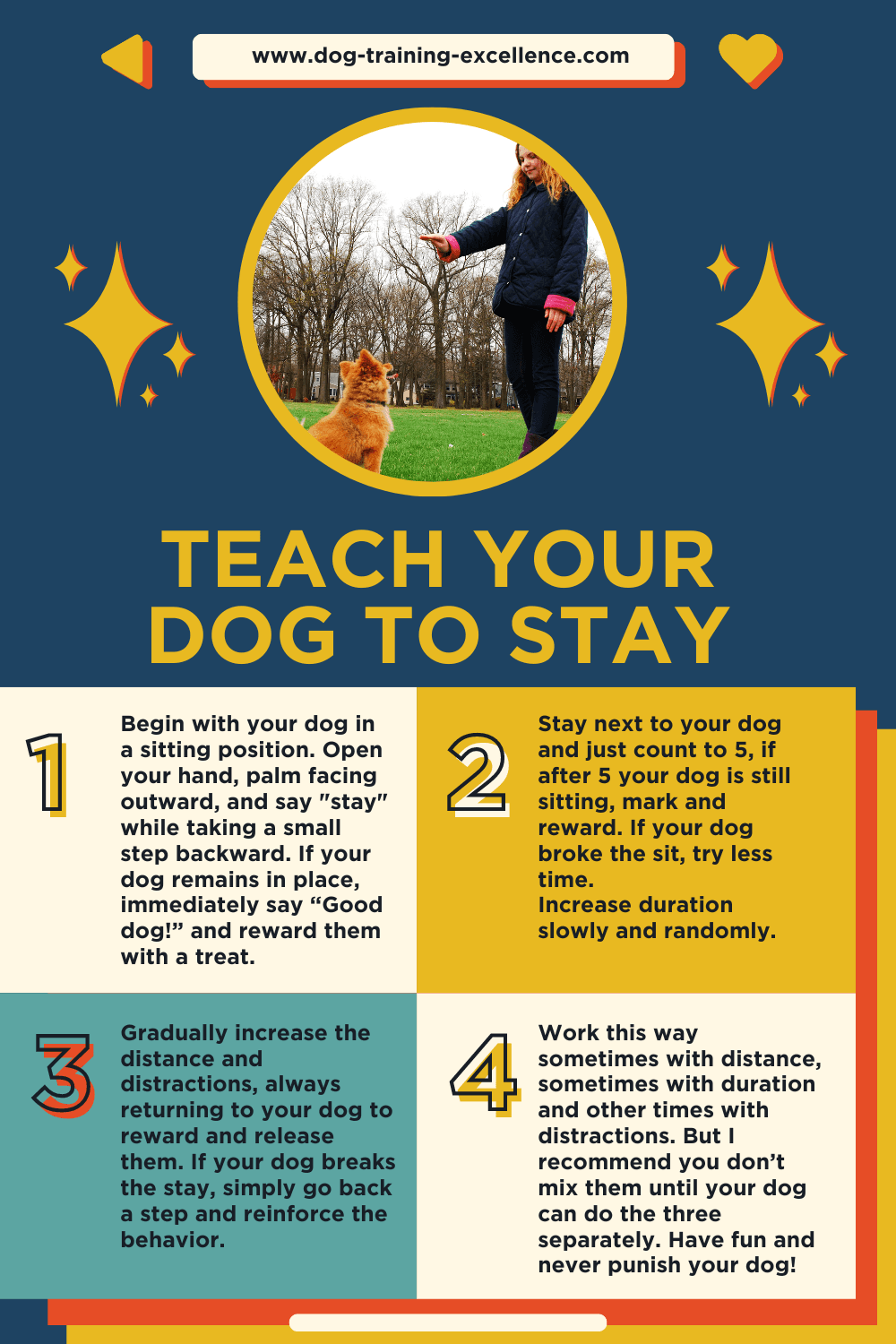
Commands like “Stay” and “Wait” are often considered unnecessary. Once a dog is in a commanded position (e.g., sit), they should remain there until given a new command. The tradition of using “stay” or “wait” commands often stems from habit rather than necessity.
The word “Heel” can serve dual purposes: indicating the desired position next to the handler and the action of maintaining that position while walking. Dogs are situational learners and can differentiate the meaning of “Heel” based on whether the handler is standing or moving. This eliminates the need for numerous “get” commands (e.g., “Get in,” “Get back”).
Utilizing Cues and Advanced Commands
Beyond core commands, helpful cues can enhance communication. “Hurry” and “Easy” can be used to help a dog adjust their pace. The cue “Ready” is sometimes used to signal the start of an exercise, but a more reliable approach is to assess the dog’s attentiveness and then initiate the exercise. If the dog is not ready, a firm “Sit” command can regain their focus.
For more advanced training, such as “Drop on Recall,” a new command isn’t required. The dog already understands “come” and “down.” The distinction between a side-lying down and a sphinx-position drop can be learned contextually, as dogs are situational.
In retrieving exercises:
- Fetch: A command to pick up an object.
- Drop: To release the object into the handler’s hand.
The command “Hold” is generally unnecessary as “Fetch” implies holding the retrieve object.
For retrieving over obstacles like a high jump, the initial command “Jump” initiates a sequence of actions. While all steps may be taught individually, the chain begins with the first command. Similarly, “Jump” is sufficient for broad jumps.
Utility commands, while introducing new exercises, do not necessarily require a significant addition to the command list. Non-verbal cues can be used for known actions. When distinguishing between retrieving a regular object and a scent article, the situational nature of dogs can be leveraged. A dog can understand to search more deliberately for articles among many options, while retrieving a single object more directly. If “Fetch” causes anxiety, alternative words like “Search” or “Find it” can be employed.
For exercises like “Directed Jumping,” the “Go-out” command directs the dog away from the handler, utilizing existing “Sit” and “Jump” commands.
Enhancing Motivation with Cues
Cues can also be used to build enthusiasm. A cue like “Mark” can alert the dog to an upcoming exercise and the location of the article pile. Similarly, “Look” can signal the dog to assess the area for directed jumping. Asking a dog if they are “Ready to fetch?” or “Want to jump?” can be motivating and fun.
Key Takeaways for Effective Training
When encountering training challenges, resist the urge to change commands. Performance issues are rarely due to the command itself. When exploring new dog sports, like agility or fieldwork, avoid adding or changing commands unless absolutely necessary. For instance, using a single command like “come” that works across different sports is more efficient than adopting sport-specific terms like “here” for the same action.
A concise list of commands offers significant advantages: they are easier for handlers to remember under pressure and simpler for dogs to learn and apply across various situations. This approach not only streamlines training but also strengthens the bond and communication between handler and dog.
