
The domestic horse (Equus caballus) is a significant ungulate mammal belonging to the Equidae family and the Equus genus. This genus also encompasses zebras, donkeys, Przewalski’s Horse, and hemionids. Notably, the domestic horse and Przewalski’s Horse are the only equids capable of producing fertile offspring when cross-bred. Historically, horses have been indispensable to human civilization, profoundly impacting warfare, transportation, art, and sport. Their beauty and power have long been celebrated, often depicted as noble steeds carrying heroes and gods.
The horse’s physical design is exceptionally suited for riding. Its rigid spine efficiently bears weight, and its tall stature provides riders with an advantage in various activities. The horse’s long, graceful, and swift legs enable rapid ground coverage, making them invaluable companions to humans. Horses are intelligent, highly social herd animals that thrive on companionship and mutual benefit, ensuring kinship and protection. This innate social nature has been leveraged through domestication, transforming their instinct to herd with horses into a willingness to bond with people, making them heroic figures in literature and film.
Feral horses, distinct from wild animals whose ancestors were never domesticated, are populations of horses living in the wild. These feral populations, such as the mustangs found in the western United States and Canada, are often named after their geographical locations.
Evolution of the Horse
The evolutionary journey of all equids within the Equidae family dates back approximately 54 million years to the Eocene epoch in North America. As odd-toed ungulates of the order Perissodactyla, equids first appeared in the fossil record shortly after the extinction of dinosaurs. For millions of years, perissodactyls dominated as large terrestrial browsing animals. However, by the Miocene epoch, even-toed ungulates, with digestive systems better adapted to grass, began to outcompete them. While twelve families of odd-toed ungulates are known from fossil records, only three survive today: horses, tapirs, and rhinoceroses.
The earliest known horse species was the diminutive Hyracotherium, also known as Eohippus. Fossils of this small horse have been discovered in the Northern Hemisphere, dating back 60 to 45 million years ago. The initial discovery in England in 1841 led to the name Hyracotherium (“mole beast”) by paleontologist Richard Owen due to an incomplete specimen. A more fitting name, Eohippus (“dawn horse”), was given later when a more complete specimen was found, though it was later recognized as the same species.
A key characteristic of equine evolution is the reduction in the number of toes per foot, from five to three, and finally to a single toe. The primitive Hyracotherium had four hoofed toes on its front feet and three on its hind feet. Over millions of years, Orohippus emerged, with vestiges of its first and second toes disappearing. Significantly, the addition of new “grinding” teeth indicated a shift towards a diet of tougher plant material, including grasses. This adaptation allowed horses to transition from primarily leaf-eating forest dwellers to grass-eating inhabitants of the Great Plains. The genus Equus, to which all modern equids belong, evolved a few million years ago.
Domestication and Historical Significance
Horses exhibit a wide range of sizes and builds. Draft breeds can exceed 20 hands (about 2 meters) in height, while miniature horses can be as small as 5.2 hands (about 0.56 meters). The Patagonian Falabella is often considered the world’s smallest horse, comparable in size to a German Shepherd dog.
The domestication of horses may have occurred as early as 4500 B.C.E., with evidence suggesting extensive human utilization in Babylon, Assyria, Egypt, and Eurasia around 5000 B.C.E. Other early evidence points to domestication in Central Asia around 4000 B.C.E.
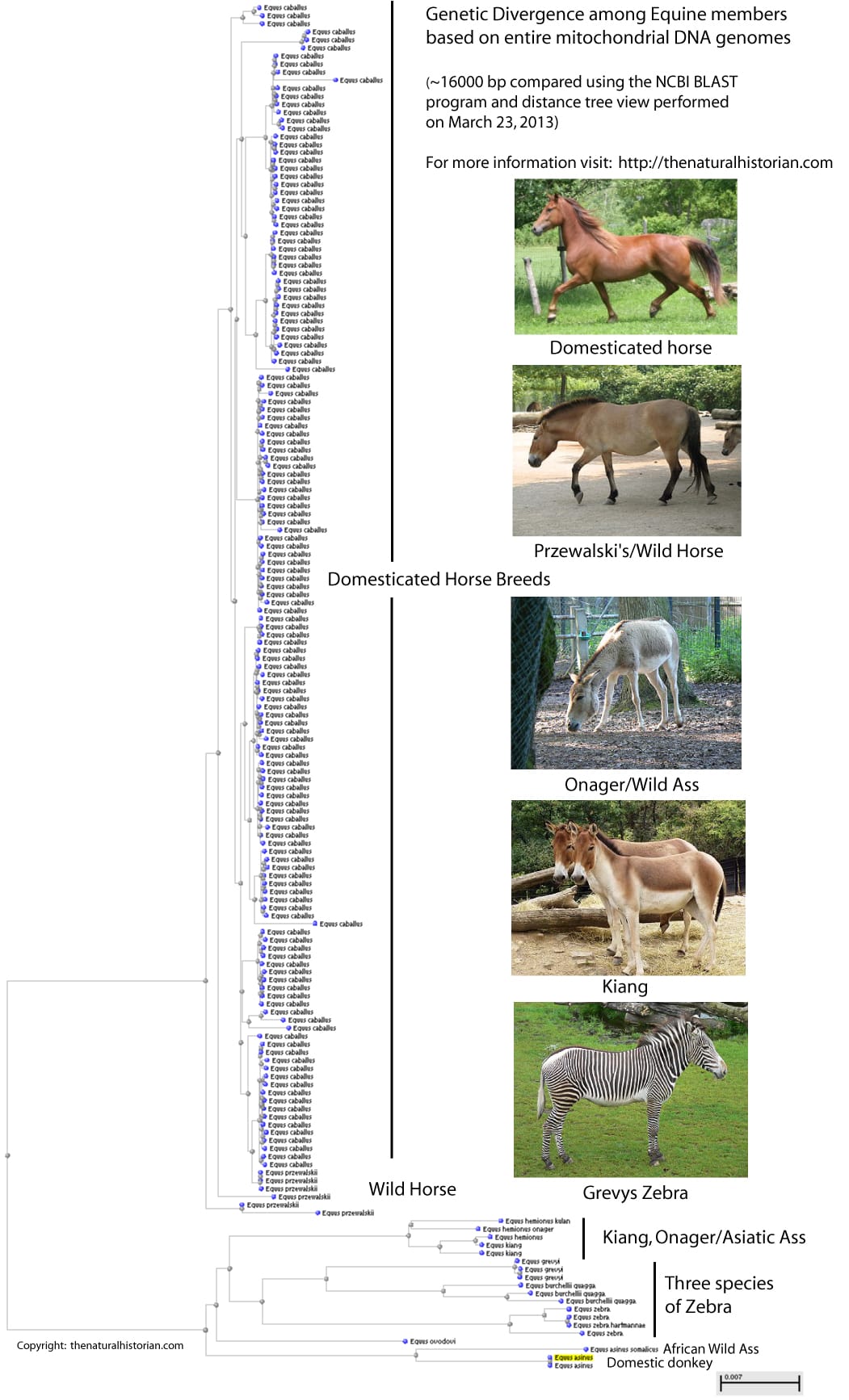
There are competing theories regarding the exact time and location of initial domestication. The “Four Foundations” theory posits that modern horses evolved from two types of early domesticated ponies and two types of early domesticated horses, explaining the diversity in modern breeds. Conversely, the “Single Foundation” theory suggests that only one breed of horse was domesticated and subsequently diverged due to human selective breeding or ecological pressures in feral populations. Modern analysis of DNA and mitochondrial DNA is currently helping to clarify equine family trees.
Until the mid-20th century, horses were crucial in warfare and for domestic transportation. Conquerors utilized vast numbers of horses to cover extensive territories, with the swiftness of horses contributing to the success of empires built by figures like Attila the Hun, Alexander the Great, the Romans, the Ottomans, and Napoleon Bonaparte. Even today, military units that have replaced horses with machinery often retain horse-oriented names, such as “cavalry” units.
In the last few centuries, specific equine breeds have been developed for specialized purposes. While still used for practical work in some regions, horses are now primarily engaged in competitive sports and recreational activities. These pursuits can be broadly categorized into horse racing, horse showing, and pleasure riding.
Horse racing is historically considered the world’s most popular spectator sport, with origins predating recorded history. Early civilizations, including those in Mesopotamia, Ancient Greece, and Rome, featured horse-drawn chariot races. These events were often intense, with fierce stallions driven by ruthless competitors. Modern horse racing includes flat racing (on turf or tracks), steeplechasing (long-distance races with obstacles), and harness racing.
Horse showing, or equestrian sport, encompasses any competition involving horses other than racing. “Sporthorses” participate in English disciplines like dressage, show jumping, and eventing. Horse shows also include Western disciplines, which originated in the western United States and feature events such as reining, rodeo, and western pleasure.
Horse Behavior and Social Structure
Horses are prey animals with a natural “flight or fight” instinct, typically choosing to flee from threats. However, they will defend themselves when cornered, and their fight instinct is also activated when their young, known as foals, are endangered. Selective breeding has resulted in more docile horses, but many sport horse breeds retain the natural instincts of their wild ancestors.
Horses are highly social herd animals. In the wild, horse societies are matriarchal, with a dominant mare leading the herd, which consists of mares, foals, and immature horses of both sexes. Herds typically gather in the center for safety, away from predators, with lower-ranking individuals on the periphery. Expulsion from the herd, either temporarily or permanently, serves as a form of punishment.
The dominant stallion often resides on the herd’s periphery, serving to sire offspring and fend off challenges from other stallions. This position is precarious, exposing him to predators and rivals. Contrary to popular mythology, the stallion’s primary value to the herd is reproductive, and he is easily replaced, ensuring a strong successor is always available. Colts, upon reaching maturity, are expelled by the dominant stallion and may form bachelor herds until they are ready to challenge for leadership.
The establishment of a stable hierarchy is crucial for the smooth functioning of these large groups. Contention for dominance can be risky, as a serious injury could leave a horse vulnerable. Survival depends on cooperation, with the dominant mare often moderating aggressive behavior to maintain herd cohesion.
Human-Horse Interaction
The ability of humans to cooperate with horses stems from the strong social bonds horses form. Horses resist separation from their herd due to the inherent danger of isolation. Horse training is based on establishing a person as the dominant herd member, not through force, but through confidence and ability. In pastures, horses naturally gravitate towards the most mature and confident individuals, recognizing these traits as essential for survival. An overly fearful horse expends unnecessary energy and may be unable to escape genuine threats.
Provided humans are not perceived as predators, horses will interact with them similarly to how they interact with other horses. This allows for cooperative relationships, but horses may also challenge humans for dominance. Experienced horse trainers emphasize that aggression towards humans is met with appropriate and measured retaliation. Once horses are deterred from biting or kicking for dominance, a cooperative relationship can be maintained.
However, instances of human abuse towards horses occur. While horses typically tolerate some misbehavior, severe abuse can lead to a horse viewing humans as predators rather than herd members, making them extremely dangerous. Horse bites can sever limbs, and kicks can be fatal. Rehabilitating horses that have been forced to defend themselves aggressively against humans is challenging and carries significant risk.
Equestrian Vocabulary and Terminology
The long history of cohabitation between humans and horses has led to an extensive and specialized vocabulary describing all aspects of equines.
Horse and Pony Size Classification
The English-speaking world measures horse height in “hands,” with one hand equaling 4 inches (101.6 mm). Height is measured at the withers, the highest point on the back between the shoulder blades. A notation like “15.2 hh” signifies 15 hands and 2 inches.
The distinction between a horse and a pony is based on height: equines measuring 14.2 hands (1.47 meters) and under are classified as ponies. Ponies are further categorized by height: small ponies (12.2 hands and under), medium ponies (over 12.2 but not exceeding 13.2 hands), and large ponies (over 13.2 but not exceeding 14.2 hands).
General Equine Terminology
- Colt: An uncastrated male horse from birth up to four years old.
- Filly: A female horse from birth up to four years old.
- Foal: An infant horse of either sex.
- Mare: An adult female horse.
- Stallion: An adult male horse capable of reproduction.
- Gelding: A castrated male horse of any age.
- Horse: An adult equine of either sex exceeding 14.2 hands.
- Weanling: A young horse recently weaned from its mother (typically around six months old).
- Yearling: A male or female horse between one and two years old.
- Purebred: Any horse whose recent ancestors are of the same breed.
- Draft horse: A heavy, muscular horse primarily used for pulling and driving.
- Light Horse: Light to medium-built horses primarily used for riding and fine harness.
- Pony: An equine measuring 14.2 hands or less.
- Green: A term describing an inexperienced or untrained horse.
Equine Gaits
Horses naturally move with four primary gaits: walk, trot/jog, canter/lope, and gallop.
- Walk: A “four-beat” lateral gait where three feet are on the ground at any time. The sequence is hind leg, foreleg on the same side, then the other hind leg, followed by the other foreleg.
- Trot/Jog: A “two-beat” diagonal gait where a foreleg and the opposite hind leg strike the ground simultaneously. Riders can perform a posting trot (rising in the saddle with each forward stride of the outside front leg) or a sitting trot (maintaining a seated position and matching the horse’s movement).
- Canter/Loap: A restrained form of the gallop, this is a three-beat gait. A foreleg and opposite hind leg land together, while the other two legs land separately. The rhythm is typically 1-2-3, followed by a brief suspension phase where all four legs are off the ground.
- Gallop: A four-beat gait similar to the canter but with the paired legs landing separately, the hind leg slightly preceding the foreleg. It is the fastest gait, with thoroughbreds capable of exceeding 40 miles per hour.
Horse Colors and Markings
Horses exhibit a wide variety of coat colors and distinctive markings, each with its own specialized terminology.
Common Coat Colors
- Bay: Ranges from light to very dark brown, with black points (mane, tail, lower legs, ear tips). Some bays may have intermingling red or blue hairs.
- Black: A horse must be entirely black, with no brown, to be considered black. Sunlight exposure can cause ordinary black horses to fade to a brownish hue, at which point they would be classified as brown.
- Chestnut: A color from golden-reddish to liver-colored, with no black.
- Dun: Yellowish-brown with a dorsal stripe along the back and occasional zebra-like striping on the legs.
- Gray: Horses with black skin and clear hairs. Grays can be born any color and typically become grayer or white with age. Albino horses are distinct from white-appearing gray horses. Very light gray horses may require sunscreen.
- Grulla: Often a grayish/silver color with dark dun factors.
- Pinto or Paint: A multi-colored horse with large patches of brown, white, or black and white. Piebald refers to black and white, while skewbald is white and brown. Specific patterns like tobiano, overo, and tovero describe the distribution of white markings.
- Palomino: A chestnut horse with one cream dilute gene, resulting in a golden yellow or tan shade with a flaxen (white) mane and tail.
- Roan: A color pattern where white hairs are sprinkled over the horse’s base color. Red roans have chestnut and white hairs, while blue roans have black or bay with white hairs. Roans typically have solid-colored heads.
- Rose Gray: A gray horse with a pinkish tinge, often seen during the “graying out” process.
- Sorrel: A light brown coat with a flaxen mane and tail.
- Appaloosa: A breed characterized by various spotting patterns, such as blanket (white over the hindquarters with spots), snowflake (white spots on a dark body), and leopard (dark spots on a white body).
Facial and Leg Markings
- Facial Markings: Star (white patch between the eyes), Snip (white patch on the muzzle), Stripe (narrow white stripe down the face), Blaze (broad white stripe down the face), White Face (or Bald Face).
- Leg Markings: Ermine marks (black spots on white above the hoof), Sock (white marking not extending as high as the knee or hock), Stocking (white marking extending to the knee or hock).
Hotbloods, Warmbloods, and Coldbloods
Equine breeds are often categorized by temperament:
- Hotbloods: Breeds like the Arabian and Thoroughbred are known for their sensitivity, keen awareness, athleticism, and energy. Arabians, the world’s oldest purebred breed, are valued for their refined bone structure and were foundational to the Thoroughbred. Thoroughbreds possess a unique muscle composition adaptable for sprinting or endurance. The American Quarter Horse, known for its speed, is another prominent hotblood breed. Hotbloods often offer enhanced riding rewards due to their intelligence and quick learning abilities.
- Coldbloods: Muscular and heavy draft horses, such as the Budweiser Clydesdales (originating from Scotland), are known as “coldbloods.” Bred for calm temperaments, they serve as workhorses and carriage horses, demonstrating trust when harnessed.
- Warmbloods: These breeds emerged from crosses between lighter carriage or cavalry horses and breeds like the Arabian, Anglo-Arabian, and Thoroughbred. The term “warmblood” can broadly refer to any draft/Thoroughbred cross. Currently, it specifically denotes European sporthorse breed registries like the Hanoverian, Oldenburg, Trakhener, and Holsteiner, which have dominated Olympic and World Equestrian Games in dressage and show jumping.
Tack and Equipment
Tack refers to the equipment worn by a horse, typically for exercise. It can be made of leather or synthetic materials. Essential tack includes:
- A bridle, bit, and reins.
- A saddle, stirrup leathers, stirrups, and a girth.
- A saddlecloth or pad.
- A halter and lead rope.
Horses in Modern Sport
Horse Racing
Horse racing, with its ancient roots in determining equine speed, continues to be a major sport. Thoroughbreds are highly regarded for racing, although Arabians, Quarter Horses, and Appaloosas also compete. Quarter Horses traditionally raced over a quarter mile. Steeplechasing involves racing over obstacles, most commonly in the United Kingdom. Standardbreds race in harness, pulling a sulky.
Categories of racing include:
- Formal Gambling Races: Thoroughbred flat racing, Thoroughbred national hunt racing (steeplechasing), Quarter horse racing, Appaloosa horse racing, Arabian horse racing, and Harness racing.
- Amateur Races (Without Gambling): Endurance riding, often dominated by Arabians, ranges from 20 to 100 miles. Ride and Tie involves two humans and one horse, with partners alternating between running and riding.
Show Sports
Olympic Disciplines (Traditional European Competitions):
- Dressage: Involves the progressive training of a horse to perform natural movements on request, demonstrating impulsion, collection, and obedience.
- Show Jumping: A timed event judged on the horse and rider’s ability to clear a series of obstacles with minimal refusals or knockdowns. Fences can reach heights of up to 6 feet at the Grand Prix level.
- Eventing (Combined Training/Horse Trials): Combines the obedience of dressage, the athleticism of show jumping, and the endurance demands of a cross-country phase with fixed obstacles.
Disciplines Prominent in the United States:
- Huntseat: Judges the horse’s movement and form over fences.
- Saddleseat: Showcases the animated movements of high-stepping breeds like the American Saddlebred and Tennessee Walker, often with Arabians and Morgans also shown.
- Equitation: Classes where the rider’s position and effectiveness are judged, rather than the horse’s performance.
Western Riding: Evolved from the working needs of cowboys in the American West, emphasizing skills like neck reining (responding to rein pressure on the neck) for tasks such as roping cattle.
Western Riding Sports
- Western Pleasure: The horse is judged on its control and responsiveness to minimal rider input during walk, jog, trot, and lope.
- Reining: Considered the “dressage” of Western riding, requiring precise patterns of canter circles, spins, and sliding stops from a gallop.
- Cutting: Highlights the “cow sense” of stock breeds, where the horse and rider select and separate a calf from a herd, with the horse responsible for keeping the calf separated.
- Team Penning: A timed event where a team of three riders separates specific steers from a herd and herds them into a pen.
- Trail Class: Riders maneuver the horse through an obstacle course relevant to ranch or trail riding tasks.
- Barrel Racing and Pole Bending: Timed speed and agility events common in rodeos.
- Roping: Involves catching a running calf with a lasso, stopping it, and immobilizing it by tying its legs. Team roping involves two horse-and-rider pairs to lasso a steer’s horns and hind legs, respectively.
