
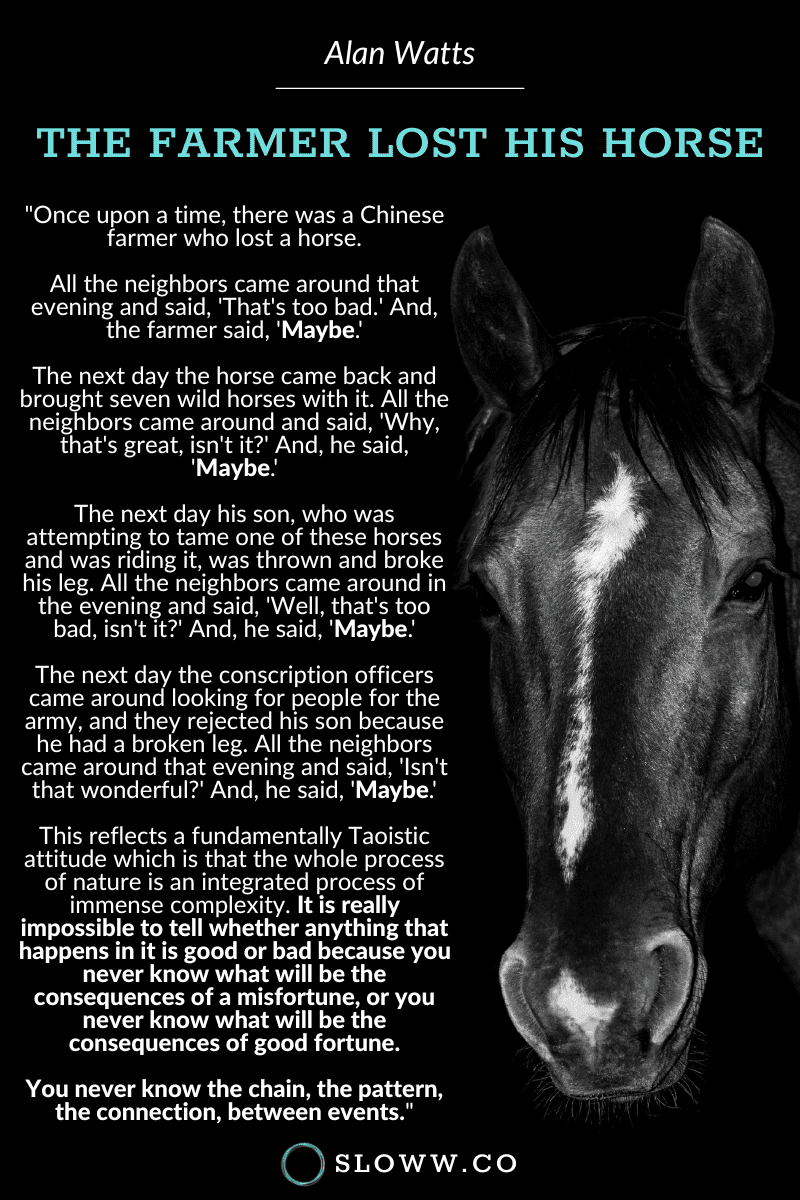
Have you ever had something happen that felt like the worst thing in the world, only for it to turn out to be a blessing in disguise? This very idea is at the heart of a timeless Chinese story about a horse, a farmer, and the unpredictable nature of destiny. This ancient Taoist parable, dating back to the 2nd century B.C., offers a profound lesson on how we perceive good luck and bad luck. It challenges us to look beyond immediate events and embrace the simple, powerful wisdom of “we’ll see.” This narrative is more than just a simple fable; it’s a guide to navigating the ups and downs of life with a calm and resilient perspective. A similar theme of unexpected outcomes can be found in the chinese story of the old man and the horse, which explores related concepts.
The Tale of the Farmer and His Horse
The story, often known as “Sài Wēng Shī Mǎ” (塞翁失馬), unfolds on the northern frontier of ancient China, where an old farmer lived with his son.
A Sudden Misfortune
The farmer’s most prized possession was a strong, beautiful horse. His neighbors often commented on his good fortune to own such a fine animal. One morning, the farmer discovered the horse had run away, disappearing into the vast neighboring lands.
His neighbors quickly gathered to offer their sympathies. “What terrible luck!” they said. “To lose such a valuable horse is a great misfortune.”
The old farmer simply listened, nodded, and replied, “Maybe. We will see.”
His response puzzled them. How could this be anything but bad news?
An Unexpected Blessing
A few months passed. Then, one day, the farmer’s horse returned. It wasn’t alone. Following it was a magnificent herd of wild horses. The farmer and his son now had a stable full of strong, valuable animals.
Once again, the neighbors rushed over, this time to celebrate his incredible luck. “This is amazing!” they exclaimed. “Your misfortune has turned into a great fortune. You are a wealthy man now!”
The old farmer, calm as ever, simply replied, “Maybe. We will see.”
The neighbors left, shaking their heads at his strange refusal to celebrate. The tale of the lost horse story often echoes this sentiment of loss and unexpected return.
A Fortunate Tragedy
The farmer’s son, eager to make use of their newfound wealth, began the task of taming the wild horses. He was a skilled rider, but one of the horses was particularly spirited. It bucked violently, throwing the young man to the ground. He landed badly, and his leg was severely broken. The injury was so bad that it was clear he would walk with a limp for the rest of his life.
The neighbors heard the news and came to offer their condolences once more. “Oh, what a terrible tragedy,” they lamented. “This ‘good luck’ has brought you such sorrow. Your only son is now disabled. This is truly bad fortune.”
And once again, the old farmer looked at the situation and said, “Maybe. We will see.”
The Final Twist
A year later, the emperor’s army marched into the village. A war had broken out, and all able-bodied young men were being conscripted to fight on the front lines. The battle was fierce, and the chances of survival were slim.
The conscription officers went from house to house, taking every young man they could find. When they arrived at the farmer’s home, they saw his son with his badly broken leg. Deeming him unfit for military service, they passed him by and left. Nine out of ten of the young men from the village who went to war never returned.
The farmer’s son was spared. The neighbors, whose own sons were now gone, came to the old farmer, their voices filled with awe. “You were right,” they said. “Your son’s injury, which we saw as a disaster, saved his life. Your wisdom is profound. This was the greatest luck of all.”
The old farmer, tending to his son and his horses, simply said, “Maybe. We will see.”
The Deeper Meaning: A Taoist Perspective
This story is a perfect illustration of core Taoist principles. Taoism, an ancient Chinese philosophy, emphasizes living in harmony with the “Tao,” the natural order of the universe. It teaches that concepts like “good” and “bad” are human inventions and that reality is far more complex and interconnected.
Embracing Uncertainty
The farmer’s constant reply, “Maybe,” is not a sign of indifference but of deep wisdom. He understands that he cannot possibly know the full chain of events that will follow any single occurrence. What appears to be a blessing could lead to a future hardship, and a present misfortune could be the seed of future joy. This is a central lesson in many fables, including the well-known chinese farmer horse story. The farmer chooses not to judge events but to accept them as they are, trusting in the flow of life.
As the modern philosopher Alan Watts, who popularized this story in the West, explained: “The whole process of nature is an integrated process of immense complexity, and it’s really impossible to tell whether anything that happens in it is good or bad.”
Beyond Good and Bad Luck
The story challenges our deep-seated need to label everything. We are quick to celebrate victories and mourn losses. The farmer shows us a different way: to observe without immediate judgment. He demonstrates a profound level of emotional balance. He is not overjoyed by his newfound wealth, nor is he devastated by his son’s injury. He remains grounded in the present moment, aware that the story is always unfolding.
This perspective is incredibly freeing. It releases us from the emotional rollercoaster of reacting to every twist and turn of fate. By accepting that we don’t have the full picture, we can find peace in the middle of uncertainty. The dynamic between father and son is also central to the narrative, a theme further explored in the chinese story man son horse.
How to Apply the Farmer’s Wisdom Today
While this is an ancient tale, its message is more relevant than ever in our fast-paced, unpredictable world. Here is how you can apply the farmer’s wisdom to your own life.
In Your Career
Imagine you get passed over for a promotion you desperately wanted. Your initial reaction is disappointment—this is “bad luck.” But a few months later, the company restructures, and the person who got the promotion is now in a high-stress, unstable position. Meanwhile, you were free to find a new opportunity at another company that turned out to be a much better fit for you. The “misfortune” was actually a hidden blessing.
In Personal Relationships
A painful breakup can feel like the end of the world. It’s easy to see it as a complete failure. However, that experience might teach you invaluable lessons about yourself and what you need in a partner. The time you spend alone might lead to personal growth that prepares you for a healthier, more fulfilling relationship in the future. The perceived “bad luck” was a catalyst for positive change.
The farmer’s story teaches us to pause before we label an event. When something happens, instead of immediately reacting with “This is terrible!” or “This is fantastic!”, try taking a step back and saying to yourself, “Maybe. We will see.” This creates mental space and allows you to respond to situations with more clarity and less emotional turbulence. For those interested in mythical creatures, the flying horse story offers a different but equally fascinating narrative.
Frequently Asked Questions (FAQ)
What is the original name of the Chinese story about the horse?
The story is known as “Sài Wēng Shī Mǎ” (塞翁失馬), which translates to “The Old Man of the Frontier Lost His Horse.” It comes from a 2nd-century B.C. collection of philosophical essays called the Huainanzi.
What is the main moral of the story?
The primary moral is that fortune and misfortune are two sides of the same coin and are constantly changing. An event that seems bad may turn out to be good, and vice versa. Therefore, it is wise to avoid making hasty judgments and to accept life’s uncertainties with a calm perspective.
How does this story relate to Taoism?
The story is a perfect allegory for Taoist principles. It illustrates the idea of non-judgment, the interconnectedness of opposites (yin and yang), and the importance of living in harmony with the natural, unpredictable flow of events (the Tao) rather than resisting it.
Who was the farmer in the story?
The farmer is not a specific historical figure but an archetypal character representing a wise elder who understands the deeper workings of the universe. His wisdom comes from his ability to observe nature and accept its cycles without interference.
How can I apply the story’s lesson in my daily life?
When you face a setback, try to suspend judgment and remain open to the possibility that it may lead to an unforeseen opportunity. Conversely, when you experience success, practice humility and be aware that circumstances can change. This balanced mindset can reduce anxiety and increase resilience.
A Final Thought on Fortune
The Chinese story about a horse and the wise old farmer is more than just a clever fable. It is a powerful reminder that life is a complex tapestry, and we can only see a tiny part of the pattern at any given moment. What looks like a tangled knot today might be part of a beautiful design tomorrow.
By embracing the farmer’s patient and accepting attitude, we can navigate our own lives with greater peace and resilience. The next time you find yourself caught in a moment of triumph or despair, remember the farmer and his simple, profound wisdom: “Maybe. We will see.”
