
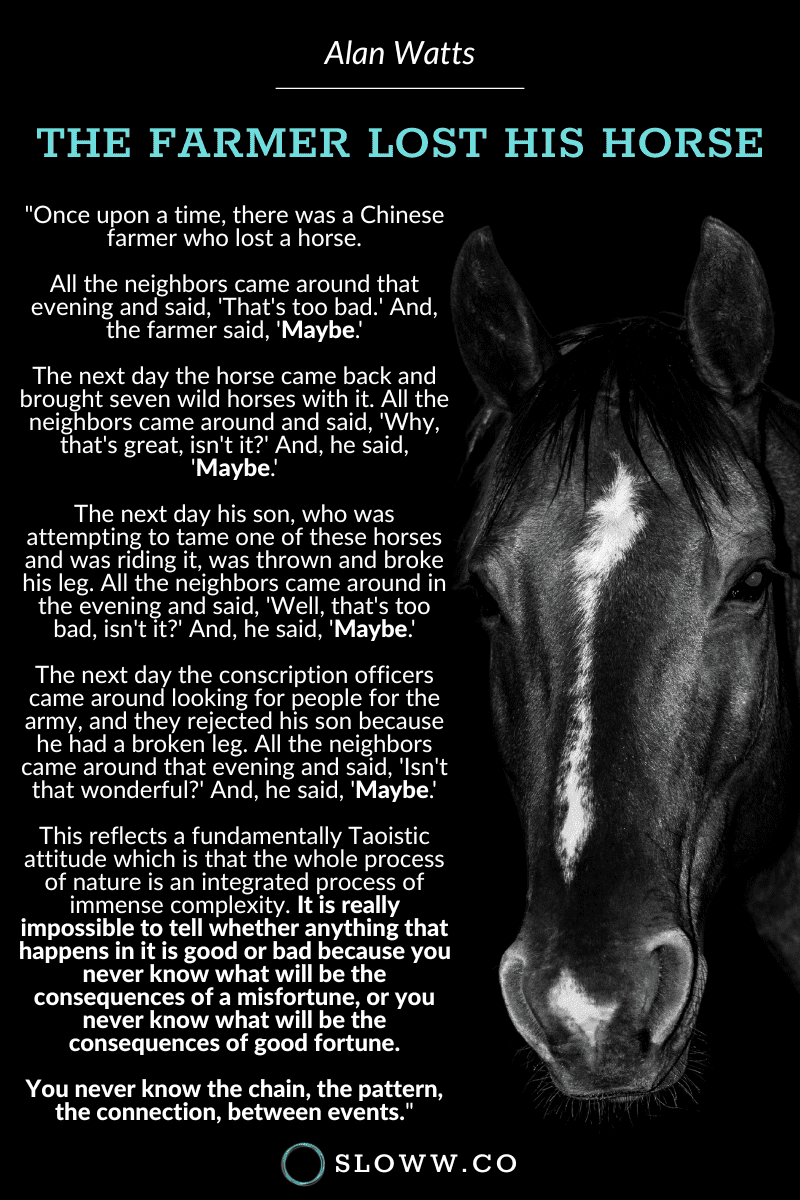
In a small village nestled among rolling hills, lived an old Chinese farmer. He was a simple man, content with his life, his land, and his single horse. One day, his horse ran away. His neighbors, hearing the news, came to offer their condolences. “We’re so sorry to hear your horse ran away,” they said. “This is terrible luck.” The farmer simply shrugged and replied, “Maybe. Maybe not. We’ll see.”
A week later, the horse returned. Not only that, but it had brought with it a magnificent wild stallion, larger and stronger than any horse in the region. The villagers rejoiced. “What wonderful luck!” they exclaimed. “Your horse has returned, and brought a wild stallion with it! This is the best fortune!” The farmer, stroking the stallion’s mane, simply said, “Maybe. Maybe not. We’ll see.”
The farmer’s son, a young man eager to prove himself, decided to break in the wild stallion. During the training, he was thrown from the horse and broke his leg. Again, the neighbors came to lament. “Your son is injured,” they cried. “He broke his leg! Such terrible misfortune!” The farmer, looking at his son’s cast, calmly replied, “Maybe. Maybe not. We’ll see.”
A few months later, a great war broke out. The Emperor’s army swept through the land, conscripting every able-bodied young man into service. The villagers’ sons were all sent to battle, and few were expected to return. But when the army came to the farmer’s village, they saw the farmer’s son, his leg still in a cast, and left him behind. “What a blessing,” the farmer murmured, watching the recruiters march away. “Maybe. Maybe not. We’ll see.”
This ancient parable, often simply referred to as the “Chinese farmer’s horse story,” beautifully illustrates a profound truth about life: the inherent uncertainty of events and the subjective nature of luck. It’s a tale that resonates deeply, offering a timeless perspective on how we perceive and react to the twists and turns of our existence.
Understanding the Horse Story’s Core Message
At its heart, the “Chinese farmer’s horse story” is about perspective. The farmer’s response—”Maybe. Maybe not. We’ll see.”—is not one of indifference, but of wisdom. He understands that what appears to be good fortune can have unforeseen negative consequences, and what seems like a disaster might, in fact, lead to something positive. This narrative challenges our conventional binary thinking of “good luck” versus “bad luck,” urging us to consider the interconnectedness and unpredictable nature of life’s events.
The story doesn’t deny that events have impacts, but it questions our immediate judgment of those impacts. The horse running away could be seen as a loss, but it led to the acquisition of a valuable stallion. The stallion’s training resulted in an injury, which, in turn, saved the farmer’s son from the ravages of war. Each event, in isolation, could be labeled, but their true significance is only revealed through the unfolding of subsequent events.
The Philosophical Roots: Taoism and the Yin-Yang Principle
The wisdom embedded in the “Chinese farmer’s horse story” is deeply rooted in Taoist philosophy, particularly the concept of Yin and Yang. Yin and Yang represent complementary, interconnected, and interdependent forces that shape our world. Nothing is purely Yin (negative) or purely Yang (positive); rather, they exist in a dynamic balance, constantly transforming into one another.
The story mirrors this principle by showing how apparent opposites—fortune and misfortune—are intertwined. The runaway horse (misfortune) brings a stallion (fortune). The son’s injury (misfortune) prevents his conscription (fortune). This cyclical, flowing nature of events suggests that trying to label them definitively as “good” or “bad” is a futile exercise. Instead, Taoism encourages acceptance and adaptability, recognizing that life’s challenges and blessings are part of a larger, unfolding whole.
“Life is a series of natural awakenings and adjustments. The good times are when we are aligned with the flow of life. The difficult times are when we are resisting the flow.” – Lao Tzu (paraphrased)
Applying the Farmer’s Wisdom to Our Lives
How can we apply the farmer’s unique perspective to our own experiences? It’s a call to cultivate a more resilient and less reactive mindset.
1. Cultivating Detachment from Immediate Judgment
When faced with a setback, try to echo the farmer’s response. Instead of immediately labeling it as “terrible luck,” pause and consider the possibilities. What might this event lead to? Could there be an unexpected benefit down the line? This doesn’t mean suppressing emotions or pretending a bad event isn’t painful, but rather refraining from definitive, negative pronouncements about its ultimate meaning.
2. Embracing Uncertainty
Life is inherently unpredictable. The “Chinese farmer’s horse story” reminds us that we rarely have a complete picture of how events will unfold. By accepting this uncertainty, we can reduce anxiety and become more adaptable. Instead of clinging to rigid expectations, we can learn to flow with life’s currents, much like the farmer.
3. Finding the Silver Lining (and its Potential Cloud)
This isn’t about toxic positivity, but about a balanced outlook. When something good happens, acknowledge it, but also remain aware that it might bring its own set of challenges. When something bad happens, acknowledge the difficulty, but keep an open mind to potential positive outcomes. This balanced view prevents us from becoming overly attached to perceived good fortune or utterly crushed by perceived misfortune.
4. Focusing on What We Can Control: Our Reactions
While we cannot control external events, we can control our internal response to them. The farmer’s wisdom lies not in predicting the future, but in his calm, measured reaction to the present. By focusing on our attitude, our actions, and our resilience, we can navigate life’s ups and downs with greater grace.
The Enduring Relevance of the Farmer’s Tale
The “Chinese farmer’s horse story” continues to be a powerful narrative because it speaks to a universal human experience. We all face events that seem overwhelmingly good or devastatingly bad at first glance. The farmer’s simple yet profound wisdom offers a timeless antidote to our tendency to jump to conclusions and get swept away by the emotional tides of fortune and misfortune.
It encourages us to pause, to observe, and to understand that life is a complex tapestry where threads of joy and sorrow are often woven together. By adopting the farmer’s perspective, we can approach life with greater equanimity, resilience, and a deeper appreciation for the intricate dance of events that shape our journey. The story serves as a gentle, enduring reminder that sometimes, the greatest wisdom lies in simply waiting to see what tomorrow brings.
