
Many pet owners dream of a harmonious household where their dogs and cats coexist peacefully, perhaps even cuddling together. While this ideal scenario is certainly achievable for some, it’s crucial to remember that every animal is an individual. Their past experiences and how they are introduced to each other significantly influence their ability to get along. If you’re struggling with your dog constantly Chasing A Cat in your home, understanding the root causes and implementing effective management and training strategies can help foster a more tranquil environment for all your beloved pets.
Why Do Dogs Chase Cats? Understanding the Instinct
The act of chasing is inherently self-reinforcing for dogs, deeply rooted in their instinctual nature. This behavior stems from their evolutionary past, where the ability to chase prey was vital for survival and securing food. Certain dog breeds, specifically those bred for herding or hunting, also have an amplified prey drive, making them more prone to chasing anything that moves quickly. For these breeds, chasing is not just an instinct but often a part of their genetic programming.
Sometimes, however, a dog’s pursuit isn’t predatory but rather an attempt to initiate play. Dogs often engage in running and chasing as a fundamental part of their playtime with other dogs or humans. They might perceive a cat’s quick movements as an invitation to a game, not realizing the distress it causes the feline. Distinguishing between playful chasing and prey-driven behavior is important, although the cat’s experience of fear and stress remains the same regardless of the dog’s intent.
The Cat’s Perspective: Fear and Aggression
A cat’s reaction to a dog is heavily influenced by its prior experiences. If your cats have never lived with dogs before, their natural inclination might be to fear these larger, more boisterous creatures. When confronted by a dog, a fearful cat’s primary responses are usually flight or fight. They will likely try to run away, which, unfortunately, can further trigger a dog’s chase instinct. If a cat is cornered and has no escape route, this fear can quickly escalate into aggressive behavior, such as hissing, swatting, or even biting, as a desperate measure of self-defense.
Furthermore, a cat that is generally fearful or anxious about new environments, people, or other animals is more likely to react by running from a dog or anything unfamiliar. Introducing dogs to such a cat requires significant patience and a much slower, more controlled approach to help them overcome their inherent apprehension. Understanding the cat’s emotional state is key to de-escalating the chasing behavior from the canine side.
Addressing Your Dog’s Needs: Exercise and Energy Management
One of the foundational steps in addressing a dog’s tendency for chasing a cat is to ensure their own needs are sufficiently met, particularly regarding physical activity and mental stimulation. An under-exercised dog, especially one with high energy levels, might resort to chasing the cats as an outlet for their pent-up energy. They may simply be looking for a way to burn off steam, and the cats’ movements provide an easy target.
Even an older dog, like the 8-year-old in the original query, can benefit from increased exercise. While they might not require the same intensity as a younger pup, regular walks, play sessions, or even mental games can help deplete excess energy and foster a calmer demeanor. Evaluating your dog’s current exercise routine and potentially increasing its duration or intensity can make a noticeable difference in reducing their motivation to chase.
Environmental Management: Creating Safe Spaces for Cats
Establishing an effective management plan is paramount. It is crucial to prevent the dog from practicing the chasing behavior while you are actively working to change it. Every time a dog successfully chases a cat, the behavior is reinforced, making it harder and longer to modify. Therefore, the first step is to manage the environment to ensure the cats feel safe and have reliable escape routes.
Consider re-implementing a form of separation, similar to the initial introduction phase. Designate a “cat sanctuary” room equipped with food, water, and a litter box, where your cats can retreat and feel completely secure from the dog. This ensures that any interactions between the dog and cats are supervised and intentional, preventing unintended chasing incidents. This temporary measure, while perhaps inconvenient, is vital for the cats’ well-being and the success of your training.
Cats inherently feel safer and more confident when they have vertical space. Providing numerous high-up perches, such as cat trees, wall-mounted shelves, or the tops of tall furniture, allows them to observe their surroundings from a safe vantage point. Additionally, create secure hiding places and escape routes that the dog cannot access. This could involve small tunnels behind furniture, strategically placed baby gates with integrated cat doors, or even simply ensuring that cats have clear paths to jump onto elevated surfaces if a dog approaches. These measures empower cats to manage their own safety, reducing their stress levels.
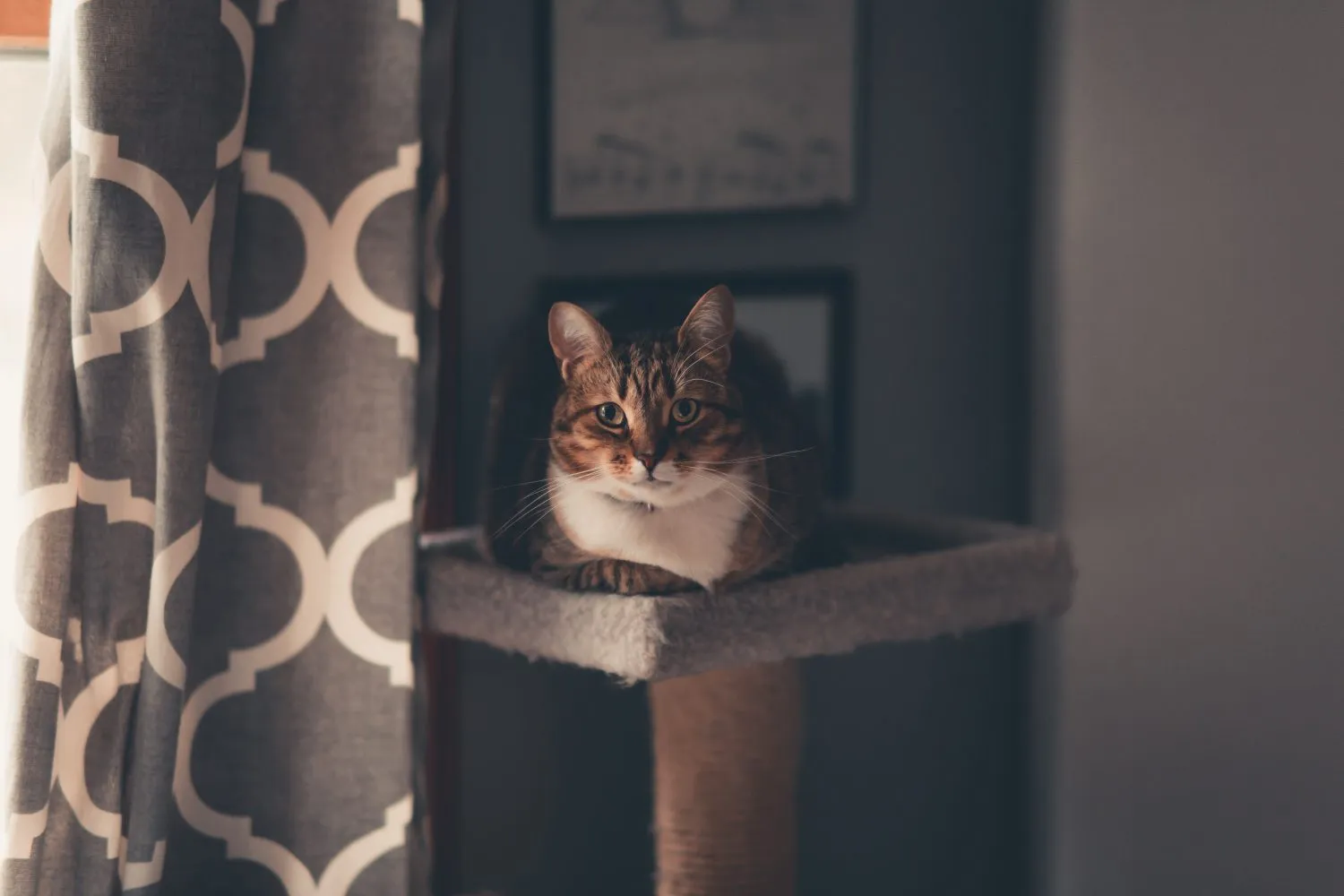 An orange cat sits calmly on a brown cat tree, observing its surroundings
Managing Your Dog’s Movement and Behavior
Beyond environmental adjustments, actively managing your dog’s movement and behavior is essential for controlling the chasing impulse. When working on this issue, your dog should ideally be dragging a lightweight leash whenever she is in the same room as the cats. This drag leash allows you to quickly and safely intervene by stepping on it, preventing any immediate cornering or chasing before it escalates. It provides you with a crucial safety net while your dog learns to respond to cues consistently.
Crate training is another invaluable tool. By having your dog comfortably crate-trained, you can place her in her crate while the cats roam freely. This allows the cats to relax and gain confidence in the dog’s presence without the threat of being chased. A training tether can also be incredibly helpful. This involves attaching your dog’s leash to a heavy, immovable object like a sturdy piece of furniture or a door frame, keeping her in a specific spot while the cats are present. This controlled environment facilitates supervised interactions where you can reward calm behavior and prevent chasing.
Essential Training Cues to Prevent Chasing
Teaching your dog specific redirection cues is fundamental to interrupting and preventing chasing behavior. The goal is to catch your dog’s focus on the cat before the chase begins. Often, staring intently at a cat is the first indicator that a dog is about to initiate pursuit.
A positive interrupter is a distinct, short sound or phrase (e.g., “Ready!”) that you condition your dog to associate with immediate, positive reinforcement. The moment your dog hears it, she should disengage from whatever she’s doing and happily come to you for a reward. This effectively breaks her focus on the cat. The “Leave It” command is another critical cue, teaching your dog to disengage from an object or animal they are approaching or fixated on and return their attention to you.
The key to success with these training cues is to teach and practice them outside the context of cat-chasing behavior initially. Do not wait for your dog to be actively fixated on a cat to introduce these commands; she won’t be in a learning state. Practice in calm environments with fewer distractions first, gradually increasing the difficulty. It’s also vital to consistently reinforce her for listening and coming back to you with high-value treats, even occasionally. Remember, you are competing with a highly rewarding, instinctual behavior, so you need to make listening to you even more rewarding.
Step-by-Step Training Application
Once your dog understands the basic cues, you can begin to apply them in more controlled situations involving the cats. Start by calling your dog away from a cat that is safely contained in a carrier or behind a baby gate. Ensure your dog is not allowed to get too close initially, making it easier for her to succeed and receive reinforcement. The goal is to gradually increase the level of difficulty, always setting your dog up for success by ensuring she can respond reliably at each stage before moving on. Slow and steady progress is far more effective than rushing.
Teaching Calmness: Stationary Cues
Another crucial aspect of training is to teach your dog how to behave calmly in the presence of cats. Stationary cues like “Stay” or “Place” are incredibly useful for this purpose. These commands teach your dog to remain in a specific spot, such as on a mat or a dog bed, even as the cats move around the room.
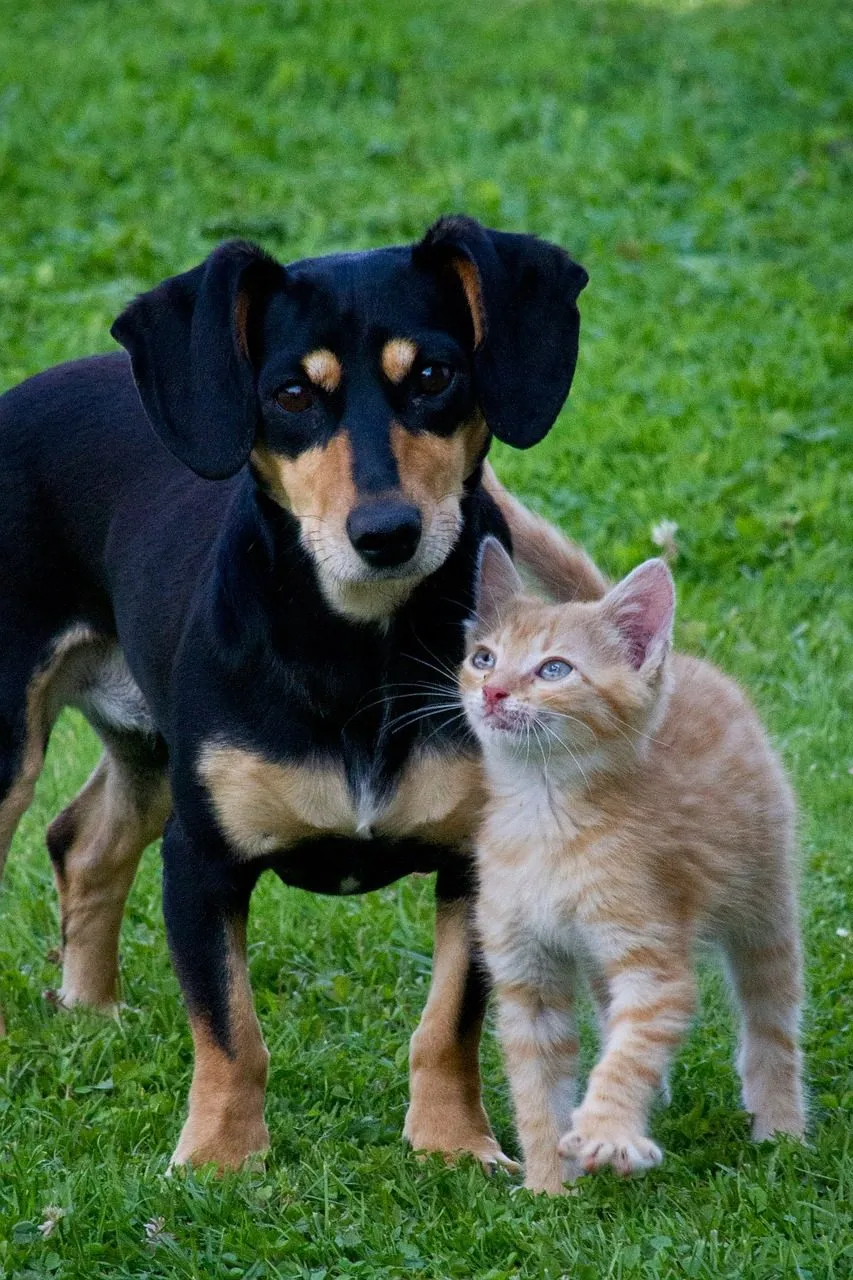 A small black dog and a ginger kitten stand next to each other, looking up calmly
Again, introduce and solidify these cues in a low-distraction environment first, away from the cats. Once your dog reliably performs “Stay” or “Place” on command, you can gradually introduce the cats into the environment, rewarding your dog heavily for remaining calm and in position. This teaches your dog that peaceful coexistence, rather than chasing, brings positive outcomes.
Changing Emotional Responses: Desensitization and Counter-Conditioning
For both dogs and cats, the goal is to change their emotional response to one another. If a cat is fearful of the dog, we can employ desensitization and counter-conditioning. This involves pairing the dog’s presence with something highly positive for the cat, such as delicious treats like tuna or chicken. The key is to work at a distance where the cat feels comfortable and relaxed. Let the cat dictate the pace, allowing them to choose how close or far they want to be from the dog.
For example, if your dog is at a baby gate, another person can feed the cat high-value treats whenever the cat calmly looks in the dog’s direction. Similarly, apply the same training principles to the dog, rewarding her for calm, non-reactive behavior in the cat’s presence. By consistently associating the other animal with positive experiences, you can gradually shift both animals’ emotional responses from fear or excitement to calmness and acceptance.
When to Seek Professional Help
The specific training and management plan will always depend on the individual personalities and histories of your pets. Some situations are more complex and may require specialized guidance. If you find yourself struggling to formulate an effective plan or if the chasing behavior persists despite your efforts, it is highly recommended to seek assistance from a qualified professional. A Certified Professional Dog Trainer can provide tailored advice, hands-on guidance, and a comprehensive strategy designed for your specific household dynamics.
You can locate a certified professional dog trainer through reputable organizations such as the Certification Council for Professional Dog Trainers (CCPDT) to ensure you’re working with a knowledgeable and ethical expert. While achieving a “best friends” relationship between your dog and cat may not always be possible, with consistent effort and the right strategies, you can certainly reach a point where all your pets can share their space comfortably and without stress, fostering peace and harmony in your home.
References
- Certification Council for Professional Dog Trainers (CCPDT): https://www.ccpdt.org/dog-owners/certified-dog-trainer-directory/
