
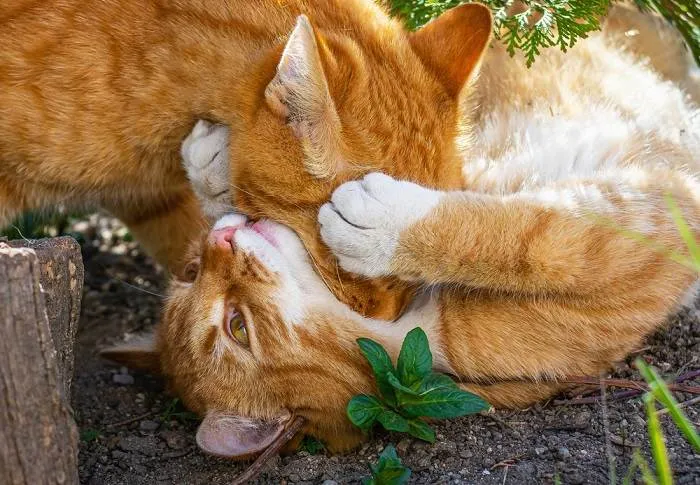
 Two cats playing, one gently biting the other's neck
Have you ever found yourself observing your feline companions and pondering, “Why do cats bite each other’s necks?” This behavior might seem primitive, something you’d primarily associate with a wildcat. However, it’s crucial to remember that our beloved domestic cats are direct descendants of their wild ancestors, carrying many innate instincts into their domesticated lives.
While our cats often appear content and cuddly, purring on our laps, they still exhibit numerous wild traits adapted for their home environment. Neck biting is one such common behavior that manifests for various reasons. While it can sometimes be alarming to witness, this adapted action also has positive and essential roles in feline communication. Not all instances of neck biting lead to injury; instead, it’s often a fundamental part of how cats interact. Understanding these behaviors can help pet owners decipher their cat’s intentions and needs.
This article will delve into the top five reasons why cats bite each other’s necks, offering insights into this intriguing aspect of feline interaction. Understanding these nuances is key to fostering a harmonious household, especially in multi-cat environments. From playful skirmishes to more serious signals, we will explore the underlying motivations behind this seemingly aggressive, yet often benign, action. Cats communicate in various ways, and a deeper understanding of their body language and vocalizations, such as a cat meowing meaning, can significantly enhance your bond with them.
Cats Biting Each Other on the neck is typically normal feline behavior and, in most contexts, harmless. It’s a natural expression of their instincts and an integral part of their communication toolkit. However, when neck biting escalates to aggressive levels and causes harm, it could signal an underlying medical or behavioral issue that requires attention.
Key Takeaways
- Cats biting each other on the neck is normal cat behavior and is usually harmless.
- There are a number of reasons cats bite each other on the neck, and it is a normal aspect of how cats express themselves.
- When neck biting becomes more aggressive and does harm, it can be a sign of an underlying medical or behavioral issue.
1. Mating Behavior
One of the primary reasons for cats biting each other’s necks is related to mating behavior. During copulation, male cats (toms) often display dominance over female cats (queens). The male cat typically mounts the female and bites her neck to hold her still. This action generally does not harm the female and serves a crucial purpose: it protects the male during a vulnerable moment and has a calming effect on the female, akin to how a mother cat handles her kittens. This gentle bite prevents the female from turning and potentially attacking him.
Beyond mating, carrying young is another instance where cat neck biting, or more accurately, scruffing, is not intended to cause harm. Mother cats are incredibly adept at carefully lifting their tiny kittens by the scruff of their neck. This method allows them to move their offspring out of harm’s way, to a new den, or to a safer bed. It is the most secure and effective way for a queen to transport her young. The kitten’s fur protects their fragile skin from the gentle bite, and holding them by the scruff is widely believed to have a calming effect on the young kitten, temporarily immobilizing them.
2. Playing and Learning
Kittens, much like human children, love to engage in play fighting with their littermates, other household cats, and even their human family members. Play is an invaluable opportunity for young felines to mimic and trial various behaviors, allowing them to test boundaries and refine their communication skills with both their peers and human companions. When new kitten meowing is accompanied by playful nips, it’s often a sign of healthy development.
Through play, kittens get to hone their fighting and hunting skills, all while having a great deal of fun. When cats bite each other’s necks during play, they are often also pouncing, tumbling, and wrestling, which is highly stimulating and exciting for them. Crucially, the recipient of the neck bite provides instantaneous feedback on what is acceptable and what is not. This interactive learning process is not only enjoyable but also vital for a cat’s social development, teaching them bite inhibition and appropriate play behavior.
However, this behavior isn’t exclusive to kittens. Sometimes, even an adult cat might turn and nip your hand when you are calmly playing or grooming them. This is often their way of communicating that they’ve had enough stimulation or physical contact, signaling for you to stop. Understanding these subtle cues is essential for harmonious interaction.
3. Fighting and Dominance
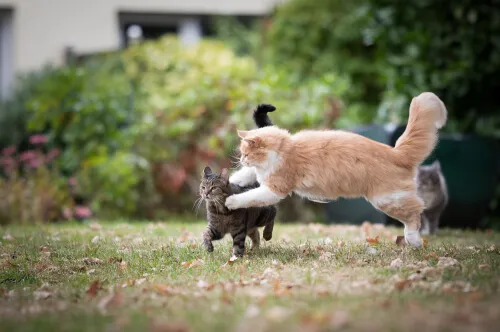 Two cats in a tense standoff, potentially about to fight
In multi-cat households, displays of dominance and neck biting can be a way for your cats to maintain their hierarchy and establish social order. While a male cat learns essential fighting skills through play during kittenhood, his perspective shifts as he reaches sexual maturity. As adult hormones surge, he becomes more adventurous, often seeking to establish and mark his territory. However, not all neighboring cats may welcome his presence, potentially leading to confrontations with more aggressive felines in the area.
Conflict can arise if your cat’s territory overlaps with another’s. Furthermore, cats frequently express dominance over various resources, including living space, food bowls, litter boxes, toys, and even human attention. When male cats bite each other’s necks in these situations, it is a clear expression of their dominance over a rival vying for the same resource. This behavior is common during outdoor territorial disputes but also occurs within multi-cat households as a means for cats to determine and maintain their social hierarchy.
Introducing a new cat into an established hierarchy requires careful management and patience. Proper introductions can help existing cats and new family members get along successfully, minimizing aggressive behaviors. Observing a male cat yowling meaning can also provide clues about territorial disputes or mating intentions.
4. Hunting Instinct
Cats possess an intense predatory drive, a legacy from their wild ancestors. You may witness your cat demonstrating a wide array of hunting skills, from silently stalking to pouncing and ultimately attacking their “prey.” This ingrained instinct can be incredibly powerful. Just like wildcats, domestic felines are programmed to immobilize their prey as quickly and efficiently as possible, and a bite to the neck of their target is highly effective in achieving this.
Even if your cat isn’t prowling outdoors every evening, their predatory instinct remains strong. You might observe this drive manifesting in their play behaviors with littermates or toys. A kitten pouncing on a toy mouse and delivering a simulated neck bite is practicing crucial survival skills. This instinctive behavior is not just about catching prey; it’s about the entire sequence of the hunt, from the stalk to the final, decisive action. This drive is often why cats enjoy games that simulate hunting.
5. Increased Aggression Due to a Medical Issue
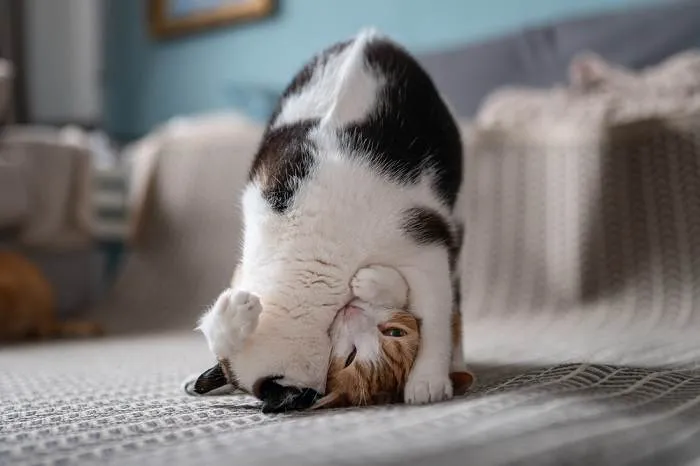 Close-up of a cat's neck, suggesting a bite mark or focus area
Occasionally, an increase in neck biting towards housemates and other aggressive behaviors might signal an underlying behavioral or medical issue. If your cat, traditionally a gentle companion, suddenly exhibits more aggressive tendencies, they might be trying to communicate that something is amiss. For instance, if you observe an unneutered male cat meowing aggressively, it could be hormone-driven.
If neck biting other cats is completely out of character for your feline, it’s important to consider whether your cat is experiencing any undue stress. Significant changes around the house, within the family dynamics, or even in the neighborhood environment can be underlying stressors. If no external cause for stress can be identified, it’s crucial to consider whether your cat feels unwell or is in pain. Behavioral changes and increased aggression in cats can be symptomatic of numerous medical conditions.
For example, certain medical conditions cause chronic pain, such as arthritis, while others lead to behavioral shifts due to hormonal imbalances, like hyperthyroidism, or even neurological diseases affecting the brain. These illnesses often come with other noticeable symptoms, so carefully monitor your cat for any other out-of-character behaviors. If you suspect your cat’s behavioral change is due to illness, a prompt visit to your veterinarian is essential for diagnosis and treatment.
Ultimately, neck biting is not a behavior that needs to be entirely eliminated from a cat’s repertoire. It is, however, crucial for pet owners to understand their cat’s body language and intervene proactively before play escalates or situations get out of control. Providing ample personal space for each cat in multi-cat families is also vital to reduce potential conflicts. If the most intense fighting occurs with neighborhood cats at night, implementing a curfew to keep your cat safely indoors might be necessary. Observing behaviors like my kitten won t stop meowing can also be an early indicator of stress or underlying issues.
Frequently Asked Questions
Is it OK for my cat to bite another cat’s neck?
Neck biting is a natural instinct for cats and is perfectly acceptable within the right context. Gentle biting to communicate their needs, or as part of play behavior, is an essential component of your cat’s communication toolkit. Playtime offers a wonderful opportunity for your cat to express themselves safely. However, aggressive biting that causes injury to other cats is less desirable and warrants intervention. In such circumstances, it is crucial to identify and address the triggers first.
How can I tell if my cats are playing or fighting?
Body language and vocalization are vital indicators for determining whether your cats are in play or fight mode. Play is typically silent or involves quiet meows and gentle hisses, especially in kittens, and is relatively gentle despite chasing and tumbling. The cats should not show any signs of distress. When play escalates to fighting, cats often display aggressive posturing beforehand, such as raised hackles, flattened ears, hissing, and growling. Cats tend to be very vocal during actual fights, and their body language is overtly aggressive, with an clear intent to cause harm. Remember, it can be dangerous to intervene directly in an intense cat fight, so prioritize your own safety to avoid getting bitten.
How can I stop my cats from fighting?
It is essential to consider all the potential reasons why your cats might be fighting. Do they have enough safe spaces where they can retreat from each other? Is there conflict over essential resources like food, water, or litter boxes? Has there been a disruption in the home environment, such as construction or a new pet? Or is an older cat experiencing health issues like arthritis, making them less patient with a younger, more energetic kitten?
Ensuring each cat has plenty of private space to hide, eat, and sleep in peace is an excellent starting point. If your cats show signs of overstimulation or frustration, try to intervene before any biting begins by redirecting their energy with engaging toys and treats, or by moving the aggressor to a quieter, separate space. Never reward biting behavior, as this can inadvertently reinforce that the action is acceptable. Similarly, punishments should be avoided as they are often ineffective and can worsen behavioral issues. It is far more beneficial to prevent undesired behavior before it even occurs.
