
Have you ever looked at your furry best friend and thought, “I wish you could come on this trip with me”? For many dog owners, the logistics of travel can be a significant hurdle. While cars are a common choice, what about public transport? Specifically, Can You Take Dogs On Trains? The answer is a resounding “yes,” but it comes with a few important caveats. Navigating the world of train travel with a canine companion can seem daunting, but with the right information and preparation, it can be a comfortable and enjoyable experience for both of you. This guide will walk you through the general rules, tips, and company-specific policies to ensure your next rail adventure is a success.
Understanding the rules is key, and it’s a topic that has much in common with the query of whether a dog on a train is a common sight. The policies can vary dramatically depending on your location and the specific train operator.
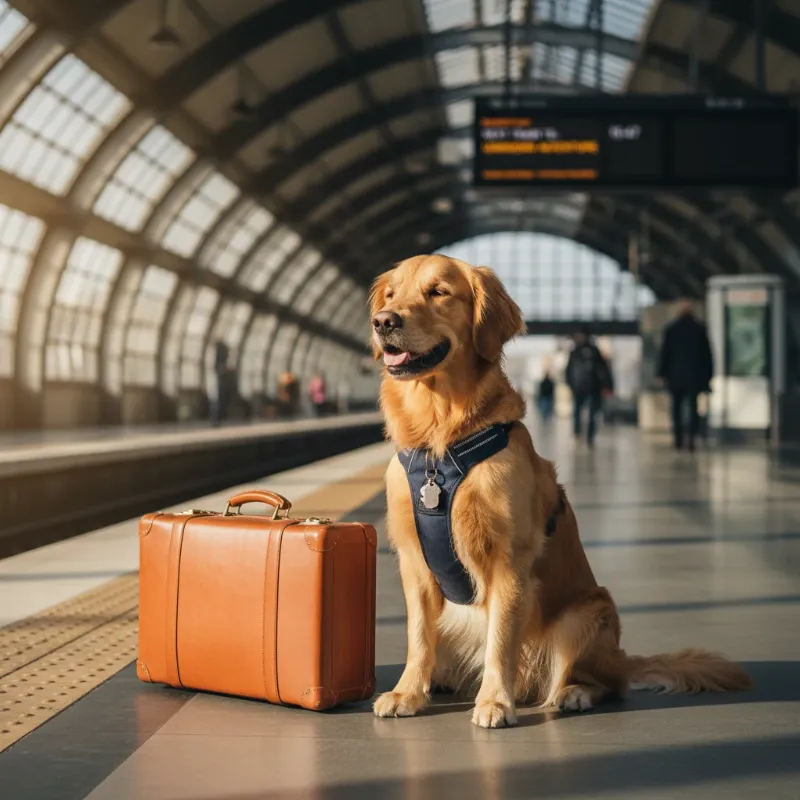 A well-behaved golden retriever sitting calmly next to a suitcase on a train platform, answering the question "can you take dogs on trains" visually.
Navigating the Rules: What to Know Before You Go
Before you even think about packing your dog’s favorite squeaky toy, the first step is to research the policies of the train company you plan to use. There isn’t a universal rule for canine rail travel, and what’s acceptable on one line might be prohibited on another.
General Policies and Common Restrictions
Most train operators that welcome dogs have a set of standard guidelines in place to ensure the safety and comfort of all passengers. These rules typically revolve around three key areas: size, containment, and behavior.
- Size Matters: Many railway companies have restrictions on the size and weight of dogs allowed on board. Small dogs are generally more widely accepted than large breeds. For example, a common weight limit is around 20-25 pounds.
- Carrier Requirements: With few exceptions, most train lines mandate that small dogs must remain in a carrier or crate for the entire journey. These carriers must be well-ventilated, secure, and typically need to fit under the seat in front of you or on your lap.
- Leash and Behavior: For larger dogs that are permitted outside of a carrier (a rarity on some long-distance routes), they are almost always required to be on a leash and well-behaved. An aggressive or disruptive dog may be asked to leave the train.
Are There Fees for Canine Passengers?
This is a very common question. Sometimes! While some train networks allow small pets to travel for free, others require you to purchase a specific pet ticket, which is usually a fraction of a human fare. Always check the ticketing policy when booking. Forgetting to pay a pet fee can lead to complications on your travel day.
Preparing Your Dog for Train Travel
A successful train journey with your dog starts long before you arrive at the station. Preparation is crucial for a stress-free experience. If your dog is new to this, you might find the process similar to what’s involved in training service dogs atlanta, where acclimatization and positive reinforcement are key.
Acclimatize Your Dog to the Carrier
If your dog needs to be in a carrier, don’t let the first time they see it be on the day of your trip. Introduce the carrier at home weeks in advance. Make it a comfortable, positive space.
- Introduce It Slowly: Leave the carrier open in your living room with a comfy blanket and some favorite toys inside.
- Use Positive Reinforcement: Encourage your dog to explore the carrier on their own. When they go inside, reward them with praise and treats.
- Practice Short Trips: Once they are comfortable, start with short car rides with your dog in the carrier to get them used to the feeling of being contained while in motion.
Essential Packing List for Your Dog
Packing for your dog is just as important as packing for yourself. A well-prepared bag can solve most problems that might arise during your journey.
- Leash, Harness, and ID Tags: Ensure all contact information is up-to-date.
- Food and Water: Pack enough for the trip, plus a little extra in case of delays. Collapsible bowls are a space-saving lifesaver.
- Waste Bags: An absolute must-have. Be a responsible pet owner.
- A Favorite Toy or Blanket: Something familiar can provide comfort in a new environment.
- Any Necessary Medications: Don’t forget their daily meds.
Dr. Sarah Miller, a veterinary behaviorist, advises, “The key to a successful journey is minimizing stress. Familiar scents, like a blanket from home, can significantly reduce a dog’s anxiety in a new and stimulating environment like a train.”
Major Train Operator Policies: A Quick Comparison
Policies can differ significantly by country and company. While it’s vital to check the specific operator’s website before you travel, here is a general overview of what to expect from some major players in the US and UK. Just as you’d research whether can dogs travel by train for a specific route, a little homework goes a long way.
Traveling with Dogs on Trains in the United States (Amtrak)
Amtrak is the primary passenger rail operator in the US. Their pet policy is quite specific.
- Eligibility: Only small dogs (and cats) weighing up to 20 pounds (including the carrier) are permitted.
- Routes: Pets are allowed on most routes, but trips cannot exceed seven hours in duration.
- Carrier: The carrier is mandatory and counts as one piece of carry-on baggage.
- Cost: There is a fee for pet travel, which must be booked in advance as space is limited.
- Service Animals: Service animals are not considered pets and have different rules, allowing them on all routes.
Traveling with Dogs on Trains in the United Kingdom (National Rail)
The UK is generally very dog-friendly when it comes to train travel.
- Eligibility: You can bring up to two dogs per passenger without any extra charge.
- Rules: Dogs must be kept on a leash or in a carrier and are not allowed to occupy seats. They must not be a nuisance to other passengers.
- Restrictions: Some services, like sleeper trains, may have different rules or not allow dogs at all, so it’s always best to confirm with the specific train company (e.g., LNER, Avanti West Coast). For those who enjoy traveling with their pets, exploring the details of dog travel on train can open up many new destinations.
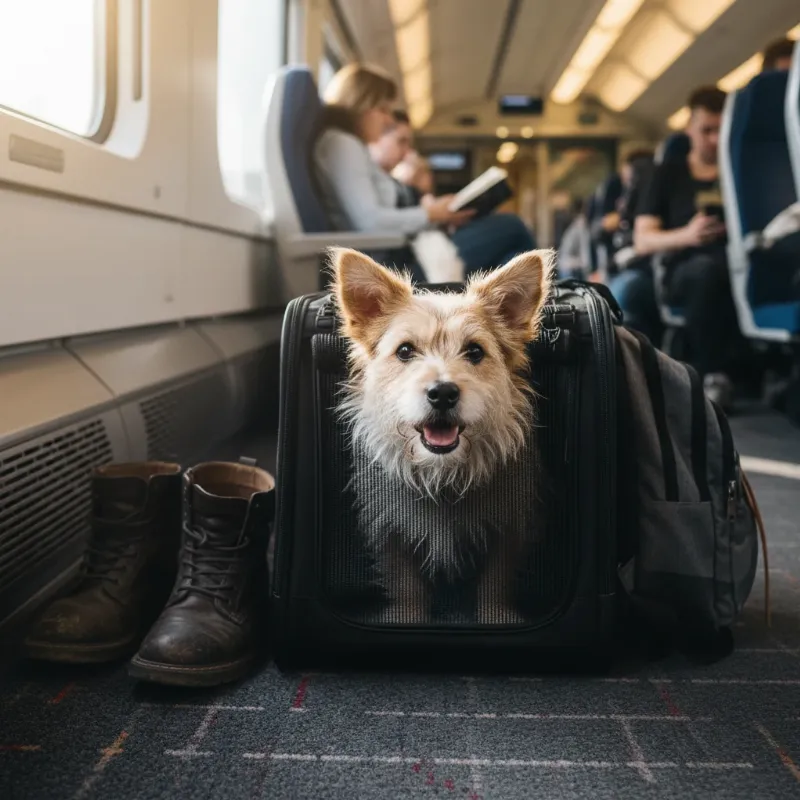 A small terrier mix peeking its head out of a soft-sided travel carrier placed on the floor of a train, illustrating the answer to "can you take dogs on trains".
Tips for a Smooth Journey on Travel Day
You’ve done your research and packed your bags. Now it’s time to travel. How can you make the actual journey as seamless as possible?
Before You Board
Plan to arrive at the station a little earlier than you normally would. This gives you time for a final potty break before boarding. A tired dog is a good dog, so a long walk or a game of fetch before heading to the station can help them settle down once on the train. Avoid feeding your dog a large meal right before the trip to help prevent motion sickness.
Onboard the Train
Once you find your seat, place the carrier in a secure location where it won’t be bumped or jostled. If your dog is on a leash, keep them close to you and away from the aisle. Reassure your dog with a calm voice and occasional pets, but try not to make too much of a fuss, as this can sometimes increase anxiety. Always be mindful of other passengers who may be allergic or afraid of dogs.
Frequently Asked Questions (FAQ)
1. Do service dogs have the same restrictions on trains?
No. Properly trained service animals are not considered pets and are protected under disability laws. They are generally permitted on all trains with their handler and are not subject to the same size, carrier, or fee requirements as pet animals.
2. What happens if my dog barks or is disruptive?
You are responsible for your dog’s behavior. If your dog is continuously barking or causing a disturbance, train staff may ask you to move to a different car or, in worst-case scenarios, to disembark at the next station. This is why familiarization and pre-travel exercise are so important.
3. Can I take a large dog on a train?
This is highly dependent on the train operator. In the UK, large dogs are generally allowed on a leash. In the US on Amtrak, large dogs are not permitted unless they are service animals. Always check the specific policy.
4. Where do dogs go to the bathroom on a long train journey?
This is a major logistical challenge. Most trains do not have designated pet relief areas. For long journeys, this is why many operators have time limits (like Amtrak’s seven-hour rule). You must rely on potty breaks during station stops, but be aware that stops can be very brief.
5. Do I need to bring health documents for my dog?
While not always required for domestic train travel, it’s a good practice to carry a copy of your dog’s vaccination records, especially rabies certification. If you are crossing international borders by train, health certificates are almost always mandatory.
In conclusion, the answer to can you take dogs on trains is a definitive yes, provided you do your homework. By understanding and respecting the rules of the railway, properly preparing your dog for the experience, and packing all the essentials, train travel can become a wonderful way to explore new places with your four-legged companion by your side.
