
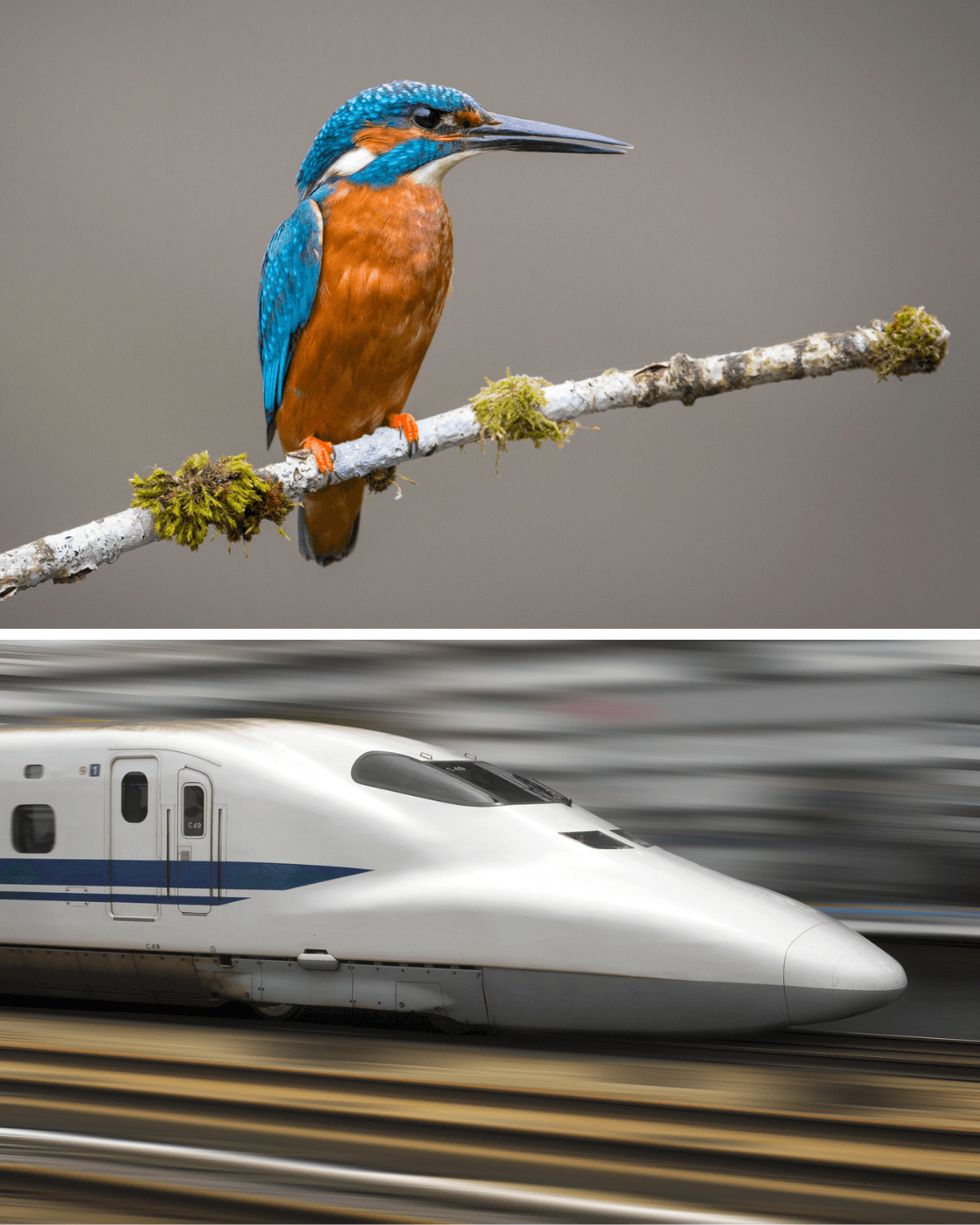
The world of high-speed rail has long been a testament to human ingenuity, pushing the boundaries of speed, efficiency, and design. Among the most iconic and groundbreaking advancements is the Japanese Shinkansen, often referred to as the “bullet train.” While its speed and punctuality are legendary, the evolution of its design, particularly the adaptation of biomimicry, offers a fascinating glimpse into how nature’s perfect solutions can inspire technological marvels. One of the most celebrated examples of this is the redesign of the Nozomi train’s nose, drawing inspiration from the majestic kingfisher bird. This innovation not only solved a significant engineering challenge but also redefined what was possible in high-speed train design.
The Problem: Sonic Booms and Aerodynamic Drag
Early Shinkansen trains, while incredibly fast, faced a persistent issue. As they exited tunnels at high speed, the sudden change in air pressure created a powerful, low-frequency “boom” – a sonic boom that was not only disruptive but also caused aerodynamic drag, reducing efficiency and increasing noise pollution. This phenomenon, known as the tunnel boom, became a significant hurdle in further increasing train speeds and improving passenger comfort. The train’s design, optimized for open air, struggled with the abrupt transition into and out of confined tunnel spaces. Engineers were seeking a solution that could mitigate this pressure wave and improve the train’s overall aerodynamic performance.
The Inspiration: Nature’s Master of Transition
The answer, quite surprisingly, came from observing the natural world. Eiji Nakatsu, a keen birdwatcher and engineer at JR West, noticed the remarkable way the kingfisher bird dives into water. The kingfisher’s beak is perfectly shaped to minimize splash and resistance as it plunges from the air into water – a medium far denser than air. This elegant, streamlined design allows the bird to enter the water with minimal disruption. Nakatsu realized that the challenge faced by the bullet train exiting a tunnel was analogous to the kingfisher’s entry into water: a rapid transition between two different densities of medium, causing a pressure wave.
The Solution: Biomimicry in Action
Inspired by the kingfisher’s beak, Nakatsu and his team redesigned the nose of the Shinkansen 500 series. They meticulously studied the shape of the kingfisher’s beak – long, slender, and pointed – and applied its aerodynamic principles to the train’s front end. The new design featured a longer, more pointed nose, mimicking the smooth, low-resistance entry of the bird into water.
This biomimetic approach had a dramatic impact:
- Reduced Sonic Boom: The reshaped nose helped to gradually dissipate the pressure wave as the train exited the tunnel, significantly reducing the intensity of the sonic boom. The air could flow more smoothly around the train, preventing the sudden compression that caused the noise.
- Improved Aerodynamics: The streamlined design also reduced overall aerodynamic drag, allowing the train to travel faster with the same amount of power, or use less power to maintain the same speed. This led to greater energy efficiency.
- Quieter Operation: The reduction in the boom also contributed to a quieter and more comfortable ride for passengers both inside and outside the train.
- Enhanced Aesthetics: The new design was not only functional but also aesthetically pleasing, giving the Shinkansen a sleeker, more futuristic appearance.
Beyond the Kingfisher: A Legacy of Innovation
The success of the kingfisher-inspired redesign was a landmark achievement in biomimicry and high-speed rail engineering. It demonstrated the power of looking to nature for innovative solutions to complex technical problems. This principle of biomimicry has continued to influence design across various fields, from architecture to product development. The Shinkansen’s journey, from its initial development to its elegant evolution, serves as a compelling narrative of human ambition paired with the timeless wisdom of the natural world.
The story of the bullet train and the kingfisher is more than just an engineering case study; it’s a testament to the interconnectedness of all things and the endless possibilities that arise when we observe, learn from, and collaborate with nature. It reminds us that sometimes, the most advanced solutions are found in the most elegant designs that have evolved over millions of years. This approach not only enhances performance but also fosters a deeper appreciation for the intricate beauty and efficiency of the natural world.
The commitment to continuous improvement, driven by both technological advancement and natural inspiration, ensures that the bullet train will continue to be a symbol of progress and a marvel of engineering for years to come. It’s a story that resonates with anyone who marvels at the speed of a diving bird or the smooth, swift passage of a modern train, connecting these seemingly disparate elements into a harmonious whole.
