
The British Shorthair cat breed consistently ranks high in popularity, attracting a significant number of devoted owners. Revered as feline nobility, these cats possess a captivating and majestic appearance that charms many. Their ability to subtly integrate into family life, coupled with their philanthropic nature and striking beauty, has cultivated a growing fanbase. Among the most enchanting variations are the Chinchilla and Silver Shaded British Shorthairs, which have garnered considerable international acclaim since their recognition in 1980. While their refined manners and kind disposition are widely appreciated, these specific colorations remain less common in the United States, making them increasingly sought after by breeders and enthusiasts alike.
Distinguishing Between Silver Shaded, Chinchilla, Standard Point, and Color Point British Shorthairs
Within the genetic lines producing silver-toned cats, a variety of names are often used, leading to some confusion. To clarify these distinctions, this article delves into the differences, some of which are not widely understood, even by breeders.
The most subtle, yet significant, difference lies in the hair shaft tipping. Chinchilla cats exhibit a tipping of approximately 1/8th or less of the upper hair shaft, appearing more predominantly white. In contrast, Silver Shaded cats have at least 1/4th to 1/3rd of the upper hair shaft tipped with color, presenting a more noticeable shading. It’s important to note that “Chinchilla” and “Shaded” refer to a pattern, not a specific color. Often, these cats are characterized by striking darker “makeup” around their eyes, nose, and sometimes mouth, enhancing their regal appearance.
Silver Chinchilla and Silver Chinchilla Point
Silver Chinchilla cats often have very light or no visible shading, making them appear almost white, and they typically possess green eyes.
The Silver Chinchilla Point shares these characteristics but will display darker shading on some or all of its points—ears, face, tail, and legs—and will always have blue eyes.
Silver Shaded and Silver Shaded Point
Silver Shaded cats exhibit more pronounced shading. The colored tipping on the hair shaft, ranging from 1/4th to 1/3rd, varies with the specific shade (e.g., black, blue, chocolate), influencing the depth of the coloration. They generally have green eyes.
Silver Shaded Point cats are born pure white or cream and develop color around two weeks of age. They appear whiter than Silver Shaded cats, with darker coloring on their points and usually possess blue eyes.
A visual comparison of kittens side-by-side clearly illustrates the difference: a Silver Chinchilla Point might show subtle color development, while a Silver Shaded Point displays more noticeable color early on, even though both were born all white.
 Kittens showing Chinchilla vs. Shaded point differences*This photo illustrates the distinct coloration between a Silver Chinchilla Point (red collar) and a Silver Shaded Point (orange collar) at four weeks old, highlighting the varied development of their coat patterns.*
Further examples showcase the diversity within the Silver Gene British Shorthairs, including Silver Lynx Points and variations like the long-haired Silver Shaded.
Standard vs. Color Point British Shorthairs
Standard/Traditional British Shorthairs
These cats are born with a darker coloration that gradually lightens with age, often appearing with tabby or marble patterns. They typically have green eyes.
 Brutus, a Black Silver Shaded Tabby British Shorthair*Brutus, a Black Silver Shaded Tabby, demonstrates the classic, darker markings characteristic of Standard British Shorthairs.*
Color Point British Shorthairs
Color Point cats are born completely white, developing color over several weeks. This shading is temperature-sensitive, appearing darker in cooler conditions and lighter when warm. While they may have overall shading, the color is most prominent on their points. They invariably have blue eyes. The color of their paw pads often indicates the shading color. For instance, black paw pads suggest a Black Silver Shaded or Black Silver Chinchilla pattern.
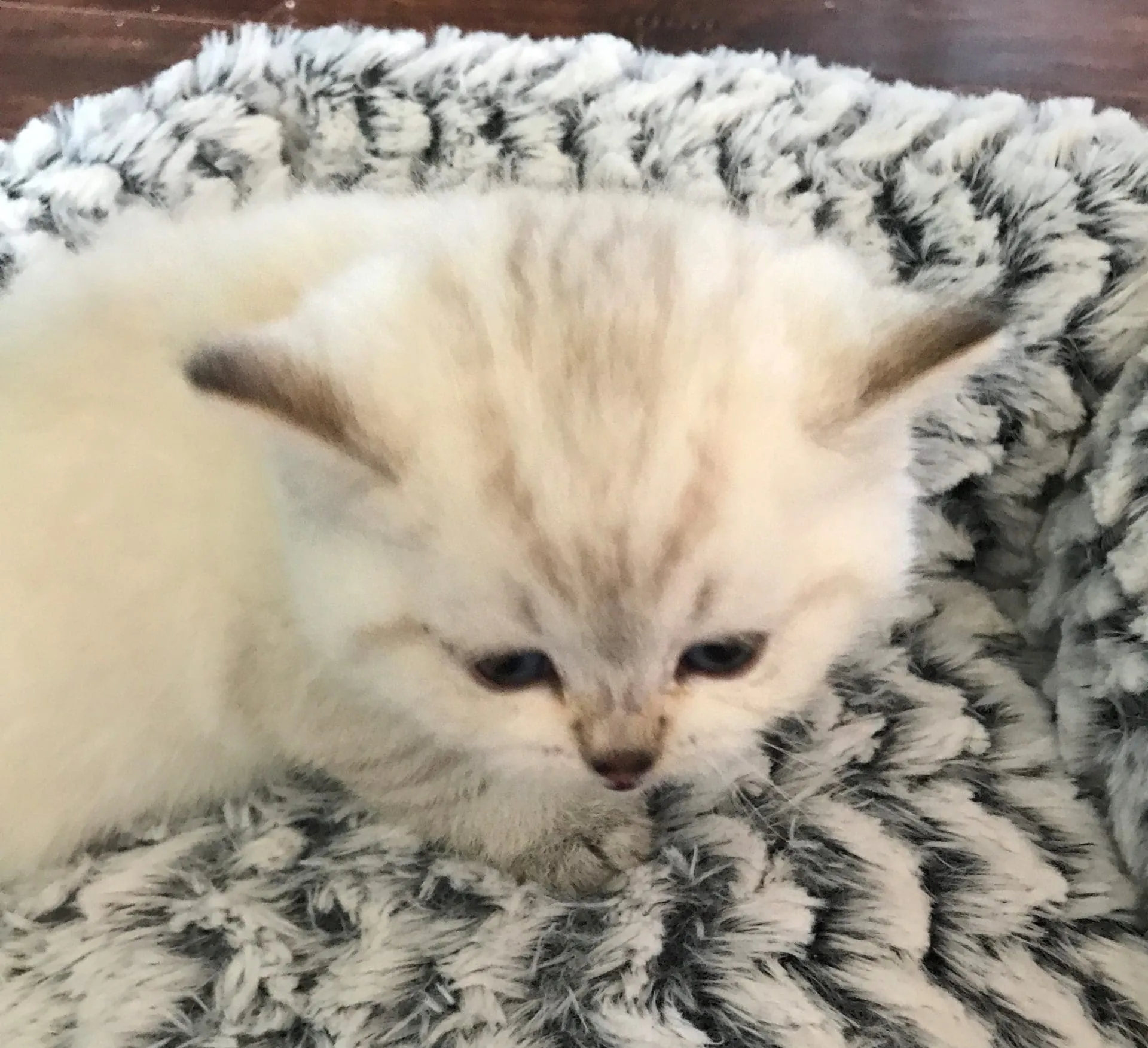 Kittens displaying Color Point patterns*These young Color Point kittens showcase the developing patterns typical of this variation.*
Additional Patterns and Variations
Beyond the standard and point variations, British Shorthairs exhibit a range of other captivating patterns:
- Lynx: Characterized by dark stripes on the legs, face, and sometimes tail, resembling a lynx. This pattern can be seen in various colors, such as Black Silver Lynx.
- Torbie: A rare pattern, typically found in females, featuring a marble-like design.
- Ticked or Tabby: These cats display stripes all over their body, differentiating them from the Lynx pattern.
- Chinchilla: Defined by minimal shading on the very tips of the hair shaft, usually no more than 1/8th, resulting in a predominantly white appearance.
- Silver Shaded: This pattern features more pronounced shading, with approximately 1/4th or more of the hair shaft tips colored, making the shading more noticeable than in Chinchillas.
These patterns, combined with variations in coat length (longhair and shorthair) and a spectrum of colors (including blue, chocolate, lilac, and golden), create a stunning array of British Shorthair appearances. The nomenclature for these colors can sometimes vary across breeds, leading to names like “Silver Tipped” or “Shell” for Chinchillas. Efforts are underway to standardize these names for clearer understanding and judging.
History and Origins
The British Shorthair breed traces its ancestry back thousands of years to the British Isles. The Chinchilla and Silver Shaded varieties were developed more recently. Breeder Norman Winder is credited with creating the British Shorthair Chinchilla in the early 1970s by crossing a Persian Chinchilla with a British Shorthair. This successful cross led to the recognition of the “British Shorthair black silver tipped” (Silver Shaded) color by the Board of Cat Clubs in England in 1980. Through the dedication of breeders, these silver variations have evolved, producing exquisite colors and patterns now gracing cat shows and homes.
The term “chinchilla” refers to the fur’s resemblance to that of the South American rodent. Given their Persian and Exotic ancestry, British Shorthairs can be either long-haired or shorthaired. These regal cats are known for their striking white coats with subtly tipped hairs, often enhanced by natural “makeup”—dark lines around their eyes, lips, and nose. Their large, expressive eyes, often emerald green, combined with a distinctive mouth shape, contribute to their captivating look. British Shorthairs mature slowly, reaching full growth around 4-5 years of age, and can live up to 18-20 years. Females are typically smaller than males and mature earlier, around 2-3 years.
Temperament of Silver Shaded/Chinchilla British Shorthairs
The calm and balanced nature inherited from their Persian lineage, combined with their distinct silver variations, makes these cats highly desirable. They are known for their good manners and adapt well to various living environments, getting along with other pets. Their innate intelligence, loyalty, and kindness are evident. Due to their Persian influence, Silver Shaded and Chinchilla varieties tend to be more affectionate and enjoy being held. They are generally placid and playful, rarely losing their temper. While they may not constantly sit on laps, they appreciate close proximity and companionship. Many owners describe them as dog-like in their loyalty and affection, yet they retain a cat’s independence. They are also known to be trainable and can learn tricks. Many owners find them to be deeply affectionate companions who enjoy cuddling and playing, while also appreciating their own exploration time.
