
If you’ve ever driven to or from Denver International Airport (DIA), you’ve seen him. Rearing up on the vast plains, a colossal, cobalt-blue mustang stands silhouetted against the Colorado sky. At 32 feet tall and weighing 9,000 pounds, with veins bulging from his muscular form and eyes that glow a demonic red in the dark, he is impossible to miss and even harder to forget. This is “Mustang,” but the people of Denver know him by another name: Blucifer. The Blue Horse Denver Airport Story is more than just the tale of a controversial piece of public art; it’s a saga of artistic vision, tragic death, and a whirlwind of conspiracy theories.
This magnificent, terrifying creature was not just placed there; it was born from a specific vision. The journey of how this statue came to guard the entrance to DIA is as dramatic and intense as the sculpture itself. It’s a story that begins with a celebrated artist and ends with a piece of his own creation dealing a fatal blow, forever linking the art with the artist in the most tragic way possible. Much like the mysterious blue horse denver story, the statue’s narrative is packed with unexpected turns.
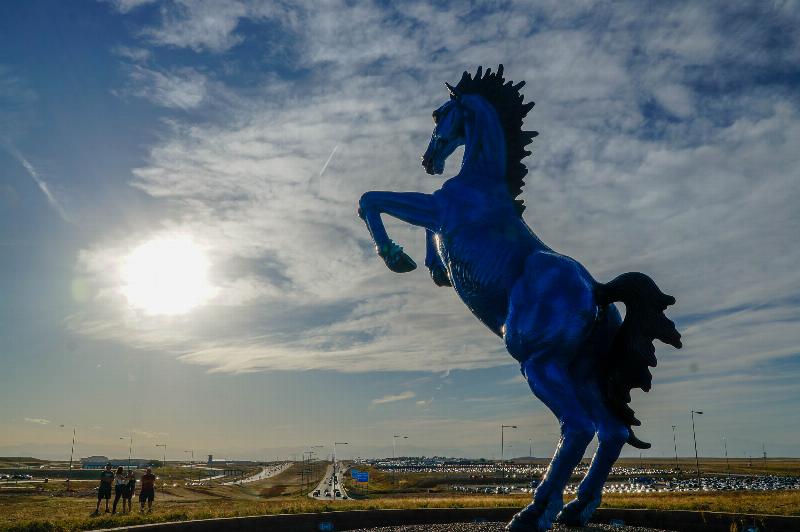 The giant blue horse statue known as Blucifer at Denver International Airport, with its glowing red eyes under a cloudy sky.
The Visionary Artist Behind the Beast
The creator of “Mustang” was Luis Jiménez, a renowned Mexican-American sculptor celebrated for his large, vibrant fiberglass works that captured the spirit of the American West and Chicano culture. Commissioned in 1993, the sculpture was intended to embody the wild, free spirit of the West. Jiménez poured his soul into the piece, wanting it to be a powerful and dynamic welcome for travelers.
His style was unmistakable: bold, colorful, and full of raw energy. He saw mustangs as symbols of freedom and power, representing the untamed nature of the American frontier. The choice of the brilliant blue color was inspired by a legend from the San Luis Valley of a mythical, powerful blue mustang that led its herd to safety. The glowing red eyes, which have become the statue’s most infamous feature, were a heartfelt tribute to his father, who ran a neon sign shop. They were Jiménez’s way of embedding his own history and heritage into the very fabric of his creation.
A Masterpiece Tinged with Tragedy
The creation of “Mustang” was a long and arduous process, plagued by delays and legal disputes that stretched on for over a decade. But the story took its darkest turn in 2006, just as the colossal sculpture was nearing completion in Jiménez’s New Mexico studio.
In a horrifying accident, a large section of the 9,000-pound fiberglass torso broke free from a hoist, falling directly onto the artist. The immense weight crushed his leg and severed a major artery. Tragically, Luis Jiménez, aged 65, died on his studio floor, killed by the very masterpiece he was struggling to bring to life.
After his death, the fate of the “cursed” statue hung in the balance. Ultimately, Jiménez’s sons, with the help of his studio staff, undertook the somber task of completing their father’s final work based on his detailed plans. In February 2008, nearly 15 years after it was first commissioned, “Mustang” was finally installed at Denver International Airport. Its arrival was not met with universal praise; instead, it ignited a firestorm of public debate, forever cementing the denver airport horse statue story in local folklore.
Controversy and Conspiracy: Why “Blucifer” Became Infamous
From the moment it was unveiled, “Mustang” was controversial. Its fierce, almost demonic appearance, with those piercing red eyes and bulging veins, struck many as more nightmarish than welcoming. Critics called it unsettling and even satanic, quickly christening it “Blucifer,” a portmanteau of “blue” and “Lucifer.”
“We have this fierce blue mustang that we look at as kind of a protector of travelers, guarding this airport,” one DIA official stated, though many travelers felt more threatened than protected.
The statue’s dark backstory only fueled the public’s unease. The fact that it had killed its creator led many to believe the sculpture was cursed. This narrative fit perfectly into the existing ecosystem of conspiracy theories surrounding Denver International Airport, which has long been rumored to be a headquarters for the Illuminati or the New World Order, with its strange murals and underground tunnels.
Here’s what people found so unsettling:
- The Demonic Appearance: The aggressive posture, anatomically detailed form, and, most of all, the glowing red eyes, led to nicknames like “Satan’s Stallion” and “DIAblo.”
- The Artist’s Death: The tragic story of Jiménez’s death gave the statue a morbid aura, with many calling for the removal of a piece of art with such a dark history.
- The Conspiracy Connection: For conspiracy theorists, Blucifer was the “Pale Horse of the Apocalypse” and a sinister symbol confirming DIA’s supposed evil secrets.
Despite petitions and public outcry calling for its removal, airport officials have stood by the artwork. Over time, the narrative has shifted. Many Denverites who once hated the statue now embrace it as a uniquely weird and iconic part of the city’s identity. The initial horror has evolved into a kind of proud ownership, a shared inside joke.
What Does the Blue Horse Really Symbolize?
Beyond the controversy and conspiracy, what was Luis Jiménez trying to say with “Mustang”? At its heart, the sculpture is a tribute to the American West. It represents the wild, untamed spirit of the mustangs that once roamed the plains. This interpretation is a far cry from the demonic symbolism it’s often saddled with. The story is a complex one, much like the denver airport horse story which also has layers of meaning.
The vibrant blue color connects to regional folklore, while the dynamic energy of the sculpture is a hallmark of Jiménez’s celebratory style. He wanted to create something that was powerful and memorable, and in that, he undeniably succeeded. The sculpture provokes a strong reaction, forcing people to confront art in a public space, which is precisely what much of great art is meant to do. It starts a conversation.
Today, Blucifer stands as a complex legacy. It is a memorial to a brilliant artist, a lightning rod for public debate, and a beloved local icon. It is a story of how art can be beautiful and terrifying, tragic and triumphant, all at once. The blue horse of Denver is no longer just a statue; it is a legend.
Frequently Asked Questions (FAQ)
Why is the Denver airport horse called Blucifer?
The statue’s official name is “Mustang,” but locals nicknamed it “Blucifer” due to its striking blue color, demonic-looking appearance, and glowing red eyes, combining the words “blue” and “Lucifer.”
How did the artist of the Denver horse die?
The artist, Luis Jiménez, died in 2006 in his studio while working on the sculpture. A large section of the 9,000-pound statue fell from a hoist, pinning him, severing an artery in his leg, and causing his death.
Is the blue horse at DIA permanent?
Yes, despite numerous petitions and controversies calling for its removal over the years, “Mustang” is considered a permanent installation. Airport and city officials have defended the artwork, and it has since become an iconic, if unofficial, mascot for Denver.
What is the real story behind the Denver airport’s strange art?
Denver International Airport has a wide collection of public art, including “Mustang” and several large murals. While the art is intended to reflect Colorado’s history and culture, its often surreal and apocalyptic imagery has fueled numerous conspiracy theories about the airport’s “true purpose,” none of which have been substantiated.
What do the red eyes on the Mustang mean?
The glowing red eyes were a personal tribute from the artist, Luis Jiménez, to his father, who owned and operated a neon sign business. They are lit with LED lights and are one of the statue’s most distinct and controversial features.
