
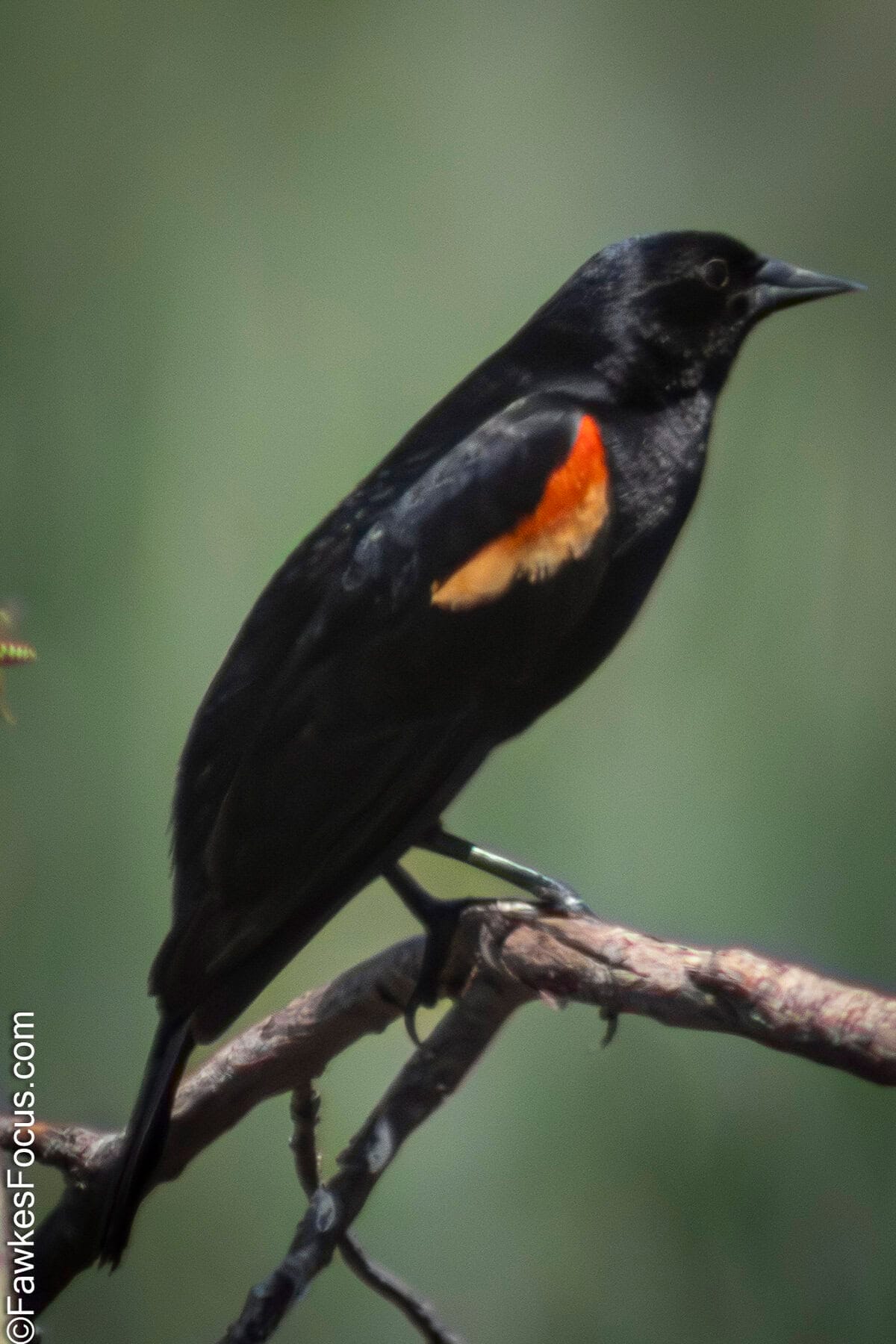
The intricate world of bird communication often leaves us pondering their motives. Is that flash of color a sign of courtship, a territorial dispute, or a simple foraging behavior? For the male Red-winged Blackbird, the answer is often written on its shoulders. The striking red epaulets, coupled with subtle shifts in posture, serve as a sophisticated language, revealing whether the bird is seeking a mate, defending its territory, or engaging in social feeding. A vibrant display, the angle of a wing, or even a sliver of yellow can convey a wealth of information to both rivals and potential partners.
The “Song Spread” Display: A Dual Purpose
One of the most commanding displays is the “song spread.” In this dramatic posture, the male Red-winged Blackbird erects its epaulets, hunches its shoulders forward, and lowers and spreads its tail. This powerful visual serves a dual purpose: it acts as a strong deterrent against rival males encroaching on its territory and simultaneously functions as an alluring signal to attract females. Research suggests that the brilliance and prominence of the epaulets, along with the sheen and solidity of the black plumage, intensify with age. Older, more experienced males tend to secure the most desirable territories and consequently attract the fittest mates. In fact, experiments where males had their epaulets blackened demonstrated a significant loss of their territories, underscoring the critical role of these colorful shoulder patches in establishing dominance and reproductive success.
Flight Display: Territorial Assertion in Motion
When Red-winged Blackbirds engage in aerial displays, their entire bodies become part of the communication. During a flight display, the male raises its body feathers, accentuating the epaulets, and spreads and lowers its tail. Its wingbeats become slow and deep, allowing for flight at a reduced speed. This specific flight pattern is performed exclusively when the male is above its own territory, often triggered by the presence of another male flying overhead or the arrival of a female.
Resting and Feeding Behaviors: Subtle Signals
Even when simply perching on a cattail, reed, or twig within its territory, a male Red-winged Blackbird typically displays its red and yellow epaulets. However, when blackbirds are observed perching outside their established territories, such as when foraging in flocks, they tend to conceal their epaulets, often revealing little more than a thin line of yellow. This behavior is particularly evident during the height of the breeding season when Red-winged Blackbirds, despite their territorial nature, will forage together in flocks on neutral grounds. To maintain peace and avoid provoking aggressive interactions within these mixed-species groups, males suppress their territorial signals by minimizing the visibility of their epaulets.
Chasing Behavior: Protecting the Nest
Red-winged Blackbirds are also known for their assertive defense of their nesting sites against potential predators. They will often attempt to drive away larger birds, such as crows and hawks, from the airspace above their territories. In these pursuit scenarios, the blackbird positions itself above and behind the intruder, ensuring it remains out of reach of the predator’s beak or talons. Unlike the slow, deliberate movements of a territorial flight display, a blackbird engaged in chasing a predator will match its speed to that of the intruder, demonstrating agility and determination in protecting its offspring.
Understanding these diverse behaviors provides valuable insights into the complex social dynamics and survival strategies of the Red-winged Blackbird. The subtle yet effective communication through visual displays, particularly the prominent epaulets, plays a crucial role in their breeding success, territorial defense, and social interactions.
References:
- All About Birds. (n.d.). Red-winged Blackbird. Cornell Lab of Ornithology.
