
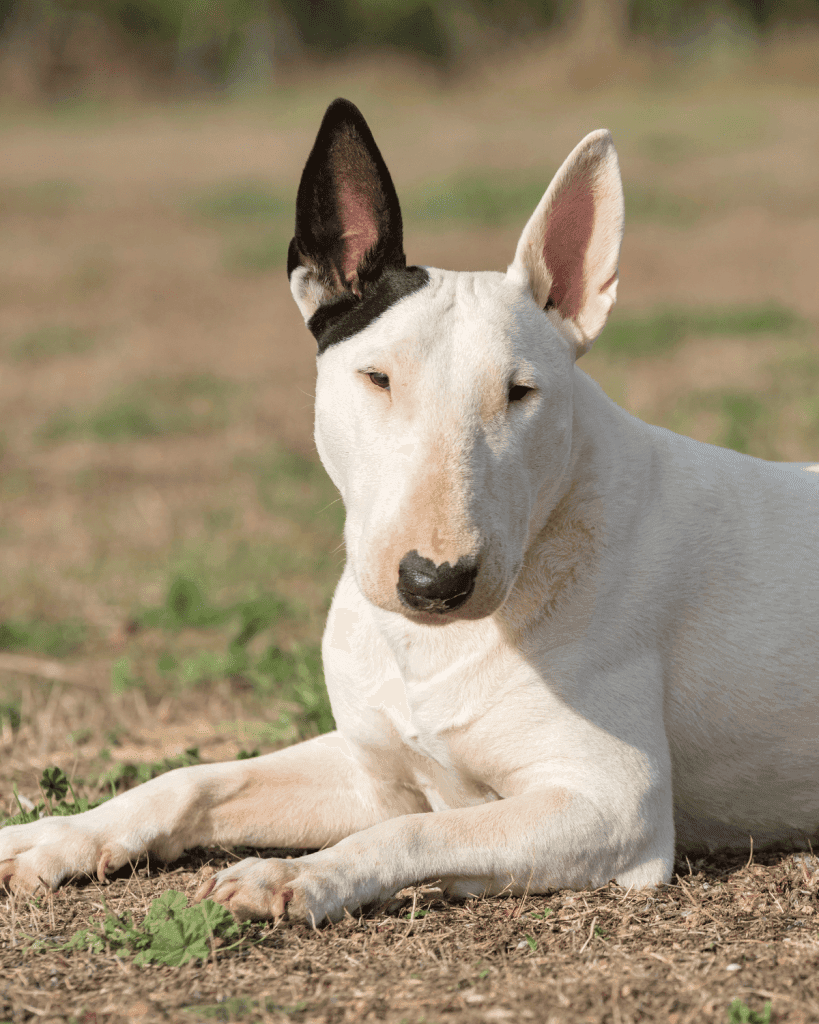
Bull Terriers are known for their distinctive appearance, and their coat colors are a significant part of their charm. Whether you’re considering owning a Bull Terrier or are already a devoted owner, understanding the genetics behind their various colors can be fascinating. This guide delves into the different color classifications and the scientific principles that govern them, providing a comprehensive overview for enthusiasts and potential owners alike.
The Two Main Color Groups: White and Colored
Bull Terriers are broadly categorized into two main groups: “white” and “colored.” It’s important to note that even a seemingly all-white Bull Terrier carries color genes, which may not always be visible on the surface. For white Bull Terriers, any color markings are permissible only on the head.
White Bull Terriers and Their Markings
A “white” Bull Terrier can range from completely white to having various colored markings on its head. These variations include:
- White: An entirely white coat.
- White and Brindle: Head markings with a range of brown shades, from reddish-brown to dark mahogany, often exhibiting tiger-like striping or marbling.
- White and Black Brindle: Head markings that are black with lighter brindling, which can sometimes make it difficult to distinguish from black and tan markings.
- White, Black and Tan: Head markings that are black and tan, without the marbling seen in black brindle patterns.
- White and Fawn: Head markings in a lighter, faded red hue, occasionally accompanied by dark black “smut” hairs.
Colored Bull Terriers: A Spectrum of Hues
Colored Bull Terriers predominantly display color, though they may have white markings. Their colors can range significantly, with brindles varying from dark brown to lighter fawn shades.
- Brindle: Often called “solid brindle,” these dogs have a body primarily covered in brown stripes with minimal white, perhaps on the snout, chin, paws, chest, or belly. They might also have a darker mask.
- Brindle and White: Brindle dogs with white markings on the head (a blaze), legs, chest (often extending up the neck), belly, and tail tip.
- Black Brindle: Primarily black with brindling on the cheeks, chest, behind the elbows, flanks, and under the tail. Small white markings may be present on the face, chin, paws, chest, or belly.
- Black Brindle and White: Black brindle dogs with distinct white markings on the head, legs, chest, belly, and tail. The brindling is often visible where the black meets the white.
Reds and fawns are distinguished by their coat depth. Reds range from deep red to orange, while fawns have a sandy, tan appearance.
- Red: Similar to solid brindle, these dogs are primarily red with minimal white markings. If they have a dark mask on the face and muzzle and black hairs throughout the body, especially concentrated on the tail, they are termed “red smut.”
- Red and White: Red dogs with significant white markings on the head, legs, chest, belly, and tail. If they also possess the smut masking, they are classified as “red smut and white.”
Tricolors and black brindles can sometimes be mistaken for one another.
- Black and Tan: Primarily black with tan markings on the cheeks, chest, behind the elbows, flanks, and under the tail. White may be present but doesn’t define them as a “tri color.”
- Black, Tan and White (Tricolor): A black coat with white markings on the head, legs, chest, belly, and tail, along with tan markings on the cheeks, chest, behind the elbows, flanks, and under the tail.
The Genetics Behind Bull Terrier Colors
The captivating variety of Bull Terrier coat colors is a result of interactions between specific genes. While numerous genes influence coat color in dogs, Bull Terriers primarily exhibit variations determined by four key gene series:
- The A-Series Locus (Agouti Series): This gene determines the base coat color, offering two main options: a Red Base Coat (ranging from light tan to deep red-brown) or a Black on Red Base Coat (a black overcoat on the red base, where red is visible as markings on the face, chest, and legs).
- The K-Series Locus (Brindle Patterning Gene): This gene controls whether brindling is present. No Brindle Pattern results in solid red or black and tan dogs, while the Brindle Pattern creates black stripes on the base coat, leading to Brindle or Black Brindle dogs.
- The E-Series Locus (Pigment Extension): While not directly controlling brindle, this series influences the presence of a dark facial mask, known as “smut marking.” This mask is most visible in red dogs but can be present in other colors, even if masked by darker pigment or white.
- The S-Series Locus (White Spotting Pattern): This gene dictates the extent of white markings. It ranges from minimal white (“Solid-Colored”) to significant white markings (“Colored & White”) to almost entirely white (“White”).
These genes interact in various combinations, leading to the diverse range of recognized Bull Terrier colors. For instance, a White Bull Terrier isn’t truly devoid of color; its white coat is a result of the S-Series gene masking the underlying red or black and tan base coat and brindle patterns.
Understanding Color Inheritance
Breeders can predict potential offspring colors by understanding how these genes are passed down. For example:
- Two White Bull Terriers will always produce white puppies, though these puppies may have colored head markings.
- A Solid-Colored parent can never produce an all-white puppy.
- Brindle puppies will only occur if at least one parent carries the brindle gene.
By knowing the genotypes of breeding dogs, breeders can make informed decisions to achieve desired color outcomes. The complex interplay of these genetic factors results in the stunning and varied palette seen in Bull Terriers today.
