
Himalayan cats are a striking breed, easily identified by their luxurious colorpoint coats, charmingly flattened faces, and exceptionally sweet dispositions. Known for their laid-back and affectionate nature, these felines offer a unique blend of beauty and gentle companionship. The development of the Himalayan breed was driven by a desire to combine the Siamese’s distinctive colorpoint pattern with the Persian’s long, flowing fur. Today, cat associations worldwide recognize 20 different coat colors for this breed, a significant expansion from its early days. While their exquisite coats are often the first feature that draws people in, it is their endearing personalities that truly capture hearts.
Origins of the Himalayan Cat
The genesis of the Himalayan cat lies in the deliberate efforts of breeders in the 1930s who aimed to create a cat possessing both the colorpoint pattern of the Siamese and the silken, long coat of the Persian. Breeders Clyde Keeler and Virginia Cobb were instrumental in this endeavor. Both the long hair and the colorpoint pattern are recessive genetic traits. To successfully pass these traits on, both parent cats needed to carry both genes. Keeler and Cobb achieved this by mating a female Siamese with a black-coated Persian male, and subsequently, a black-coated Persian female with a male Siamese. The offspring from these initial pairings were then bred together, resulting in a cat that exhibited both the desired long fur and the distinctive colorpoint patterning. Though the breed’s standards were once quite rigid, dedicated breeders have since worked to expand the range of accepted colors, ensuring that no matter the coat color, the Himalayan remains a gentle, sweet-natured companion for families.
Physical Characteristics of the Himalayan
The Himalayan is particularly admired for its opulent long coat and its characteristic colorpoint pattern. These two features combine to create a truly captivating feline. Himalayans are considered medium to large-sized cats, but their abundant fur can make them appear even larger. They are robustly built with substantial bone structure, typically weighing between 7 and 14 pounds. It’s worth noting that the Himalayan is often described as a relatively sedentary breed. They possess low energy levels and enjoy ample periods of rest, basking in the sun, and general relaxation. This tendency towards a less active lifestyle means they can be more prone to weight gain compared to other cat breeds. Therefore, maintaining a healthy weight through consistent playtime and carefully portioned, nutritious meals is crucial for their well-being.
Himalayans generally present a rounded physical appearance, evident in their heads, faces, and bodies. Echoing the Persian breed, they often have what are termed “snub noses,” being shorter than those found on many other cats. Their chests are broad and well-developed, supported by thick, sturdy legs. Despite their substantial build, they are known for their remarkably gentle demeanor, earning them the affectionate title of “gentle giants.”
The Distinctive Himalayan Pattern
Himalayan cats exhibit a very specific and recognizable pattern. A cat displaying this breed’s characteristics but lacking the colorpoint pattern is unlikely to be a purebred Himalayan. The defining feature of the Himalayan pattern is a body color that is typically a single, lighter shade, with minimal or no shading. In contrast, their “points”—the coloration on their face, ears, tail, and paws—are noticeably darker than their body. This distinct contrast is a hallmark of the breed.
Himalayan Cat Colors
While all Himalayans share the characteristic colorpoint pattern and distinct blue eyes, their specific point and body colors can vary widely. Here are some of the recognized colors:
Seal Point
This is perhaps the most iconic Himalayan coloring, often the first that comes to mind, likely due to its prevalence in the Siamese breed. Seal point Himalayans feature a creamy or pale beige body with deep, dark brown, almost black points. The nose leather and paw pads should also be a dark brown.
Chocolate Point
Chocolate point Himalayans boast an ivory-colored body contrasted by milk-chocolate points. Their bright blue eyes stand out beautifully against the darker facial mask. The nose leather and paw pads are a cinnamon-pink hue that subtly blends with the coloring on their legs and face.
Lilac Point
A truly unique and beautiful variation, the lilac point Himalayan has a purplish-white base coat with grey-pink points. The distinction between the body and point colors is less pronounced than in other variations. Their nose leather and paw pads are a delicate lavender-pink.
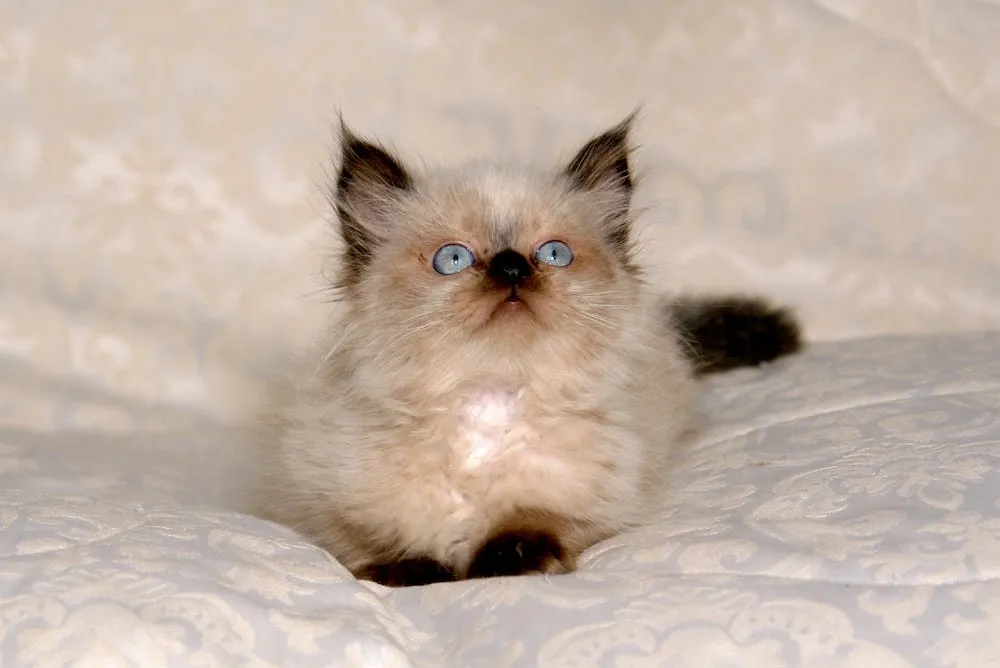 lilac himalayan cat color
Blue Point
The body color of a blue point Himalayan is a distinctive bluish-grey with cool undertones. The points are a darker shade of blue. Both the nose leather, paw pads, and eyes are also blue, creating a harmonious cool-toned appearance.
Red / Flame Point
These Himalayans display a creamy base coat with points in shades of orange or red, which can vary in intensity. The nose leather and paw pads are typically coral pink.
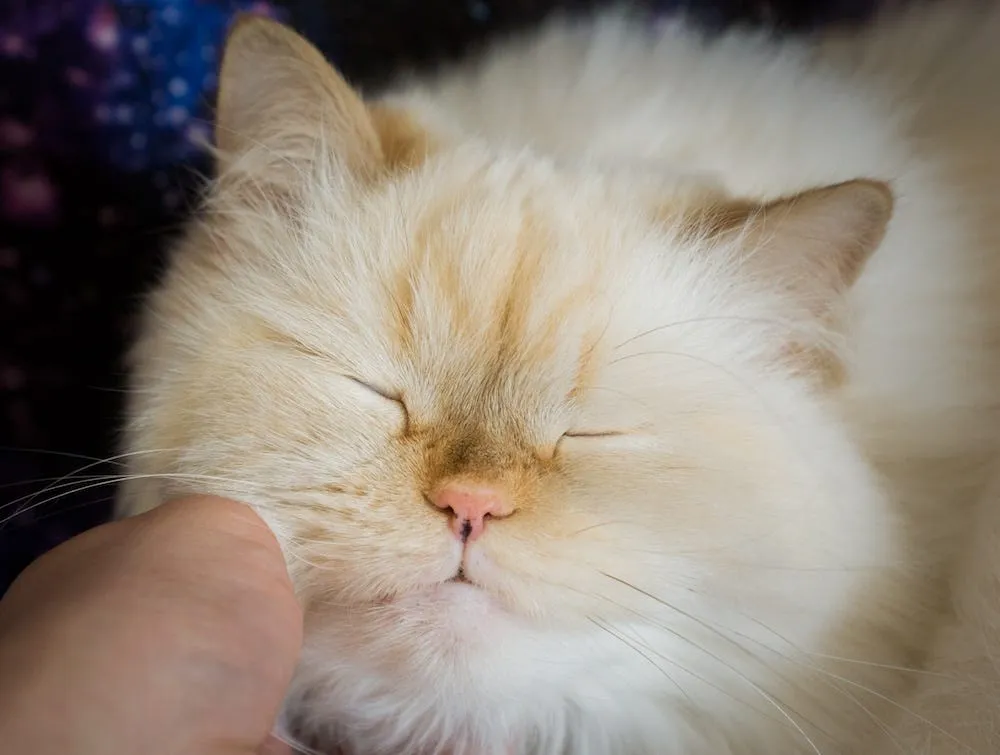 red flame point himalayan cat color or himalayan orange cat
Cream Point
The body of a cream point Himalayan is a white cream color, with points often described as buff cream. The color difference is subtle, and their nose leather and paw pads are coral pink. For white cats, maintaining a clean litter box is especially important as dirt can be more apparent.
Blue-Cream Point
This variation features a cream-colored body with a hint of blue, and blue points interspersed with patches of cream. The nose leather and paw pads can be either blue or pink.
Lilac-Cream Point
These cats possess a creamy base coat with lilac points that feature patches of cream. They typically have lavender-pink nose leather and paw pads.
Seal-Tortie Point
The body color is creamy white, with dark brown points that display unbridled patches of red and cream. Their nose leather and paw pads can be either dark brown or coral pink. Tortoiseshell Himalayans are considered quite rare.
Chocolate-Tortie Point
Chocolate-tortie Himalayans have an ivory body color with chocolate points, distinctly marked with patches of red and cream. Their nose leather and paw pads are either cinnamon pink or coral pink.
Himalayan Lynx Patterns
The Himalayan lynx pattern is characterized by the presence of a tabby “M” marking on the forehead, which is echoed in the striped patterns extending throughout their points. This creates a fashionable, striped appearance. Their bodies, however, remain a solid color.
Seal Lynx
The body of a seal lynx Himalayan is beige, with beige-brown points featuring darker brown tabby markings. Their paws are seal-brown, while their nose leather can range from seal brown to brick red.
Blue Lynx
These cats have a bluish-white body with light, almost silvery, blue points. These points are ticked with darker blue tabby markings. Their paw pads are blue, and their nose leather can be blue or rose-colored.
Red / Flame Lynx
This variation presents a creamy white body with orange points, intricately ticked with red tabby markings. The nose leather and paw pads are coral pink.
Cream Lynx
The body color is white, with cream-colored points ticked with darker cream tabby markings. Their nose leather and paw pads are coral pink.
Seal Tortie Lynx
Their body is creamy-white, with beige-brown points displaying dark brown tabby markings and spotted with patches of red. The nose leather and paw pads can be seal-brown, brick red, or coral pink.
Blue-Cream Lynx
This cat has a bluish-white body with blue points that are ticked with dark blue tabby markings and interspersed with patches of cream. Their nose leather and paw pads can be blue, rose, or pink.
Chocolate Lynx
Their body is ivory, with milk-chocolate points that are ticked with darker chocolate tabby markings. Their nose leather and paw pads can be cinnamon pink or coral pink.
Lilac Lynx
This cat’s body is a white-purple color, with frosty grey points ticked with darker lilac tabby markings. Their nose leather and paw pads are a lavender-pink.
Chocolate-Tortie Lynx
The body is an ivory color, with milk-chocolate points ticked with darker chocolate tabby markings and distinct patches of red. Their nose leather and paw pads are cinnamon pink or coral pink.
Lilac-Cream Lynx
These cats have a white body with a hint of purple. Their points are a pale frosty grey-pink, ticked with darker purple tabby markings that include patches of cream. Their nose leather and paw pads are lavender-pink or coral pink.
Caring for Your Himalayan
Given their majestic coats, regular grooming is essential for Himalayans to prevent tangles and maintain cleanliness. Consistent brushing will keep their luxurious fur in excellent condition. By attending to their hygiene needs, providing appropriate nutrition, and ensuring sufficient physical activity, your Himalayan can be a cherished companion for many years. Beyond their stunning looks, Himalayan cats are characterized by their kind, gentle, and deeply affectionate nature, making them wonderful additions to any family.
