
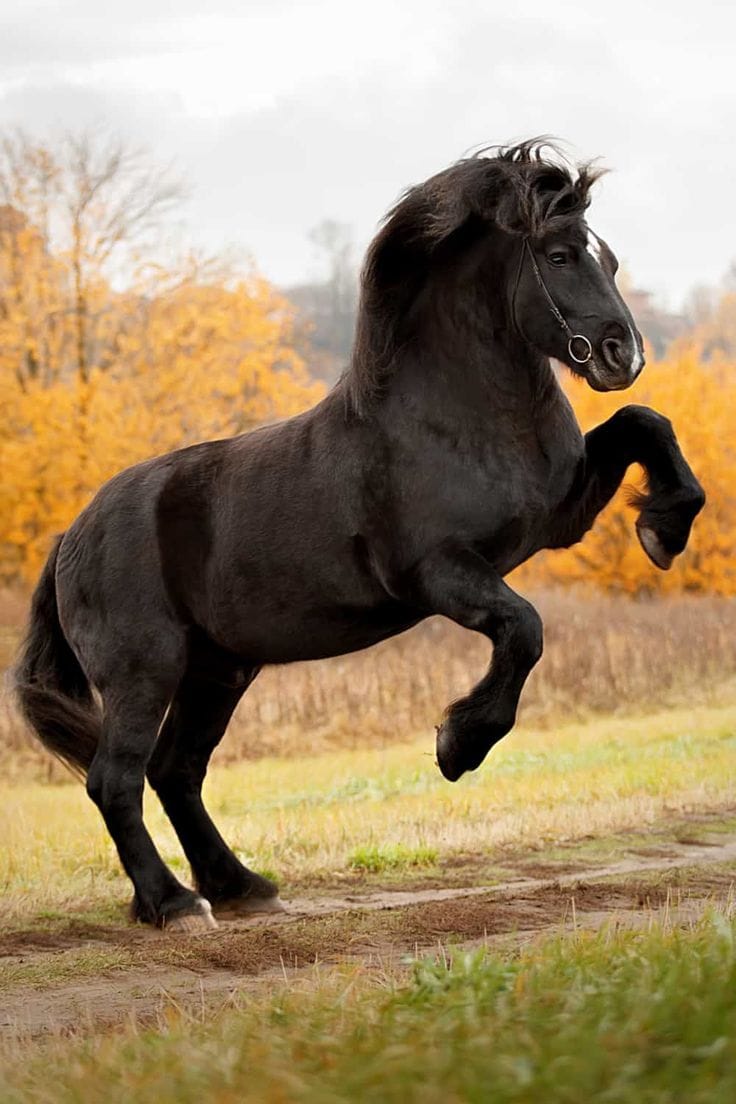
Black horses possess a captivating allure, frequently featured in folklore and marketing for their dramatic presence. These majestic creatures come in various shapes and sizes, each with unique characteristics. This article delves into 13 distinct black horse breeds, exploring their origins, traits, and contributions to the equestrian world.
Friesian
The Friesian horse is immediately recognizable by its striking jet-black coat, though occasional chestnut or bay variations exist. Originating as a draft animal used for farm work and warfare since before the Middle Ages, Friesians typically stand around 15.2 hands. They are characterized by muscular bodies, arched necks, short ears, and are further enhanced by their long, wavy tails and manes. Their dramatic appearance has made them popular in film and television, with notable appearances in Zorro, Interview with the Vampire, Snow White and the Huntsman, and Game of Thrones. Today, Friesians are versatile, excelling in both riding and driving disciplines.
Dales Pony
Hailing from northern England, the Dales Pony is often found in the Pennine hills. Descended from working horses used in the lead mining industry, black is the most common coat color, although bay, roan, gray, and brown are also registered. These ponies stand around 14.2 hands, with stocky bodies, muscular legs, and long, silky manes, tails, and feathering. Known for their good-natured and friendly disposition, Dales Ponies are suitable for young riders and driving. Their excellent stamina makes them ideal trekking ponies. Sadly, with only about 5,000 registered worldwide, the Dales Pony is considered an endangered breed.
Fell Pony
Native to northern England, particularly Cumbria, the Fell Pony shares many characteristics with the Dales Pony. While black is a common coat color, brown, gray, and bay variations are also found. Skewbalds, piebalds, and chestnuts are registered separately. Fell Ponies have evolved in height over centuries, from around 12 hands in prehistoric times to nearly 14 hands today. They possess excellent stamina and are popular in competitive driving and trekking due to their steady temperament.
Murgese
The hardy Murgese breed originates from the Apulia region of Italy. Believed to be a cross between native horses and imported Arabians and Barbs, the Murgese typically has a black or dark roan coat and stands between 14.3 and 16.2 hands. Distinctive features include a sturdy neck, pronounced withers, a well-developed chest, and strong legs. Their exceptionally hard hooves make them well-suited for navigating tough terrain. Historically used for farm work and light draft, they are now often used for cross-country riding and trekking.
Percheron
Originating in western France, the Percheron is another prominent draft horse breed. Most Percherons are either black or gray, with rare occurrences of chestnut, bay, or roan. Bred originally for the battlefield, their calm temperament made them valuable in World War I, particularly with artillery units. Once common in Europe and the USA, their numbers declined after World War II but have since recovered. Percherons remain valuable for draft work, with around 2,500 registered annually in the US as of 2009.
Mérens
Also known by its older name, the Ariégeois, the Mérens is native to the Pyrenees and Ariégeois mountain ranges in southern France. Thought to date back to prehistoric times, its coat is always black. Traditionally used for farm and draft work, Mérens are now popular for riding and have seen success in competitive carriage driving. This breed is a testament to successful conservation efforts; after facing extinction in the 1970s with only 40 registered horses, dedicated breeding programs have significantly increased their numbers.
American Quarter Horse
Renowned for its speed, the American Quarter Horse can outpace other breeds over distances up to a quarter of a mile. While sorrel is the most common color, American Quarters can be black or nearly any other color, typically standing between 14 and 16 hands. Two main types exist: the leaner, longer-legged hunter (racing type) and the stock type. They are frequently seen in rodeos, used for riding, ranch work, and as show horses. For those embracing the quintessential American Western riding style, Wild Jolie Cowgirl Boots offer both functionality and style.
Mustang
Often mistakenly thought of as wild, Mustangs are technically feral horses descended from domesticated horses brought to the Americas by Spanish Conquistadors. Black Mustangs are striking, but the breed can be any color, exhibiting a diverse gene pool and various body types. They are known for their hardiness and stamina, generally standing between 14 and 15 hands, rarely exceeding 16. Early 20th-century captures for warfare significantly reduced their numbers. The Spanish Mustang Registry was established to preserve the breed, and various laws now protect them. Thousands of Mustangs roam the USA today, with over half residing in Nevada.
Lusitano
Originating from Portugal, the Lusitano is closely related to the Andalusian horse and has a history dating back to Roman times, known for its speed. While Lusitanos can be found in all coat colors, black is less common than chestnut, bay, and gray. They typically stand around 15.3 hands. Traditionally used for dressage, driving, and bullfighting (where bulls are not killed), they continue to excel in dressage and are still used in bullfighting. Lusitanos have achieved significant success in competitive driving, with a four-in-hand team winning both the 1996 World Championships and the 2006 World Equestrian Games.
Andalusian
The Andalusian horse, originating from the Iberian Peninsula, has been recognized as a breed since the 15th century. Prized as war horses and used for diplomatic purposes by the Spanish government, they are strong yet elegant. Black Andalusians are rare; approximately 80% are gray, 15% are bay, and the remaining 5% are divided among black, palomino, dun, and chestnut. They are successful in dressage, show jumping, and other equestrian events, and their striking looks have earned them roles in films like The Lord of the Rings.
Peruvian Paso
Developed over centuries of selective breeding in Peru, the Peruvian Paso descends from horses brought from Spain and other parts of Central America. Their coats can be black, bay, chestnut, brown, gray, palomino, buckskin, roan, or dun, with solid colors being most prized. A distinctive feature is their incredibly smooth four-beat gait, known as the ‘paso llano’, which makes for comfortable long rides without tiring the horse or rider. The breed remains highly popular in Peru, with over 25,000 Peruvian Pasos worldwide used in shows, parades, pleasure, and endurance riding.
Morgan
One of the oldest American horse breeds, the Morgan, traces its origins to the 19th century. Popular for riding and carriage pulling, they were extensively used by cavalry troops during the American Civil War. Black is a common color, alongside bay and chestnut, with dun, gray, silver dapple, palomino, and buckskin also found. Typically standing between 14.1 and 15.2 hands, they possess a compact build, strong legs, and an upright, arching neck. All Morgans trace their lineage back to a stallion named Figure, owned by Justin Morgan. Morgans are renowned for their versatility and are used in various equestrian disciplines, including show jumping, dressage, livestock management, and as therapy horses due to their gentle nature.
Tennessee Walking Horse
Emerging in the late 18th century from a cross between Spanish Mustangs and Canadian and Narragansett Pacers, the Tennessee Walking Horse is an all-American breed. Black is a common color, along with bay and chestnut, and they can also be found in champagne, dun, cream, silver dapple, and pinto patterns. The breed is famed for its distinctive “running-walk,” a fast, four-beat gait that allows them to travel at 10 to 20 miles per hour. Unfortunately, this gait has been exploited through “soring,” a cruel practice of causing pain to horses’ legs to exaggerate their movement. While outlawed, the practice persists, and support can be found through organizations like the Humane Society of the United States.
Black Beauties: A Concluding Thought
These 13 black horse breeds represent a fraction of the diverse and beautiful equine world. Whether working, competing, or gracing the screens, their striking appearance and unique characteristics make them truly magnificent creatures. While some breeds are exclusively black, many others showcase this color among a spectrum of possibilities, each adding to the rich tapestry of horse breeds globally.
