
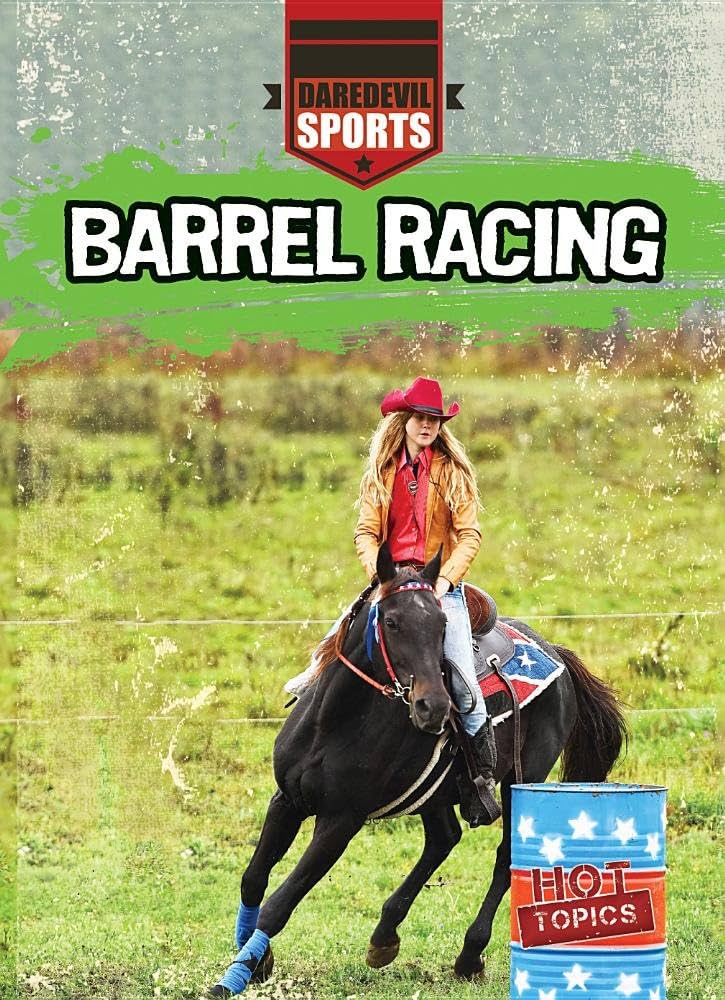
Barrel racing is an exhilarating equestrian sport that offers competitors the chance to win significant prize money. It is recognized as one of the most lucrative events in horse competitions, with numerous local, regional, and national contests awarding substantial payouts. For instance, the RFD-TV American Finals rodeo awarded a remarkable $100,000 to Taci Bettis, the 2020 barrel racing champion, for completing the cloverleaf pattern in an impressive 14.848 seconds.
The core of barrel racing involves riders and their horses racing against the clock to complete a specific “cloverleaf” pattern around three barrels arranged in a triangular formation. Competitors have two primary strategic options for navigating this pattern. If a rider begins by approaching the right-hand barrel, they will execute two right turns, at the first and second barrels, followed by a left turn at the third barrel, after which they turn to sprint back towards the finish line. Conversely, “lefties” commence their run at the left barrel, executing two left turns, and concluding with a right turn before the final dash to the alleyway.
Understanding the Barrel Pattern
The precise spacing of the barrels is contingent upon the dimensions of the arena and the specific rules set forth by the hosting organization. However, the Women’s Professional Rodeo Association (WPRA) has established a standard pattern. This standard dictates that the distance between the first and second barrels should be 90 feet. Both of these barrels are positioned 60 feet from the timing gate. The distance between the first barrel and the third barrel is set at 105 feet.
The world record for completing this standard pattern was set by a Brazilian horse and rider combination. Evelino Rocha, riding Rollin In The Fame, achieved a record-breaking time of 16.339 seconds in 2017. As of now, no American rider has surpassed this remarkable feat; the current U.S. record stands at 16.479 seconds. It is worth noting that in smaller arenas, where the barrels are placed closer together, the times for elite horse and rider teams can be as fast as the mid-13-second range. A critical rule in barrel racing is that knocking over a barrel incurs a five-second penalty added to the rider’s final time. One of the significant advantages of barrel racing is the sheer abundance of events available to competitors. While breed associations often restrict entries to registered horses, open, regional, and professional rodeo events focus solely on the horse’s innate ability, heart, and agility.
Top Horse Breeds for Barrel Racing Success
Speed is paramount for success in timed events like barrel racing, and the Quarter Horse is unequivocally the most favored breed among competitors. This versatile stock breed gained renown in colonial America for its exceptional speed over short distances, particularly quarter-mile races. The fastest Quarter Horses have been clocked at an astonishing speed of 55 mph.
Many of the top barrel racing Quarter Horses begin their competitive careers on a flat track, and it is not uncommon for them to have Thoroughbred sprinting lineage. Appendix Quarter Horses, which are a crossbreed between Quarter Horses and Thoroughbreds, combine the speed of both breeds, making them highly desirable for this discipline. The Quarter Horse is classified as a stock horse, a category that also includes Paint horses and Appaloosas. These three breeds are closely related, sharing similar attributes of speed and maneuverability. The addition of Paints and Appaloosas brings an element of visual appeal, with their striking coat patterns adding an extra layer of excitement as riders navigate the course.
Exploring Other Suitable Breeds for Barrel Racing
While genetics and conformation play a role in competitive barrel racing, unlike some other equestrian disciplines, success in this sport can also be significantly influenced by determination, grit, and individual talent. Every horse is unique, and the wide range of competitive levels available provides numerous avenues for success.
Here are a few other breeds that have proven capable of excelling in barrel racing:
1. Thoroughbred
When one mentions Thoroughbreds, the immediate association is often with flat racing. However, for retired racehorses or those who may not thrive on the racetrack, barrel racing offers an excellent alternative where they can indeed excel. Their inherent drive to run makes them a natural fit for the demands of barrel racing.
It’s important to consider the two primary body types within the Thoroughbred breed, as this can influence their suitability for the sport. The lean and lanky build common in horses that compete in races like the Kentucky Derby may not be ideal for the sharp turns required in barrel racing. Thoroughbreds that possess a more compact and coupled conformation, similar to stock horses, tend to be better suited. When considering a Thoroughbred as a barrel racing partner, look for these conformational traits: a balanced neck, a sloping shoulder, powerful hindquarters, and a compact, athletic frame.
2. Arabian
Arabian horses possess a distinct advantage over larger-boned stock breeds due to their lighter build. This breed is celebrated for its remarkable speed, strength, and agility, qualities that make them highly capable partners for barrel racing.
Jennifer Cockrell, a successful barrel racer, qualified her Arabian horse for the National Barrel Horse Association World Championship Show and actively competed in events organized by the 4-H and the National High School Rodeo Association. This gelding was her first barrel horse and was a financially feasible choice at the time. Cockrell shared, “I didn’t have a quarter horse which is what most girls ran at the National Finals Rodeo in Las Vegas, but I wished I could do what they did. I started training my Arabian and he did well for me. Arabians are good for barrel racing because of their determination and endurance. They can be pretty competitive as far as running really close to the quarter horse times, but it always depends on the horse.”.
3. National Show Horse
Occasionally, a breed not typically associated with barrel racing can surprise competitors with its aptitude for the sport. Blair Cecil had initially intended to breed her National Show Horse named “Sadie” after retiring her from the show circuit. This mare had previously competed successfully in a variety of English and Western disciplines. When the first breeding attempt was unsuccessful, Cecil recognized that her horse still needed a fulfilling activity. Having always harbored a desire to compete in barrel racing, she embarked on this new adventure with Sadie. Cecil humorously remarks, “I jokingly tell people that the Arabian half of Sadie has the speed and endurance, and the Saddlebred and the Arabian half is what whoas when I tell it to. Both breeds are ridiculously intelligent, they crave having a purpose, and learning new things.”.
Maintaining an Open Mind in Barrel Racing
While the Quarter Horse remains the preferred breed among many elite barrel racing athletes, it is always advisable to maintain an open perspective regarding potential equine partners. An individual horse’s inherent talent and its genuine desire to compete can lead to unexpected triumphs, even from breeds not traditionally recognized for barrel racing prowess. Ultimately, the clock serves as the sole arbiter in this sport; it is impartial to breed, thus allowing for the possibility of forming a successful partnership with less common breeds.
