
The echo of thundering hooves has faded to silence, the roar of the crowd now a whisper on the wind. For nearly a century, Arlington Park Horse Racing was not just a sport; it was the heart of a community and a jewel of the global racing circuit. Located in the Chicago suburb of Arlington Heights, this legendary institution carved out an unforgettable legacy of innovation, drama, and purebred poetry in motion. Though its gates have closed for the final time, the story of Arlington Park remains a masterclass in sporting excellence.
The Dawn of an Era: The Golden Age of Arlington
When Arlington Park opened its doors on October 13, 1927, it was immediately hailed as “the most beautiful track in America.” Over 20,000 spectators gathered on that chilly autumn day to witness jockey Joe Bollero ride Luxembourg to victory in the track’s inaugural race. This was the beginning of a golden era. The track not only survived the Great Depression and World War II but thrived, becoming a premier destination for Thoroughbred racing. Its stunning six-story grandstand became an iconic backdrop for some of the sport’s most memorable moments.
Arlington was always ahead of the curve. It was the first track to install a public-address system, letting fans hear the legendary calls of Clem McCarthy. It pioneered the use of the electric totalizator in 1933, introduced a photo finish camera in 1936, and unveiled the first electric starting gate in 1940, all innovations that modernized the sport for decades to come.
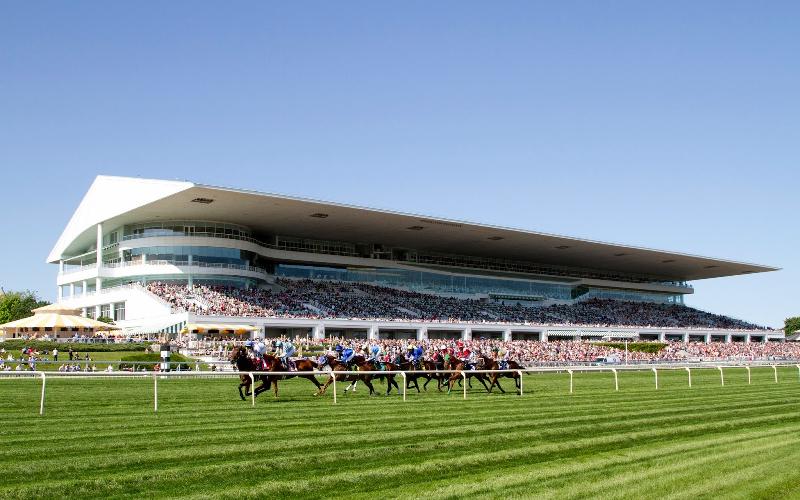 The iconic grandstand of Arlington Park during a packed race day, showcasing its grand architecture and vibrant atmosphere.
The Million-Dollar Dream
Arlington Park cemented its international reputation on August 30, 1981, by hosting the world’s first-ever million-dollar horse race: the Arlington Million. This audacious event drew the best turf horses from around the globe, forever changing the financial landscape of the sport. The inaugural race delivered a Hollywood ending, as the legendary horse John Henry, ridden by jockey Bill Shoemaker, won by a nose in a breathtaking finish. This incredible moment is immortalized in the “Against All Odds” bronze statue that greeted visitors, a timeless tribute to a horse and a race that defined greatness.
“The Million became the track’s signature event, a symbol of its ambition and its commitment to world-class competition,” notes equine historian Dr. Michael Vance. “It put Arlington on the international map permanently.”
Trial by Fire: The Miracle Million of 1985
The track’s resilience was put to the ultimate test in the early morning hours of July 31, 1985. A devastating fire erupted and completely destroyed the grandstand. With the Arlington Million just weeks away, many assumed the season was lost. However, under the determined leadership of owner Richard L. Duchossois, the impossible was achieved.
In a monumental effort, crews worked around the clock to clear the debris and erect temporary bleachers and tents. Just 25 days later, on August 25, Arlington hosted the “Miracle Million.” Over 35,000 fans showed up to witness Great Britain’s Teleprompter win the race and to celebrate the indomitable spirit of the racetrack. This incredible feat earned Arlington a special Eclipse Award, a testament to the dedication of its team.
Legendary Champions on a Hallowed Turf
The list of equine royalty that graced Arlington’s track is staggering. The mighty Secretariat made his first post-Triple Crown appearance there in 1973, winning the Arlington Invitational with ease. In 1996, the superstar horse Cigar drew a crowd of over 34,000 as he won his 16th consecutive race, tying the modern-day record set by Citation. The track’s prestige was further confirmed when it hosted a sold-out Breeders’ Cup World Thoroughbred Championships in 2002, the first time the event was held in the Midwest.
Key Milestones in Arlington’s History
- 1927: Arlington Park opens.
- 1940: Introduces the first electric starting gate.
- 1973: Secretariat wins the Arlington Invitational.
- 1981: Hosts the inaugural Arlington Million, the sport’s first $1 million race.
- 1985: The “Miracle Million” is held after a fire destroys the grandstand.
- 1989: A new, state-of-the-art grandstand is opened.
- 1996: Cigar wins his 16th consecutive race.
- 2002: Hosts the Breeders’ Cup World Thoroughbred Championships.
- 2021: The final race is run.
The Final Furlong: Why Did Arlington Park Close?
Despite its rich history and passionate fanbase, Arlington Park faced mounting economic challenges in its later years. After merging with Churchill Downs Incorporated in 2000, the track struggled against increased competition from riverboat casinos and later, video gaming terminals at bars and restaurants, which siphoned off gambling revenue. The burden of high property taxes in Cook County also made running a profitable racing season increasingly difficult.
Despite efforts to secure a casino license to supplement racing revenue, a viable long-term solution could not be found. The final horse race at Arlington Park was held on September 25, 2021, marking the end of a 94-year era.
A New Era on the Horizon: The Chicago Bears
In February 2023, the sprawling 326-acre property was sold to the NFL’s Chicago Bears for $197.2 million. The team plans to redevelop the site, with proposals including a new state-of-the-art enclosed stadium and a surrounding entertainment and residential district. In 2023, demolition of the iconic grandstand began, physically removing the structure that had been the backdrop for nearly a century of sporting history. While the future promises a different kind of athletic spectacle, it closes the book on Arlington Park horse racing for good.
 A poignant image of a lone horse and jockey on the Arlington Park track at sunset, evoking a sense of nostalgia and the end of an era.
Frequently Asked Questions about Arlington Park
When did Arlington Park close for good?
Arlington Park held its final day of horse racing on September 25, 2021. The property was officially sold in February 2023, and demolition of the grandstand began later that year.
Why was Arlington Park sold?
The track was sold due to a combination of financial pressures. These included high property taxes, declining revenue, and increasing competition from other forms of gambling in Illinois, which made operating the racetrack unsustainable for its owner, Churchill Downs Inc.
Who bought Arlington Park?
The Chicago Bears football organization purchased the 326-acre property. They intend to build a new, modern stadium and an accompanying entertainment district on the site.
What was the most famous race at Arlington Park?
The most famous race was undoubtedly the Arlington Million. First run in 1981, it was the world’s first Thoroughbred race with a purse of one million dollars and consistently attracted top-tier international competitors to its turf course.
Will horse racing return to Arlington Park?
No, horse racing will not return to the Arlington Park site. The property is being completely redeveloped by its new owners, the Chicago Bears, for a new football stadium and mixed-use development, and the track and grandstand have been demolished.
An Unforgettable Legacy
The story of Arlington Park horse racing is a bittersweet symphony of triumph and farewell. It was a place of innovation, a stage for champions, and a community hub for generations of fans. While the physical structure may be gone, its legacy endures in the record books and in the cherished memories of all who witnessed the magic of a day at the races. Arlington Park set a standard for elegance and excitement that will remain a benchmark in the sport for years to come.
