
It’s a common assumption to view the zebra as simply a striped horse, an adaptation for survival in the wild. However, this notion is a misconception. While zebras, horses, and donkeys all belong to the fascinating equine family, they possess distinct characteristics and have followed separate, though interconnected, evolutionary journeys. Understanding the evolution of zebras, horses, and donkeys reveals a captivating tale of adaptation and divergence within the animal kingdom.
While these majestic animals share a common lineage, zebras, in particular, are more closely related to donkeys than they are to horses, a fact often overlooked due to their superficial resemblance to horses in stature. Their unique evolutionary paths highlight the incredible diversity that can emerge from a single ancestral species.
Beyond the Stripes: Distinct Family Traits
The most striking divergence between zebras and their domesticated equine cousins lies in their temperament and trainability. Unlike horses and donkeys, which have been widely domesticated for millennia, zebras remain largely untrainable. Historical attempts to domesticate zebras have met with minimal success, with very few instances of these wild equids accepting human instruction.
This inherent wildness stems from their evolutionary history in Africa, a continent teeming with formidable predators. Zebras developed a fierce instinct for self-preservation, reacting much more aggressively when cornered compared to their Eurasian relatives, whose primary threats were historically fewer, such as wolves. This heightened survival instinct makes them challenging, if not impossible, to domesticate effectively, distinguishing them sharply from the more docile horses and donkeys. Their natural habitat demanded a constant state of vigilance and a strong fight-or-flight response, traits that are deeply ingrained in their genetic makeup and contribute to their untamed nature.
Tracing the Ancestry: The Eohippus and Early Evolution
Despite their modern differences, zebras, donkeys, and horses all share a distant common ancestor. This remarkable creature, known as Eohippus, roamed the Earth approximately 52 million years ago. Resembling a small, fox-like animal, Eohippus walked on five toes and thrived in dense jungle environments, primarily feeding on fruits and leaves. Its small size and multi-toed feet were perfectly suited for navigating the undergrowth and soft forest floors of its ancient habitat.
As the Earth’s climate and landscapes transformed, Eohippus gradually transitioned from jungles to open plains. This shift in environment necessitated profound evolutionary changes. The need to outrun predators on vast grasslands spurred the development of speed and agility. Over countless generations, the animal’s feet began to adapt, with the central toe—the third metacarpal—becoming increasingly prominent and robust. Running on this single, powerful digit proved more efficient for sustained speed across open terrain, leading to the reduction and eventual disappearance of the other toes.
This lineage continued its evolutionary march, steadily growing larger, faster, and developing teeth better suited for grazing tough grasses. Throughout this incredible transformation, the animal underwent several name changes, reflecting its evolving forms: Orohippus, Epihippus, Mesohippus, Miohippus, Kalabatipus, Parahippus, and Merychippus. Each stage marked a progressive adaptation towards the modern equine form, characterized by longer legs, a more robust body, and specialized teeth for an herbivorous diet. Merychippus, in particular, is considered a pivotal ancestor, believed to have given rise to over 19 other grassland species, including Dinohippus, which is widely recognized as the direct ancestor of the modern horse.
The Great Divergence: Modern Equids Emerge
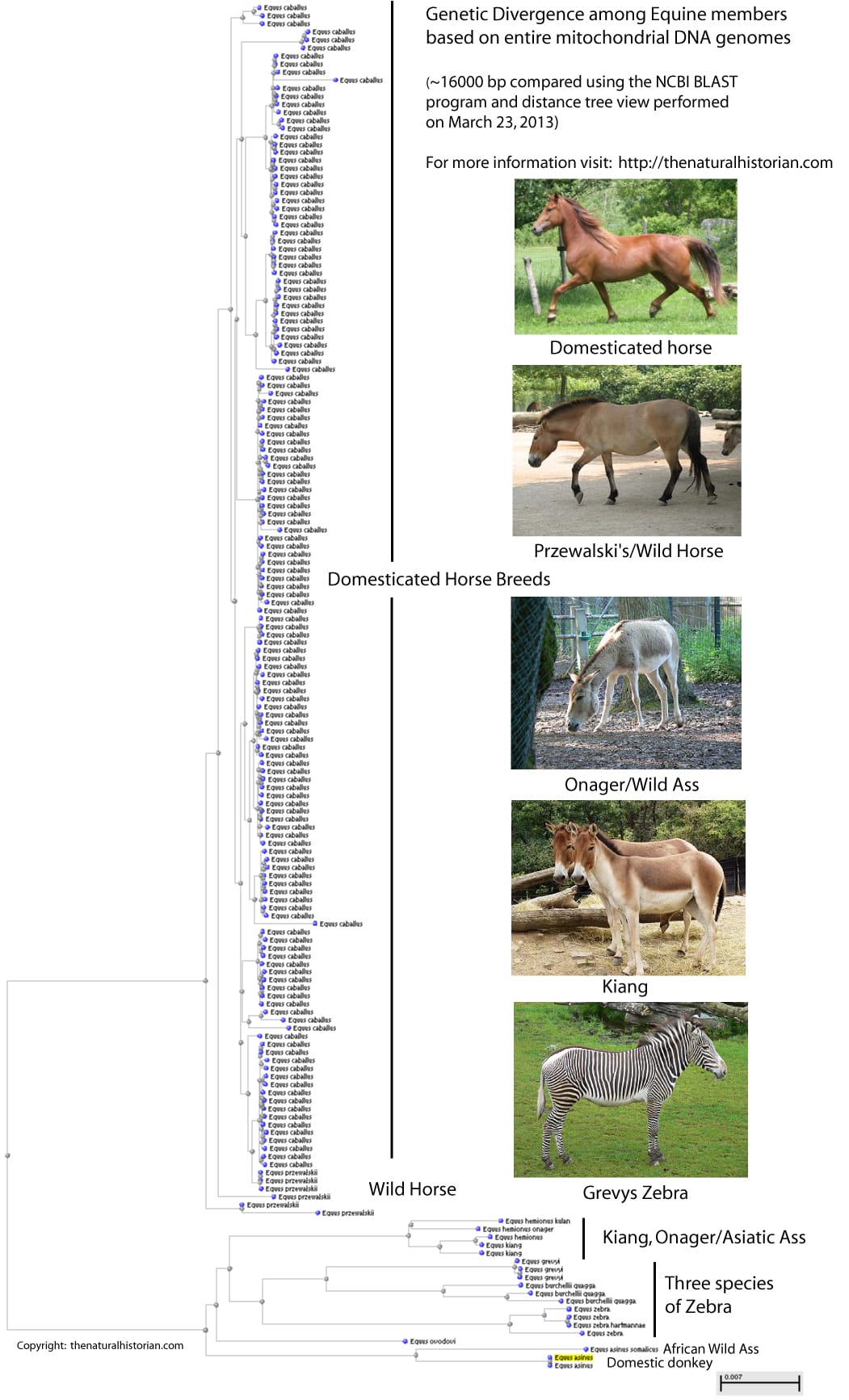
The culmination of millions of years of evolution led to the emergence of a creature strikingly similar to the modern horse. It was at this crucial juncture, with Dinohippus, that the family tree of equids began its significant divergence. From this common ancestor, three distinct branches of equids arose, carving out their own evolutionary niches and spreading across different parts of the globe.
These branches led to:
- Modern Horses: The domesticated horses we know today, prized for their strength, speed, and versatility.
- Wild Horses: Including subspecies like Przewalski’s horse, which retained more of their wild characteristics and often live in more remote, undisturbed habitats. These magnificent animals represent a living link to the wild ancestors of domesticated horses.
- The Donkey/Zebra Group: This branch gave rise to donkeys, onagers (wild asses), and all species of zebras. This grouping highlights their closer genetic relationship, despite the dramatic visual differences between, for instance, a humble donkey and a strikingly striped zebra.
Therefore, the question of which came first – the zebra or the horse – is predicated on a false premise. Neither came “first” in an isolated sense; rather, they evolved in parallel, developing along separate, yet interconnected, branches of the vast equine family tree. Their distinct features and behaviors are testaments to the power of natural selection and adaptation to varied environments over millions of years.
In conclusion, while zebras, horses, and donkeys share a remarkable common ancestor in the ancient Eohippus, their evolutionary journeys have led them down divergent paths, shaping them into the unique and magnificent creatures we admire today. Their story is a powerful illustration of adaptation, survival, and the intricate tapestry of life on Earth. To further explore the wonders of the animal kingdom, delve into our other articles on diverse wildlife and pet care.
