
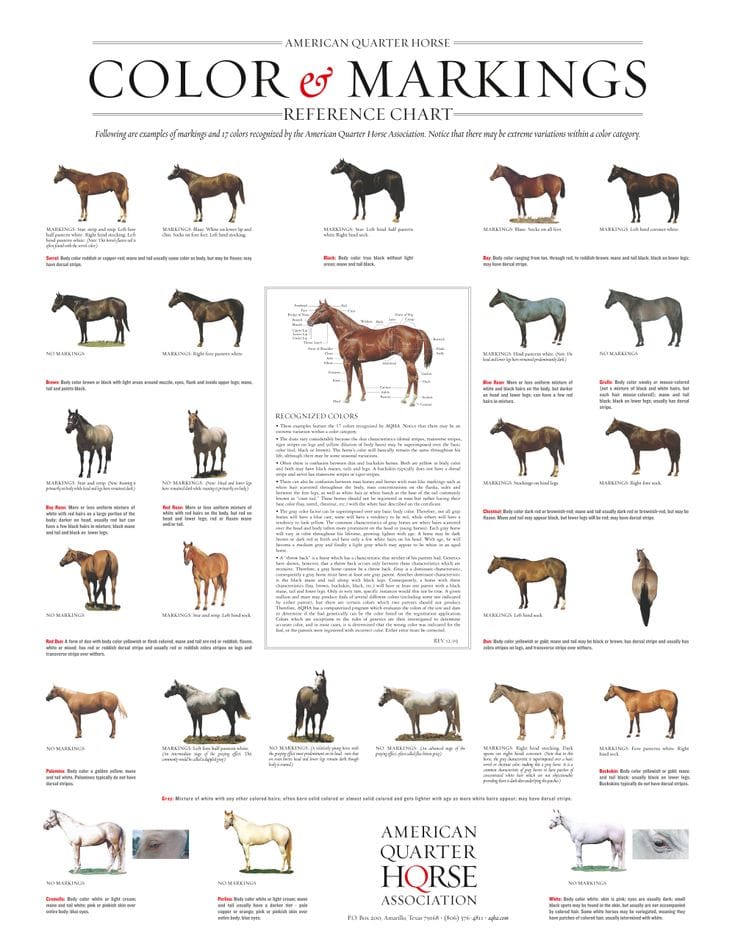
The American Quarter Horse, renowned for its versatility and iconic status in Western riding, boasts an impressive spectrum of coat colors. While old legends speak of fiery reds and tough duns, seasoned horsemen understand that a horse’s true quality transcends its hue. The American Quarter Horse Association (AQHA) officially recognizes 23 distinct coat colors, each with its own genetic basis and unique visual appeal. These colors range from the common chestnut and bay to more exotic shades like buckskin, palomino, and the intriguing champagne and roan variations.
The Genetic Foundation of Horse Colors
At the heart of all horse coat colors lies a fascinating interplay of genetics, primarily stemming from two base colors: black and red. The extension gene plays a crucial role, with ‘E’ influencing black pigment and ‘e’ influencing red pigment. White markings, such as socks and blazes, are essentially superficial layers of “icing” on the horse’s genetic “cake,” and should be considered separately from the base coat. Understanding these foundational genetics is key to deciphering the complex array of colors seen in American Quarter Horses. Black is a dominant gene, meaning a horse will appear black if it carries at least one ‘E’ gene. Conversely, a horse must have two copies of the recessive red gene (‘ee’) to display a red-based coat. A good general rule is to observe the points: black-based horses typically exhibit black on their ears, mane, tail, and legs, or are solid black. Red-based horses, on the other hand, will not have black on their points, even if their mane and tail appear dark.
Black-Based Horse Colors
The genetic code for black pigment forms the basis for a variety of striking coat colors in American Quarter Horses. These include black, bay, brown, buckskin, smoky black, grullo, dun, and the various roan colors (blue roan, bay roan, brown roan). Dilutions of the black base also produce distinctive colors like perlino and smoky cream. Even horses that appear brown due to sun-fading are genetically black. Differentiating between black and brown can sometimes be challenging, as brown horses may have very dark coats but will often display subtle brown or tan hairs around the muzzle and groin. These variations add to the rich tapestry of American Quarter Horse appearances, and understanding these nuances can be particularly helpful for owners looking to register their horses with the AQHA.
Red-Based Horse Colors
When a horse carries the recessive ‘ee’ genotype, its coat color is derived from red pigment. This category includes sorrel, chestnut, palomino, cremello, red roan, red dun, and gold champagne. While genetically similar, sorrel and chestnut are used to describe different shades of red. Chestnut horses often have a browner tint, with “liver” chestnut being the darkest shade. Sorrels tend to appear more copper or red. Variations within these red-based colors can include a flaxen mane, which might be confused with a palomino, or a darker mane and tail resulting from increased pigment concentration. For those interested in the finer points of equine genetics, resources like the American Quarter Horse Coat Color Genetics e-book offer in-depth explanations.
Key Considerations for Identifying Horse Color
It’s important to remember that the science of horse coat color genetics is complex and continually evolving. Researchers are constantly uncovering more about the intricate genetic factors that determine these beautiful colors. All white markings, whether on a gray horse or a horse with leg or face markings, are essentially layered over the base coat color. Therefore, when analyzing color inheritance, the base color must always be considered. Furthermore, foals rarely exhibit their adult coat color at birth. Their foal coat often differs significantly from their mature appearance. If there is any uncertainty about a foal’s color, it is advisable to wait until after it has shed its foal coat before making a definitive identification. The AQHA provides resources, such as the Quarter Horse Color and Markings Chart, to assist owners in this process. The organization also offers a free color correction service for registrations made before a foal reaches 12 months of age, ensuring accuracy in official records. For owners looking for more specific information on different horse types, exploring western riding horse breeds can offer further insights into color variations within specialized disciplines.
