
The term Alpha K9 Dog Training often conjures images of dominance, pack leadership, and a human asserting themselves as the top dog. For decades, this approach shaped how many people interacted with their canine companions. But what if the very foundation of this philosophy was based on a misunderstanding? Modern canine science has revolutionized our understanding of dog behavior, moving away from the outdated concept of dominance and towards a relationship built on mutual respect, clear communication, and positive guidance. True leadership isn’t about force; it’s about fostering a partnership where your dog looks to you for direction with trust, not fear.
This guide will dismantle the old myths surrounding the “alpha dog” and introduce you to a more effective and humane approach. We will explore what it truly means to be a confident leader for your dog in the modern world, using methods that strengthen your bond and create a well-behaved, happy companion. Understanding the principles of humane dog training methods is the first step toward a more fulfilling relationship with your pet.
The Scientific Crumbling of the Alpha Dog Theory
To understand where we are, we must first look at where we’ve been. The concept of the “alpha” leader in a pack stems from flawed scientific observations from the 1940s. This research, conducted on captive wolves from different packs forced to live together in an artificial environment, observed high levels of conflict and competition. The conclusion was that wolf packs are rigid, linear hierarchies where an “alpha” wolf rules through aggression and physical dominance. This theory was then incorrectly applied to domestic dogs.
Why the Wolf Pack Analogy is Flawed
The problem is, that’s not how natural wolf packs behave. Dr. David Mech, the very researcher whose early work helped popularize the alpha theory, has spent decades trying to correct this misconception. Wild wolf packs function much more like a human family unit. The leaders are typically the parents, and the rest of the pack are their offspring from various years. They guide their young through experience and wisdom, not through constant physical challenges.
As Dr. Evelyn Reed, a certified veterinary behaviorist, states, “Applying the ‘alpha’ logic from those early captive wolf studies to our dogs is like trying to understand human family dynamics by studying strangers in a prison yard. The social context is completely wrong. Our domestic dogs have evolved alongside us for thousands of years; their social structures are far more flexible and dependent on their relationship with humans than with other dogs.”
Attempting to “dominate” your dog can lead to a host of behavioral problems. Training techniques based on this outdated theory, such as alpha rolls, scruff shakes, and other physical punishments, often create fear, anxiety, and defensiveness. Instead of building respect, these actions damage trust and can increase the likelihood of aggression, as the dog learns to preemptively defend itself against perceived threats from its owner.
The New Alpha: Leadership Through Partnership
So, if being the “alpha” isn’t about dominance, what is it about? Modern alpha k9 dog training redefines the concept entirely. It’s about being a benevolent leader—a calm, consistent, and confident guide your dog can rely on. Think of yourself as a teacher or a parent, not a dictator. Your role is to set clear, predictable boundaries and to teach your dog how to navigate the human world successfully.
This leadership model is built on a foundation of trust and positive reinforcement. Instead of punishing bad behavior, the focus is on rewarding and encouraging good choices. This approach not only teaches your dog what you want them to do but also makes them want to do it. When your dog sees you as a source of positive experiences, their motivation to listen and cooperate grows exponentially. A similar philosophy is applied in specialized training programs like the one for k9 alpha dog training, where consistency and positive methods are key.
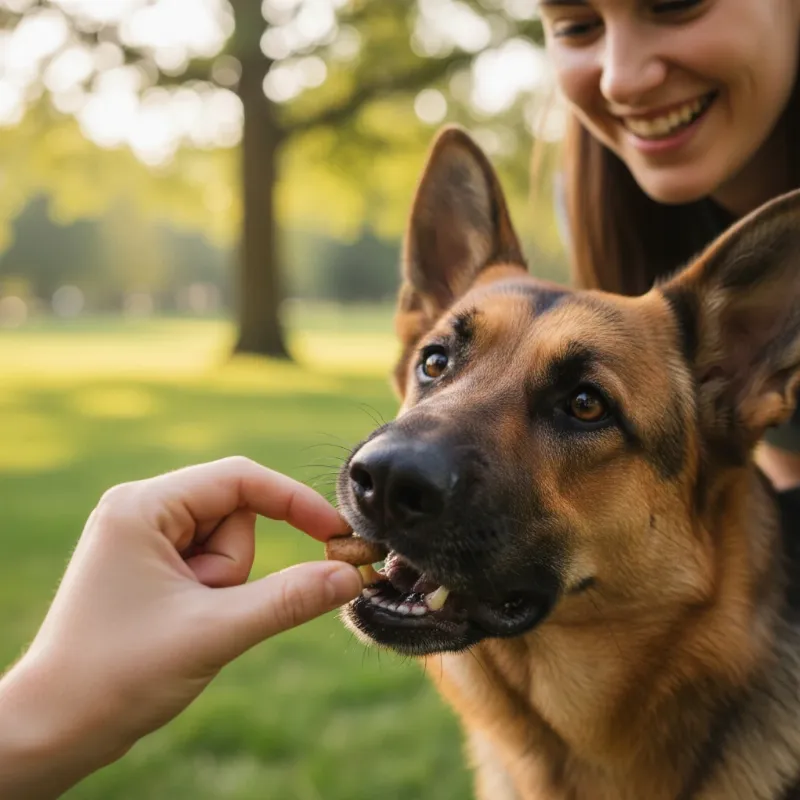 A person happily giving a treat to a German Shepherd dog that has just successfully performed the 'shake paw' trick in a sunny park, showcasing alpha k9 dog training.
Master the Core: Positive Reinforcement
Positive reinforcement is the cornerstone of modern, effective dog training. The principle is simple: when your dog performs a behavior you like, you immediately reward them with something they value. This makes the behavior more likely to be repeated in the future.
What counts as a reward?
- High-Value Treats: Small, soft, and extra-tasty treats that your dog doesn’t get at any other time.
- Praise and Affection: An enthusiastic “Good boy!” or a loving pat on the chest can be a powerful motivator.
- Toys and Play: A quick game of tug or a toss of a favorite ball can be the perfect reward for an energetic dog.
- Life Rewards: Access to things they enjoy, like opening the door to the backyard after they sit calmly.
The key is to reward the behavior immediately as it happens. The longer the delay between the action and the reward, the less likely your dog will make the correct association.
The Power of Consistency and Clear Boundaries
Dogs thrive on predictability. A leader who is inconsistent—sometimes allowing a behavior and sometimes punishing it—creates confusion and anxiety. It is crucial for everyone in the household to be on the same page with the rules.
- Establish House Rules: Decide on your rules and stick to them. Is your dog allowed on the furniture? Is begging at the table permitted? Consistency is your greatest tool.
- Manage Resources Calmly: You are naturally in control of all resources—food, toys, walks, attention. This isn’t something you need to prove with force. By asking your dog for a simple behavior, like a “sit,” before giving them their food bowl or putting on their leash, you are calmly reinforcing that polite behavior earns rewards. This isn’t dominance; it’s teaching good manners.
- Use Cues, Not Commands: Think of words like “sit,” “stay,” and “come” as cues for a desired behavior, not as forceful commands. Your tone should be encouraging and clear, not demanding.
For pet owners seeking more tailored guidance, finding a professional like a new jersey dog trainer who uses modern, science-backed methods can make a world of difference.
How Do I Implement Modern K9 Training?
Transitioning from a dominance mindset to a leadership mindset involves practical changes in how you interact with your dog daily. Here are some actionable steps you can take.
1. Teach, Don’t Command
Instead of demanding a “Sit,” lure your dog into the position with a treat. Hold the treat over their head and move it slightly backward; their rear will naturally lower. The moment it does, mark the behavior with a “Yes!” and give them the treat. After a few repetitions, you can add the verbal cue “Sit” just before you lure them.
2. Reward What You Want to See
Actively look for opportunities to praise your dog for good behavior. Are they lying calmly on their bed instead of begging at the table? Walk over and give them a gentle pat. Did they come inside immediately when called? Reward them with a high-value treat. This teaches them that calm, polite behavior earns your attention.
3. Manage and Redirect Unwanted Behavior
Instead of punishing your dog for jumping on guests, manage the situation. Keep them on a leash when people arrive. Then, redirect the behavior by asking for a “sit” and rewarding them for it. For chewing, provide plenty of appropriate chew toys and praise them for using them. If they chew something inappropriate, interrupt with a clear sound, remove the item, and immediately offer an acceptable toy.
4. Make Training a Fun Game
Keep your training sessions short, upbeat, and fun—no more than 5-10 minutes at a time. This holds your dog’s attention and prevents them from getting bored or frustrated. End each session on a positive note with a behavior they know well.
This shift in perspective is crucial for all forms of training, including more specialized fields. For example, when it comes to training service dogs atlanta, the entire process is built on positive reinforcement to foster a resilient, confident, and trusting assistance animal.
Frequently Asked Questions (FAQ)
Is it ever okay to be firm with my dog?
Being firm and being a benevolent leader are not mutually exclusive. Firmness means being clear and consistent with your rules and cues. It means calmly interrupting unwanted behavior. It does not mean using physical force, intimidation, or yelling. Your voice can be a powerful tool when used calmly and clearly.
Should I eat before my dog to show I am the alpha?
This is one of the most persistent myths. Your dog does not associate the order in which you eat with social hierarchy. They simply learn that when you are eating, they are not. Your leadership is established through consistent training and resource control, not through meaningless rituals.
My dog pulls on the leash. Isn’t that a sign of dominance?
Dogs pull on the leash for a simple reason: they want to get somewhere faster, and pulling works. It’s not a power struggle. The solution is to teach them that a loose leash gets them where they want to go, and a tight leash stops all forward movement. This is a training issue, not a dominance challenge.
What is an “alpha roll” and should I do it?
The “alpha roll” is a dangerous and outdated technique where a person forces a dog onto its back and holds it there to show “dominance.” This is a misinterpretation of wolf behavior; a submissive wolf offers this posture voluntarily, it is not forced upon it. Forcing a dog into this vulnerable position is terrifying for them and is a very common cause of defensive bites. You should never perform an alpha roll on your dog.
Can old dogs learn these new methods?
Absolutely. Dogs of any age can learn and benefit from positive reinforcement training. It may take more time and patience to undo old habits, but the principles remain the same. The process can also help rebuild trust with a dog that has previously been trained with harsh methods.
Your Journey to True Leadership
Embracing modern, science-backed alpha k9 dog training is about shifting your mindset from confrontation to cooperation. It’s about understanding that true leadership is earned through trust, consistency, and kindness, not asserted through force. By becoming a benevolent guide for your dog, you are not only shaping a well-behaved companion but also building a deeper, more joyful, and unbreakable bond. The journey is incredibly rewarding, creating a partnership that will enrich both of your lives for years to come.
