
Alex Colville’s “Horse and Train,” created in 1954, stands as one of the most iconic and recognizable works in Canadian art. This compelling painting masterfully encapsulates Colville’s unique artistic practice, exploring the inherent tensions between opposing forces: nature versus machine, order versus chaos, and the conscious world versus the realm of nightmares. While its jarring juxtapositions might suggest a Surrealist influence, the genesis of “Horse and Train” lies in a poem by South African writer Roy Campbell.
Colville, who met Campbell during the poet’s North American tour in 1953, was inspired by the lines: “And a dark horse against an armoured train.” This inspiration is directly noted in Colville’s sketches from March 1954, which served as preparatory studies for the painting.
The medium employed in “Horse and Train” is casein tempera on hardboard, measuring 41.2 x 54.2 cm. At this point in his career, Colville had not yet settled on a single, consistent medium, with some works from this period executed in oils and others in tempera. His signature pointillist style is evident, with the surface meticulously constructed from thousands of minute strokes of pure, though muted, color. This technique creates a glazed surface that effectively captures light, bestowing an atmospheric depth upon the painting despite its lack of literal surface texture.
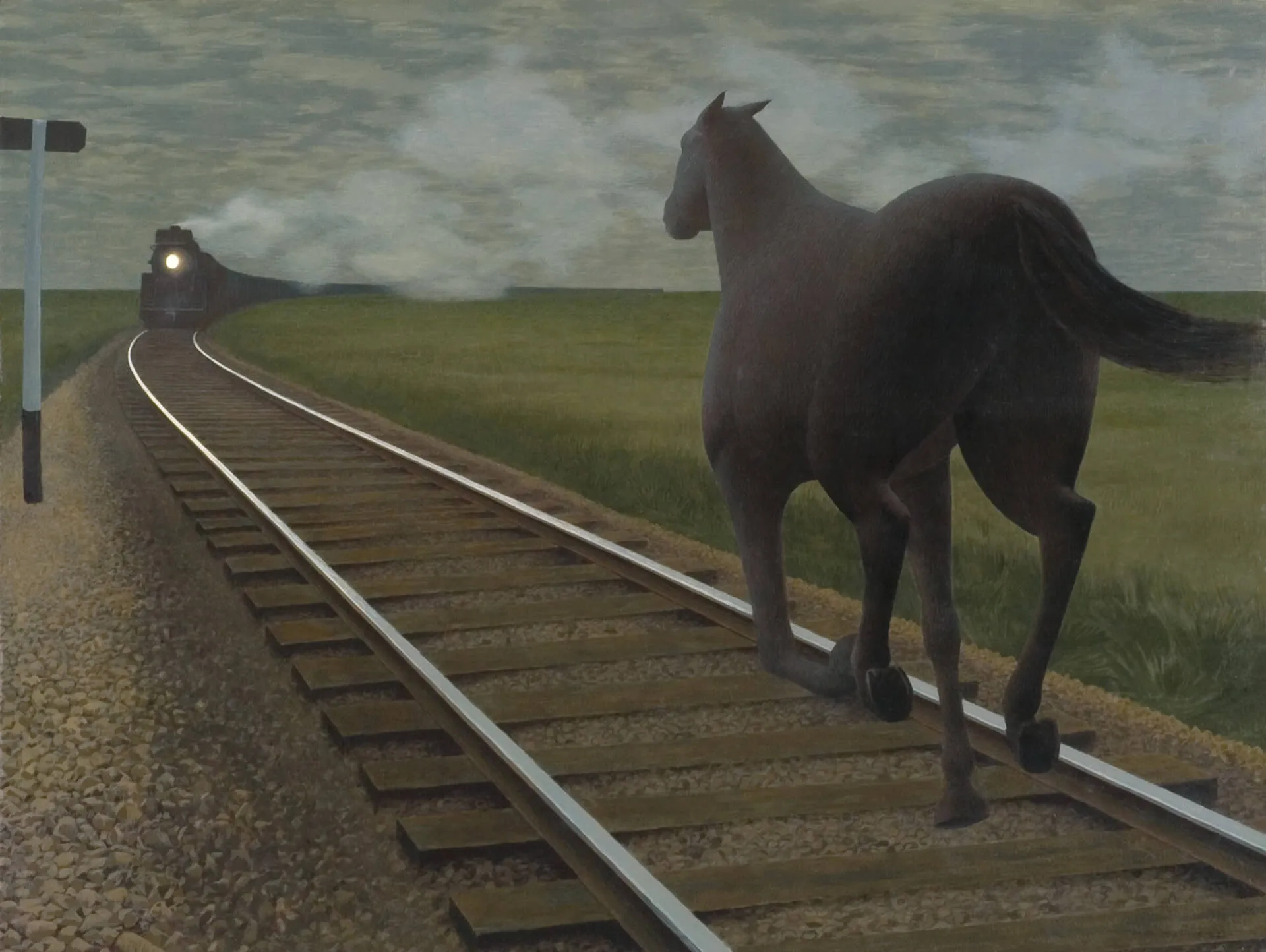 Alex Colville, Horse and Train, 1954
Further preparatory work for “Horse and Train” included a 1954 study in black ink on paper, measuring 27.2 x 16.6 cm. This drawing features Colville’s inscription of the line “a dark horse against an armoured train.” Additionally, a 1945 sketch titled “A Dead Horse,” executed in colored pencil on paper (27.4 x 35.8 cm), offers a poignant glimpse into Colville’s earlier engagement with the imagery of horses, completed near Sonsbeck, Germany.
The painting captures a moment of intense tension, frozen just before the train’s light would illuminate the dark horse as it rounds a curve. This scene is a product of Colville’s imagination, as a horse would not naturally venture onto the treacherous gravel surface of railroad tracks.
Echoing Campbell’s poem, the image starkly contrasts an individual against the immense, mechanized force of progress—a theme Colville understood intimately from his wartime experiences. During World War II, he frequently depicted the dead and dying pack animals used by armies for transporting supplies and artillery, as seen in his 1945 sketch. Regardless of the apparent hopelessness, Colville positions individual will in direct opposition to collective, historical, and mechanical inevitability.
“Horse and Train” can be interpreted as a deeply romantic portrayal of a charge into oblivion, yet it is also a profoundly thoughtful work. During the 1950s, Colville was immersed in existential philosophy, particularly the writings of Jean-Paul Sartre and Albert Camus. The concept of individual human will asserting its agency through opposition and rebellion was a familiar notion to artists of that era.
The painting offers multiple layers of meaning. It could serve as a metaphor for human life, with the horse symbolizing the individual, the tracks representing time, and the train symbolizing death. Alternatively, it might express a lament over the mechanization of the world and its detrimental impact on nature. As curator David Burnett notes, these varied interpretations do not diminish the painting’s powerful impact, stating, “One way of thinking of a dark horse does not preclude others…. And all readings (viewings) are poetically sharpened by the natural shock and surprise of the image.”
References
- Art Canada Institute. “Horse and Train.” Alex Colville: Key Works. Accessed January 14, 2026.
- Burnett, David, as quoted in Art Canada Institute. “Horse and Train.” Alex Colville: Key Works. Accessed January 14, 2026.
