
The vast, treeless steppe of Ice Age Yukon was once a realm where horses, among the most abundant mammals, roamed freely. Unlike the steppe bison, a relatively recent arrival in North America, horses and their ancient progenitors had a much longer history on the continent. In fact, the story of the horse, much like the wild horses we now associate with Africa and Eurasia, began and evolved right here in North America. The disappearance of horses around 12,000 years ago marked the first interval in approximately 55 million years where North America was without these magnificent creatures.
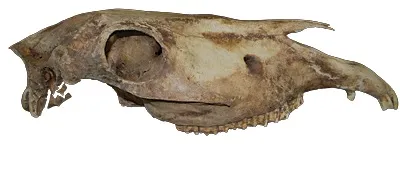 Yukon horse skull from the Yukon government fossil collection.*Yukon horse skull from the Yukon government fossil collection*
Palaeontologists have dedicated considerable effort to studying equine evolution, partly due to the exceptionally complete fossil record available. The earliest known ancestor of the modern horse was a four-toed creature, about the size of a dog, that inhabited North America between 30 to 55 million years ago. The form of the modern horse, encompassing domestic and wild horses, zebras, and wild asses, emerged around 5 million years ago in North America before spreading to other continents at the dawn of the Ice Age.
During the Ice Age, horses were widespread across North America, Eurasia, and Europe. Through the 20th and 21st centuries, palaeontologists have identified over 50 distinct species of Ice Age horse, distinguished by variations in their skeletal size and shape. In Yukon, the majority of these Ice Age horses were notably small, standing only about 12 hands (1.2 meters) at the shoulder. This characteristic suggests they might represent a unique species, Equus lambei, known as the Yukon horse. However, recent DNA analysis indicates that these diverse Ice Age horse species likely represent regional populations of a single, wide-ranging species.
The Ice Age horses found in Beringia shared striking similarities in appearance and are genetically linked to the endangered Przewalski’s horse, native to the Mongolian steppes. The Ice Age horses of Eurasia are the ancestors of the domestic horse, Equus caballus.
Yukon’s Ice Age Horse Discoveries
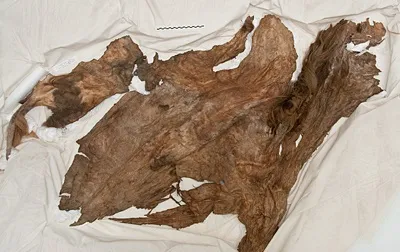 Mummified Yukon horse hide on display at YBIC. Discovered at Last Chance Creek by Olynyk and Toews.*Mummified Yukon horse hide on display at YBIC. Discovered at Last Chance Creek by Olynyk and Toews.*
One of the most remarkable Ice Age horse discoveries in Yukon occurred along the banks of Last Chance Creek. Gold miners Lee Olynyk and Ron Toews unearthed a partially frozen carcass of a Yukon horse while operating their mine with a backhoe. This significant find included a large section of hide, intact from snout to tail with hair and mane still attached, a partial forelimb with preserved muscle, tendons, and bones, and portions of the horse’s internal organs. The frozen ground had remarkably preserved these elements. This spectacular specimen is now on display at the Yukon Beringia Interpretive Centre.
Other Ice Age Equines in Yukon
While the small-bodied horse was undoubtedly the most prevalent equine species in Yukon during the late Ice Age, it was not the sole horse species to inhabit the region. The latter part of the Ice Age also saw Yukon as home to a distinct North American species: the North American “stilt-legged” horse. Characterized by much thinner leg bones, these horses were likely more delicately built than the typical Ice Age horses of Yukon. Relatively little is known about the rare stilt-legged horse. DNA recovered from bones found in Yukon and Alaska has confirmed that stilt-legged horses belong to a group that evolved within, and never ventured beyond, North America. Radiocarbon dating indicates that the stilt-legged horse had disappeared from Yukon by approximately 35,000 years ago.
Furthermore, fossils of a considerably larger-bodied horse have also been unearthed in Yukon. These animals were as massive as today’s draft horses. Scientists are still working to understand the exact relationship between these large horses and the smaller, more common Ice Age horses of Beringia.
For those eager to delve deeper into this fascinating history, explore the Beringian Research Notes on the Yukon horse.
