
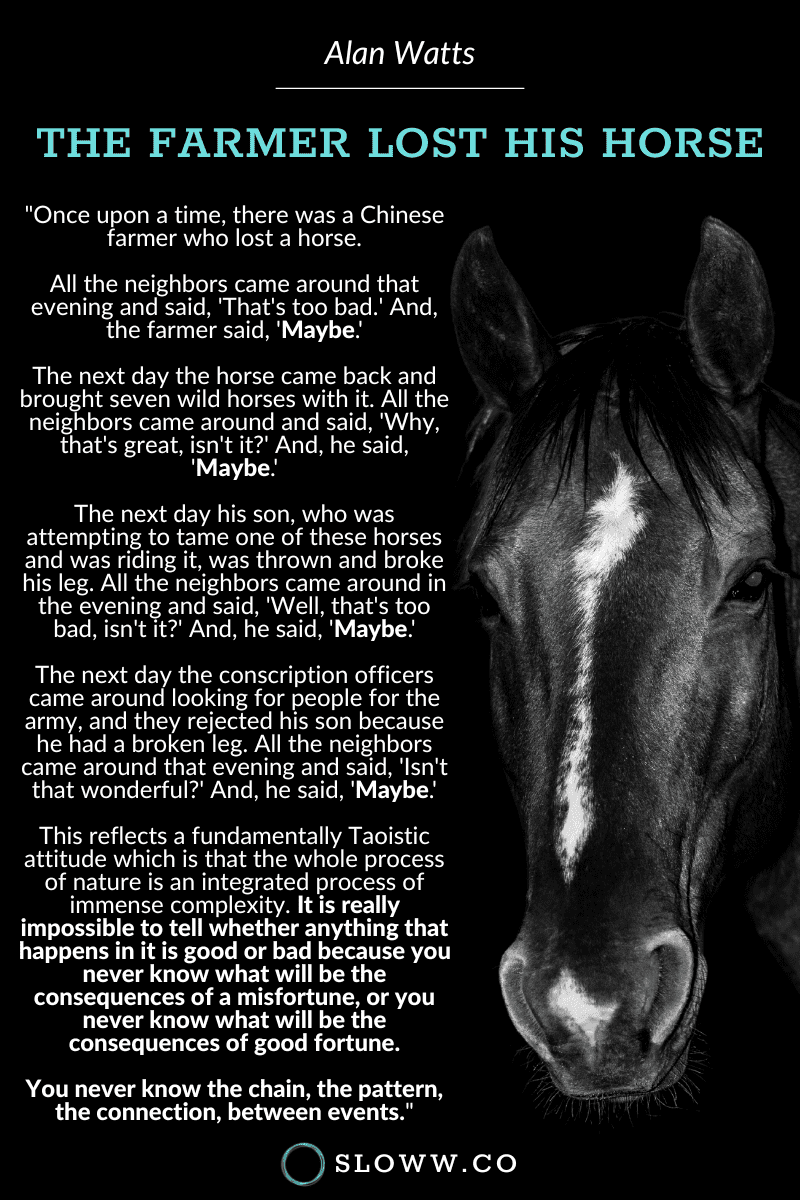
Have you ever faced a situation that seemed unequivocally bad, only for it to turn into a blessing in disguise? Or celebrated a stroke of good fortune that later led to unforeseen trouble? This dance between luck and misfortune is at the heart of the Alan Watts Horse Story, a timeless parable that challenges our deep-seated need to label every event as either “good” or “bad.” Though often attributed to the philosopher Alan Watts, who brilliantly popularized it for Western audiences, the tale is an ancient Taoist story about a Chinese farmer. It serves as a powerful reminder that life is far more complex and interconnected than our immediate judgments allow. This simple narrative offers profound wisdom on acceptance, perspective, and navigating the unpredictable currents of existence. For a deeper dive into similar narratives, the chinese story about horse offers another layer of insight into ancient wisdom.
This story’s enduring power lies in its simplicity and its direct challenge to our reactive minds. We are constantly evaluating, judging, and predicting. The farmer’s tale invites us to pause, breathe, and consider a different way of being—one rooted in observation rather than immediate conclusion.
The Unfolding Tale: The Chinese Farmer and His Horse
The story, as elegantly told by Alan Watts, revolves around a wise old farmer in a small Chinese village. His life is simple, and his wisdom is profound, though he rarely expresses it in words. Instead, he lives it. The parable unfolds through a series of seemingly dramatic events, each met with the same calm, enigmatic response from the farmer.
The Escape: A Blessing or a Curse?
One day, the farmer’s prized stallion, his only horse, runs away. Upon hearing the news, his neighbors rush to his side to offer their condolences. “Oh, what terrible luck!” they exclaim. “Your only horse is gone. How will you work your fields? This is a great misfortune.”
The farmer simply shrugs and replies,
“Maybe. Who knows what is good and what is bad?”
The neighbors leave, puzzled by his strange lack of distress. They see a clear disaster, but the farmer sees only an event, the full implications of which are yet to be revealed. He refuses to attach a final judgment to an incomplete story.
The Return: Good Fortune?
A week or so later, a remarkable thing happens. The farmer’s stallion returns, and it isn’t alone. It leads a magnificent herd of wild horses back to the farmer’s enclosure. Suddenly, the farmer is not just without a horse, but he is the owner of a dozen.
His neighbors, hearing of this incredible development, hurry back to his house, this time to celebrate his good fortune. “What amazing luck!” they cheer. “You lost one horse but gained so many more. You are now a wealthy man! This is a true blessing.”
Again, the old farmer remains placid. He looks at the new horses and calmly says,
“Maybe. Who knows what is good and what is bad?”
His response once again bewilders his neighbors. How could this be anything but a wonderful stroke of luck? They see only the immediate gain, the material wealth, but the farmer understands that this is just another chapter in a much longer story.
The Injury: A Tragic Accident?
The farmer’s only son, a strong and capable young man, begins the task of taming the wild horses. While attempting to ride one of the more spirited stallions, he is thrown violently to the ground and suffers a badly broken leg. The injury is severe, and it’s clear he may never walk properly again.
The villagers gather once more, their faces etched with pity. “Oh, what a terrible tragedy,” they say, shaking their heads. “Your son has been crippled. This is the worst thing that could have happened. Your ‘good luck’ has brought you only sorrow.”
The farmer, tending to his son’s injury, looks at them and offers his familiar refrain:
“Maybe. Who knows what is good and what is bad?”
This time, his neighbors are almost angry. The tragedy is plain to see. A young man’s future has been irrevocably altered. Yet, the old farmer refuses to accept their verdict. He continues to suspend judgment, viewing the event as just one more piece of a much larger, unseen puzzle.
The Conscription: A Final Twist
A few months later, the emperor’s army marches into the village. A war has broken out with a neighboring kingdom, and the military is conscripting every able-bodied young man for the fight. The battle is fierce, and the chances of survival are slim.
The army officers take all the young men from the village—all except for the farmer’s son, who is passed over because of his badly broken leg. As the other families weep, knowing their sons are being sent to their likely deaths, they realize the farmer’s incredible foresight.
They go to him one last time, humbled and awestruck. “You were right,” they admit. “Your son’s injury, which we saw as a curse, has saved his life. Your bad luck was actually the greatest good luck.”
The old farmer, watching the army depart with the village’s youth, simply says,
“Maybe. Who knows what is good and what is bad?”
The Deeper Meaning Behind the Alan Watts Horse Story
The parable doesn’t end with a neat conclusion because its very purpose is to dismantle our desire for them. The Alan Watts horse story is a masterclass in Taoist philosophy, teaching us to embrace uncertainty and release our attachment to rigid labels of “good” and “bad.”
Embracing Uncertainty and Non-Judgment
The core lesson of the farmer’s wisdom is the practice of non-judgment. We live in a world that demands instant analysis. We are conditioned to categorize every experience, every outcome, as positive or negative. This story reveals the folly in that habit. What appears to be a disaster can contain the seed of a blessing, and what looks like a victory can lead to a future challenge.
Dr. Aris Thorne, a philosopher and expert in Eastern thought, explains, “The farmer embodies the principle of suspended judgment. He understands that he is seeing a single frame in a very long film. He doesn’t know the plot, so he refuses to write a review based on one scene. This is a profound cognitive skill—the ability to exist in a state of ‘not knowing’ without anxiety.”
Life is an intricate web of cause and effect, where one event flows into the next in ways we can never fully predict. The farmer’s mantra, “Maybe,” is an acknowledgment of this beautiful and terrifying complexity. It’s an invitation to stay open and curious, rather than closed and certain.
The Fallacy of “Good” and “Bad”
The story systematically breaks down the dualistic thinking that governs our lives. Good and bad are not inherent qualities of events; they are interpretations we project onto them based on a limited perspective.
- The Lost Horse (Bad): Led to gaining a whole herd.
- The New Horses (Good): Led to the son’s injury.
- The Broken Leg (Bad): Led to the son’s survival.
- Avoiding the War (Good): Who knows what happens next?
This chain of events illustrates that fortune and misfortune are two sides of the same coin, often indistinguishable from one another over the long term. By clinging to one and fearing the other, we create a constant state of emotional turbulence—anxiety in the face of “bad” events and a fear of loss in the face of “good” ones.
How to Apply the Parable’s Wisdom in Your Life
The Alan Watts horse story is more than just a clever tale; it’s a practical guide to a more resilient and peaceful way of living. Here’s how you can integrate the farmer’s wisdom into your daily life.
1. Practice the Pause
When something happens—you miss a flight, you get a promotion, you receive criticism—your immediate instinct is to react and label the event. Instead, try to practice the “sacred pause.” Before you rush to judgment, take a breath and mentally say, “Maybe.” This simple act creates a space between the event and your reaction, allowing for a more measured and thoughtful response. It helps you observe the situation without getting entangled in an emotional narrative about it.
2. Zoom Out Your Perspective
When you’re caught up in a perceived crisis or a moment of triumph, try to zoom out. Ask yourself:
- How will I feel about this in a week?
- In a year?
- In a decade?
Often, the events that feel monumental in the present shrink in significance when viewed through the lens of time. This is the farmer’s perspective. He sees the long arc of life, not just the immediate dot on the timeline. This mental exercise can temper both despair and euphoria, leading to greater emotional stability.
3. Embrace the “Who Knows?” Mentality
Actively challenge your own conclusions. When you find yourself thinking, “This is the worst thing that could have happened,” add a gentle, “…or is it?” When you think, “This is the best day of my life,” you can add, “…and I wonder what it will lead to.” This isn’t about being pessimistic or cynical; it’s about being realistic and open. It’s about acknowledging that the story is still unfolding. This approach fosters a sense of curiosity and wonder about life, rather than a rigid set of expectations.
Frequently Asked Questions (FAQ)
What is the origin of the Alan Watts horse story?
The story is an ancient Chinese parable, most closely associated with the Taoist text Huainanzi, from the 2nd century BC. While Alan Watts did not create the story, his eloquent and accessible retelling introduced it to millions in the Western world, making it a cornerstone of his philosophical lectures on Taoism and Zen.
Is the story telling us to be passive?
No, it’s not about passivity or inaction. The farmer still takes action: he works his fields, he cares for his son, and he manages his horses. The story is about our internal reaction to events, not our external response. It advocates for acting without frantic attachment to the outcome, a concept known in Taoism as Wu Wei (effortless action).
How can this story help with anxiety?
Anxiety is often rooted in fear of the future—specifically, the fear of “bad” things happening. The horse story directly addresses this by showing that we are very poor judges of what is ultimately “bad.” By internalizing its lesson, we can learn to release the need to control and predict every outcome, thereby reducing the fuel for our anxiety.
What does “Maybe” really mean in the story?
The word “Maybe” is the farmer’s expression of intellectual humility. It means, “I don’t have enough information to make a final judgment.” It signifies an acceptance of reality as it is, without imposing a premature and likely inaccurate narrative upon it. It is a powerful tool for maintaining inner peace in a chaotic world.
Isn’t it okay to be happy about good things?
Absolutely. The story doesn’t advise against feeling joy or sadness. It advises against becoming attached to the judgment that a situation is permanently “good” or “bad.” Enjoy good fortune, but hold it lightly, knowing it is part of a larger, ever-changing tapestry. Grieve during misfortune, but do so without the added layer of despair that comes from believing it is the final word.
The Enduring Wisdom of the Farmer
The Alan Watts horse story is a compass for navigating the unpredictable journey of life. It teaches us that wisdom isn’t about having all the answers, but about becoming comfortable with the questions. The farmer’s peace does not come from his circumstances, which are constantly in flux, but from his perspective. He has cultivated an unbreakable inner calm by letting go of the need to understand everything at once.
By embracing the simple yet profound philosophy of “Maybe,” we can free ourselves from the emotional rollercoaster of our own judgments. We can learn to ride the waves of life with more grace, resilience, and a deep-seated trust that the full story is always yet to be written.
