
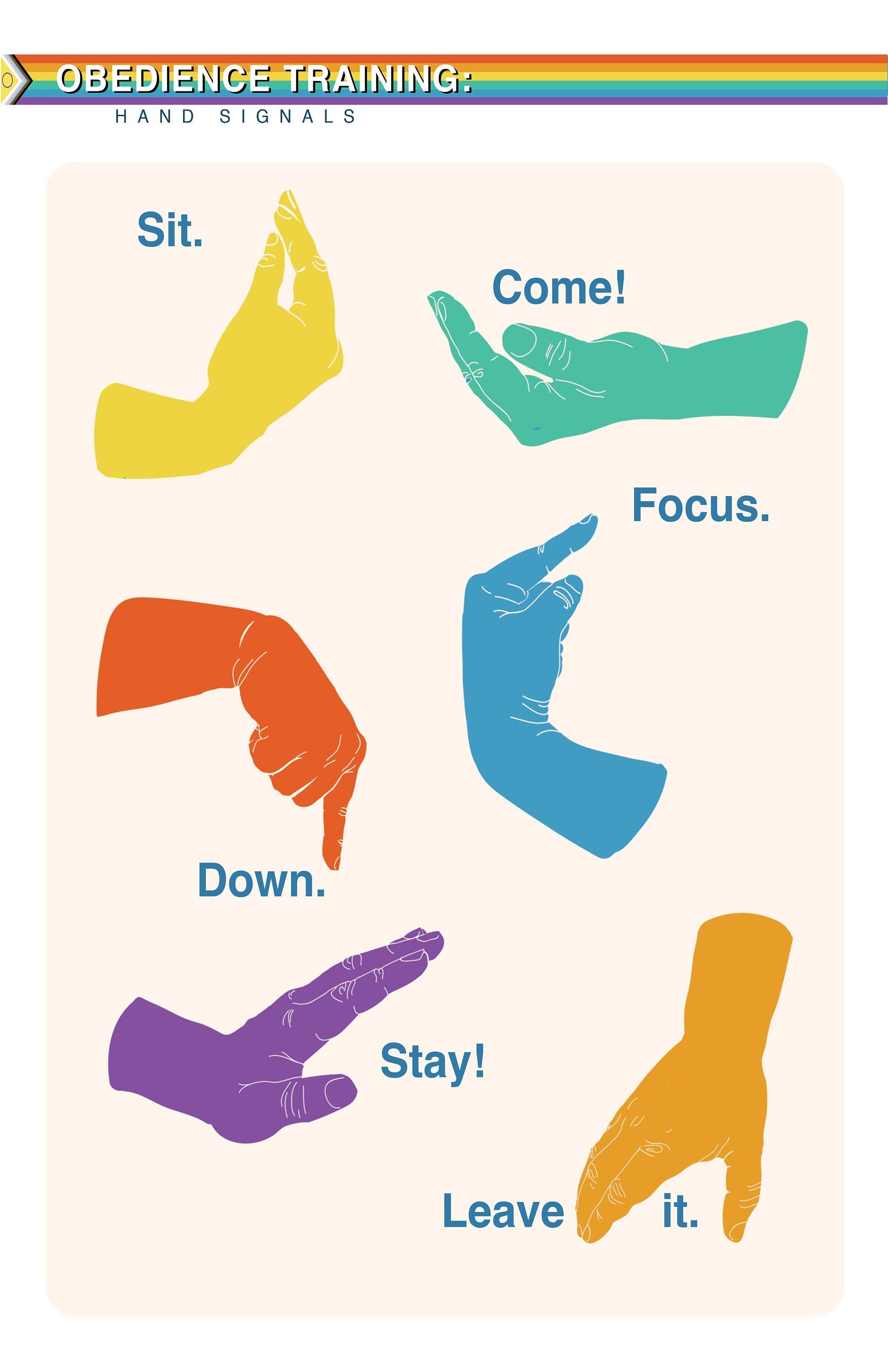
Hand signals are a powerful tool in a dog’s training arsenal, offering a clear and consistent way to communicate commands. The American Kennel Club (AKC) emphasizes their importance for effective training and a strong bond between dog and owner. Whether you’re a seasoned trainer or just starting with a new puppy, understanding and implementing AKC-approved hand signals can significantly enhance your training sessions. This guide will walk you through the essentials of using hand signals for dog training, ensuring your canine companion understands your every cue.
Why Use Hand Signals in Dog Training?
Dogs are masters of reading body language. While they can learn verbal cues, hand signals offer several advantages:
- Clarity: Visual cues are often easier for dogs to perceive and differentiate, especially in noisy environments or when the dog is at a distance.
- Consistency: Unlike verbal commands which can vary slightly in tone or pronunciation, a hand signal remains constant.
- Reduced Frustration: For dogs with hearing impairments or those who are distracted, hand signals provide an alternative communication method, reducing training frustration for both dog and owner.
- Enhanced Bond: The synchronized communication through hand signals deepens the connection and understanding between you and your dog.
- Versatility: Hand signals can be used in various settings, from the living room to the park, and are particularly useful during dog sports or when you need to remain quiet.
Basic AKC Hand Signals Every Dog Owner Should Know
The AKC recommends starting with a few fundamental hand signals that form the building blocks of obedience. Consistency in both the signal and the associated verbal cue is key.
1. Sit
- Signal: Hold your hand flat, palm facing upwards. Move your hand slowly from in front of the dog’s nose upwards and slightly back over their head. As the dog sits, simultaneously say “Sit.”
- Verbal Cue: “Sit”
- Purpose: This is often the first command taught and is crucial for impulse control and basic manners.
2. Down
- Signal: Start with your hand open, palm facing down, in front of the dog. Move your hand downwards towards the floor, in a smooth, sweeping motion. As the dog lies down, say “Down.”
- Verbal Cue: “Down”
- Purpose: Essential for relaxation and teaching the dog to be calm in a stationary position.
3. Stay
- Signal: Hold your hand flat, palm facing the dog, in a clear “stop” gesture. Keep your arm extended. As the dog holds the position, say “Stay.”
- Verbal Cue: “Stay”
- Purpose: Critical for safety, ensuring your dog remains in place until released.
4. Come (Recall)
- Signal: Extend your arm out to your side, with your palm facing upwards or slightly cupped. Swing your arm towards yourself in a beckoning motion. As the dog comes to you, say “Come.”
- Verbal Cue: “Come”
- Purpose: The most vital command for your dog’s safety, ensuring they return to you when called.
5. Heel
- Signal: Hold your hand at your side, palm facing inwards, with your index finger pointing downwards. As the dog walks beside you in the heel position, say “Heel.”
- Verbal Cue: “Heel”
- Purpose: For walking politely on a leash without pulling.
Implementing Hand Signals Effectively
Success with hand signals, like any training method, relies on a systematic approach. The AKC suggests the following best practices:
Start Simple and Be Consistent
- Introduce One Signal at a Time: Don’t overwhelm your dog. Master one signal before moving to the next.
- Pair with Verbal Cues Initially: For the first few weeks, always pair the hand signal with its corresponding verbal cue. This helps the dog associate the visual cue with the command. For example, when you move your hand up for “Sit,” say “Sit.”
- Fade Verbal Cues Gradually: Once your dog reliably responds to the paired cues, begin to phase out the verbal command, relying solely on the hand signal. You can do this by whispering the verbal cue or saying it very softly before giving the signal. Eventually, your dog will respond to the signal alone.
Choose Clear and Distinct Signals
- Uniqueness: Ensure each hand signal is distinct from the others. A signal for “sit” should not closely resemble the signal for “down.”
- Size and Visibility: Make signals large enough to be easily seen by your dog, especially at a distance.
- Body Language: Your overall body language should support the signal. For example, when asking your dog to sit, face them directly with a relaxed posture.
Practice in Various Environments
- Controlled Settings First: Begin training in a quiet, familiar environment with minimal distractions, such as your living room or backyard.
- Gradually Increase Distractions: Once your dog is proficient, practice in more challenging environments like parks or during walks. This helps generalize the cues, ensuring your dog responds reliably regardless of the surroundings. You might find resources on dog training you tube helpful for seeing these signals in action in different scenarios.
Keep Sessions Short and Positive
- Duration: Aim for short, frequent training sessions (5-10 minutes) rather than long, infrequent ones. This keeps your dog engaged and prevents them from becoming bored or tired.
- Rewards: Always reward successful responses with praise, treats, or a favorite toy. Positive reinforcement is crucial for building a strong foundation and making training enjoyable for your dog.
- End on a High Note: Always try to end each session with a command your dog knows well and can perform successfully, followed by a reward.
Advanced Hand Signals and Their Applications
As your dog progresses, you can introduce more advanced signals for more complex behaviors. These might include:
- “Go Find It”: For scent work or finding hidden toys.
- “Wait”: Similar to stay, but often used for shorter durations or in conjunction with other actions.
- Directional Cues: Pointing in a specific direction to guide your dog.
- “Speak”: To encourage barking on command.
Many dog training programs, including those from organizations like the american kennel club dog training resources, offer structured approaches to learning these advanced signals.
Troubleshooting Common Issues
Even with the best intentions, you might encounter challenges. Here are a few common issues and how to address them:
- Dog Ignores Hand Signal:
- Cause: The dog may not fully understand the signal, or there are too many distractions.
- Solution: Go back to basics. Pair the hand signal with the verbal cue again, and practice in a less distracting environment. Ensure your signal is clear and consistent. You might need to work on basic obedience training akc dog training hand signals to reinforce foundational understanding.
- Dog Responds to Verbal Cue Only:
- Cause: The verbal cue might be too strong, or the hand signal hasn’t been faded out effectively.
- Solution: Increase the frequency of practicing the hand signal without the verbal cue. Make the verbal cue very soft or whispered when paired with the signal.
- Dog Gets Confused:
- Cause: Signals might be too similar, or the dog is being asked to perform too many commands at once.
- Solution: Ensure all signals are distinct. Practice commands individually before combining them. Consider revisiting basic dog training elkton md or similar local resources if you suspect a need for more personalized guidance.
The Role of AKC in Promoting Effective Dog Training
The American Kennel Club (AKC) plays a significant role in promoting responsible dog ownership and effective training methods. Through its various programs, including Canine Good Citizen and Agility, the AKC advocates for clear communication and a strong bond between dogs and their handlers. Their resources often highlight the benefits of using a combination of verbal cues and hand signals, emphasizing consistency and positive reinforcement. For those seeking specialized training, programs like those offered by wild acres dog training can provide in-depth instruction.
Conclusion: Mastering Communication with Your Canine Companion
Incorporating AKC-approved hand signals into your dog training routine is an investment in a clearer, stronger, and more harmonious relationship. By understanding the fundamentals, practicing consistently, and always employing positive reinforcement, you can unlock a new level of communication with your furry friend. Remember, every dog learns at their own pace, so patience and persistence are your greatest allies. Embrace the journey of training, and enjoy the profound connection that blossoms with every understood signal.
